|
 |
|||
 |
Chapter 1 - BACKGROUND |    |
||
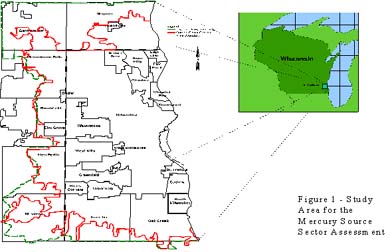
| Introduction The Mercury Reduction Project for the Greater Milwaukee Area is a joint effort of the Pollution Prevention Partnership, Milwaukee Metropolitan Sewerage District (MMSD) and the Wisconsin Department of Natural Resources (DNR). The Mercury Source Sector Assessment was undertaken to help set priorities for developing cooperative mercury education, technical assistance and collection programs. This report is the result of the first phase of the project. The study area for the Mercury Source Sector Assessment is the service area of the Milwaukee Metropolitan Sewerage District, consisting of all of Milwaukee County and relatively small portions of Waukesha, Ozaukee, Washington and Racine Counties. (See Figure 1.) This area covers 420 square miles and includes 382,000 households. The 1995 service area population of 1,065,000 represents 20.7% of the total Wisconsin population and 0.4% of the total United States population.
Why focus on mercury? Mercury is released to the environment from many sources. It is used in household and commercial products, as well as industrial processes. Coal-fired power plants, incinerators, some manufacturing processes, hospitals, dental practices, schools and even homes have all been found to release mercury. In the home, mercury can be found in electrical switches, thermostats, fluorescent lights, batteries and even some children's toys. Most of theses sources release relatively small amounts of mercury. The problem arises from the propensity for mercury to build up, rather than break down, in the environment and the ability of minute concentrations (parts per billion or less) to cause serious health and environmental impacts. This problem is exacerbated by the potential for mercury to travel long distances in the atmosphere and then return to the earth. In fact, air deposition accounts for a major portion of the total loading of mercury to the Great Lakes ecosystem. Mercury is extremely dangerous to both fish and people. When mercury is deposited in lakes or streams, bacteria convert it to methylmercury, which concentrates in the tissue of fish, wildlife and humans who eat the fish. An adult walleye may contain in its body a level of mercury 150,000 times higher than the water it lives in. Due to high mercury levels in fish and the potential health impacts for people who eat the fish, the state of Wisconsin (as well as many other states) issues advisories each year cautioning people to limit their consumption of certain species and sizes of fish.
Human exposure to methylmercury can result in long-lasting health
effects, especially on fetal development during pregnancy. In addition, mercury poisoning
has been linked to nervous system, kidney and liver damage and impaired childhood
development. Nervous system disorders include impaired vision, speech, hearing and
coordination.
Mercury comes from a wide variety of community sources not regulated by
DNR or EPA. For the purposes of this study, "source sector" refers to a category
of mercury use, such as a type of equipment that incorporates mercury, a service or
industrial category that utilizes mercury in some way, or an activity that uses materials
which incidentally contain small amounts of mercury. These include:
Some source sectors will be much more amenable to mercury reduction efforts based on education, technical assistance and collection programs than others. This provides the basis for characterizing mercury source sectors later in this report. Some national and statewide estimates of the relative contributions from the various mercury source sectors are available. However, information necessary to establish an effective community-based mercury program is often unavailable. In Wisconsin, the DNR is evolving new approaches and policies for the control of
mercury and is finalizing a Mercury Source Book for Municipalities to aid in the design of
local reduction programs. The UW Extension has developed some educational materials on
mercury reduction at medical facilities. The MMSD promulgated and enforces a local
effluent limit for mercury for dischargers to the sewer system. Elsewhere, the Western
Lake Superior Sanitary District has completed a Mercury Blueprint for moving toward
virtual elimination of the discharge of mercury. Mercury Reduction Project Description The goals of the Mercury Reduction Project are:
This report helps address the first goal and sets the stage for developing effective reduction programs, tailored to specific source sectors, during the second phase of the project. The lead organization for the project is the Pollution Prevention Partnership. The Partnership (formerly called the Greater Milwaukee Toxics Minimization Task Force) brings together representatives of business, industry, environmental groups, universities, government, law firms, engineering firms and others interested in helping to reduce the use and release of toxic and hazardous substances. Their stated mission is to "minimize toxic and other pollutants entering the environment through education and promotion of waste reduction techniques, considering the financial. social and public health impacts of such efforts." The MMSD provided an intern who did most of the work on the Mercury Source Sector Assessment. The DNR provided the majority of the funding for the first phase of the Mercury Reduction Project. This project could not have been carried out without the assistance of these two agencies. A Mercury Reduction Project Advisory Committee was created, made up of representatives
of the project partners and other members of the community with interest or expertise
relating to mercury. A list of advisory committee members is included in Appendix D of
this report.
Mercury Source Sector Assessment Description The purposes of the Source Sector Assessment are to help provide a data baseline for evaluating the success of the Mercury Reduction Project and to guide decisions about which mercury source sectors to work with in developing cooperative mercury education, technical assistance and collection programs. In designing both the Mercury Reduction Project and the Source Sector Assessment, we attempted to utilize a broad, ecosystem approach to the mercury issue. An ecosystem approach recognizes that all parts of the environment--air, land, water, plants, animals and people--are connected in complex ways. Activities affecting one part of the environment have the potential to affect all parts of the environment. Thus, we have attempted to assess all significant sources of mercury, not just those releasing mercury to the sewer system. This is particularly important for mercury, an element which easily moves from one part of the environment to another. This approach also led us to consider the presence or use of mercury in various sectors, as well as the environmental releases from those sectors. In this report, "use" refers to purposeful use of mercury in processes and/or product. "Presence" refers to the storage of mercury before or after such uses. Releases of mercury to the environment are summarized in two categories: releases resulting from purposeful uses and releases due to trace impurities. An example of the former is air emissions from medical waste incineration and an example of the latter is trace amounts of mercury in coal used to produce electricity. It is probable that the second phase of this project will focus on purposeful uses of mercury, because these are more amenable to mercury reduction programs based on education, technical assistance and collection. However, all significant sources were evaluated in the Source Sector Assessment Report in order to provide the "big picture" of mercury presence/use and release in the Greater Milwaukee Area. The focus of this study is also on current uses, stockpiles and releases, as opposed to historical releases which may have to be addressed through remediation efforts. Twenty-five different sectors were evaluated. For some sectors, estimates were made for both presence/use and release. For other sectors, it made sense to estimate either presence/use or release. The source sectors included in this study are:
It should be noted that two of these source sectors--households and municipal wastewater treatment--represent "double accounting" of mercury when considering the list of other source sectors. Thus, these sectors are not included in the release and presence/use totals for all sectors. The household sector includes thermostats, switches, gasoline combustion and other uses or releases which were also evaluated in other source sector estimates. The household sector was included in this study to illustrate how the average residential household contributes to the use and release of mercury to the environment. Similarly, the municipal wastewater treatment sector actually represents a "re-release" which includes mercury discharged to the sewer system from industries, hospitals, dental facilities and others. Mercury use and release from many of these sources are estimated in other source sectors on the list. The municipal wastewater treatment sector was included for comparison purposes, as well as to illustrate the fate of some of the mercury released in the Greater Milwaukee Area. Due to this "double accounting", neither the household mercury nor the
re-release of mercury are included in the total releases or total presence/use
calculations which are represented in Tables 1, 2 and 3 and Figures 2, 3, and 4. Using the Source Sector Assessment It is important to restate that the purposes of the Mercury Source Sector Assessment are to help provide a baseline for evaluating the success of the Mercury Reduction Project, and to guide decisions about which mercury source sectors to work with in developing cooperative mercury education, technical assistance and collection programs. The estimates of presence/use and release from the various sectors are just that--estimates. Some of the estimates are better than others. We have attempted to provide subjective indicators (high, medium or low) of the confidence level for each of the factors (information or assumptions) used in the calculations. The "High" rating is generally assigned to factors that are thought to be within 25% (+/-) of actual values. The "Medium" rating is assigned to factors that are thought to be within 50% (+/-) of actual values. The "Low" rating is assigned to factors that are thought to have greater than 50% (+/-) error ranges. These confidence level ratings are based on the best professional judgment of the authors and the project advisory committee. Each reader must judge for oneself the quality of the data and assumptions included in each sector assessment. The quality of the data and assumptions allow for reasonable, relative comparisons among mercury source sectors in order to provide a basis, along with other considerations, for prioritizing source sectors for cooperative mercury reduction programs. The variations in the quality of the data and assumptions do not allow us to say, with any degree of confidence, that these are the actual amounts of mercury being used and/or released by the various source sectors. The table(s) for each source sector lists the factors used, the sources of these factors and a confidence levels for these factors. These are followed by the actual calculation of the presence/use or release estimate. When additional, independent information was available, an alternate calculation is also provided. The last portion of each table contains detailed notes about the factors and calculation to help the reader further understand the reasoning behind the estimate. All data are for the year 1995 unless otherwise indicated. The mercury release tables also include estimates of the amounts of mercury released to air, solid waste and wastewater. The apportioning of releases to the different media are based on available information and best professional judgment. It should be understood that these represent initial fates of releases to the environment. Due to the high degree of mobility of some forms of mercury, their immediate fates often are not their long term fates. For example, mercury in coal burned at electric generating plants is initially released to the atmosphere, but may eventually be returned to land and water surfaces via wet or dry deposition. For each source sector, we attempted to apply the best available information from reports, trade associations, agency staff and other experts. In some cases the best estimates are determined from specific, local information, sometimes combined with literature values. In other cases, the best that could be done was to apply factors to national or statewide estimates, based on population ratios. In compiling the tables and developing the estimates for presence/use and releases, we have identified areas where further refinements or additional information would enhance the accuracy of the estimates. We have also identified additional potential source sectors, for which we had little or no information, which may warrant further study in the future. These "Recommendations for Improving Source Sector Estimates" are included in Appendix E. This Mercury Source Sector Assessment Report can provide a "boilerplate" for similar efforts in other communities or geographical areas. Each community must determine which source sectors are applicable to its area. After determining the appropriate list of source sectors, the assessment would then collect the necessary information to determine the localized factors that were included for the Greater Milwaukee Area in this study. These localized factors, along with the literature values and key assumptions from this assessment, can be incorporated into the sample calculations provided in the tables for each source sector. Obviously, care must be taken to make sure that these values and assumptions do indeed apply to each community's situation. In any case, this assessment can provide a reasonable starting point for similar efforts in other areas. This Mercury Source Sector Assessment is composed of four sections: Annual Releases of Mercury, Presence/Use of Mercury, Re-Releases of Mercury from Municipal Wastewater Treatment and Household Contributions of Mercury. |
||||
|
This Page created March 11, 1998 |
||||