General Motors Holdens (GMH) occupied the site at Port Melbourne
from 1936 and began production of vehicle engines around 1944.
HEC was formed in 1986 as a break up of GMH into two companies,
one manufacturing engines and the other manufacturing vehicles.
Operations at HEC currently include:
- Machining & Grinding Operations:
| Machining and grinding operations of components for FII (both single and dual overhead cam engines), V6 and V8 engines and other components such as disc brakes and steering knuckles, are carried out using various different machines and processes. The operations are generally carried out using a number of coolants which provide lubrication, cooling and chip removal. |
- Engine and Component Cleaning:
| Components, including engine blocks, require cleaning to remove residual oils (especially from imported parts), fine metal chips and cutting fluid. This is achieved in industrial washing machines, which also apply anti-corrosion solutions to various components. Spent solutions from the washing machines, which are high in dissolved solids, are treated in the TWTP. |
- Assembly:
| HEC has extensive semi-automated assembly lines for all engine types machined at the facility, including FII, V6 and V8 and special production engines. |
- Tooling, Maintenance and Stores:
| HEC has maintenance workshop facilities to maintain operations, a toolroom to maintain machining, cutting and grinding tools and a large stores area for all imported components |
- Employees:
| 2,385 people are currently employed at the HEC Fisherman's Bend site, of which 317 have management, supervisory or administrative roles. The remainder are directly employed for production work or casual work. |
- Production & Markets:
| HEC annually exports around 220,000 FII engines to South Korea, Egypt, China, Germany, the United Kingdom, South Africa and Indonesia. The company also supplies approximately 90,000 V6 and 8,000 V8 engines locally to General Motors Holden in Elizabeth, South Australia. |
- Quality and Management:
| HEC's quality management system is certified to ISO 9001. HEC are in the process of implementing an Environmental Management System (EMS) which will be certified to the ISO 14001 standard |
2.0 PLANNING AND
ORGANISATION OF THE HEC CLEANER PRODUCTION PROJECT
2.1 CLEANER PRODUCTION
APPROACH USED AT HEC
At the outset of the project, a decision was made
to study the effects of a newly established Chemical Management
Program at HEC as the Cleaner Production Demonstration Project.
Dames & Moore, HEC and Castrol identified the Chemical Management
Program implemented at HEC's provided direct benefits not only
with respect to chemical usage but also wastewater discharges.
The program also demonstrated an unusual approach to implementing
cleaner production which could be applied by other industries.
The principal personnel involved in the Chemical Management Program and the Cleaner Production Project were:
| Donald Campbell,
Senior Environmental Engineer | Involved in all phases of the Project and Dames & Moore's primary contact at HEC. |
| Ross Macfarlane, Chemical Manager (Castrol): | Involved in all phases of the Project. Ross was actively involved in identifying trends in wastewater quality and cost savings realised from Chemical Management initiatives. |
2.2 CLEANER PRODUCTION OPPORTUNITIES AT HEC
2.2.1 Chemical Management Program
Prior to the introduction of the Chemical Management Program,
HEC considered that it had an acceptable chemical management system
at the facility. Chemical costs associated with coolant usage
had been significantly reduced due to the activities of the HEC
coolant committee, which included representatives from the HEC
laboratory, maintenance, production, occupational health and safety,
purchasing, finance and environmental groups. Initiatives developed
by the coolant committee, endeavoured to ensure that coolant suspected
of causing problems with production could be dumped to the TWTP.
Laboratory approval was required for the addition of top-up chemicals,
biocides and anti-foaming agents. However, deficiencies were
observed in the HEC system of control of chemicals. It became
evident that there were further opportunities for improvement
in management of chemicals in all areas of production.
The concept of the Chemicals Management Program arose out of the
necessity for HEC to reduce costs in order to remain competitive
and to improve its environmental performance. HEC identified
that contracting out the chemicals management on the site could
provide, through the contractual arrangements, an incentive by
which chemical costs and use could be decreased. Castrol+Plus
(Castrol) was contracted by HEC to implement the Chemicals Management
Program on-site. HEC's contract with Castrol is a fixed price
contract with certain performance guarantees. Therefore, there
is an incentive for Castrol to decrease costs, eg. through chemical
use. The contract also specifies an annual reduction in chemical
usage, for which Castrol is penalised if the target is not met.
Castrol personnel at HEC work very closely with HEC supervisors
and operators to optimise chemical usage, not only to reduce actual
volumes used, but to improve equipment efficiency and reduce waste
volumes. Castrol set up a small office within the plant from
which they manage their operations for HEC. In this role, Castrol
has provided the additional expertise required to achieve HEC's
objectives.
The principal area where the new chemicals management program
was expected to lead to decrease chemical usage was in the use
of coolants and lubricants. Coolant systems throughout the facility
comprise a network of pipes and channels which supply coolant
to machining and grinding operations and return coolant to a central
coolant unit servicing area which filters metal waste (swarf)
and insoluble oil from the solution. Coolant which cannot be
recycled back to the process is treated in the Trade Waste Treatment
Plant (TWTP).
Two potential cleaner production initiatives were identified as
being associated with the chemical management program. These
were:
- decrease in chemical use; and
- improved wastewater quality as a result of the decreased chemical use.
No evaluation was undertaken as part of the Project. The Project
was chosen from the outset by HEC and commitment was obtained
well before the commencement of the Project.
The concepts of the Chemical Management Program were seen to be
applicable to a wide range of industries and the potential economic
and environmental benefits, once demonstrated, would provide incentives
to all industry to implement similar programs.
3.0 CLEANER PRODUCTION
INITIATIVES
3.1 CHEMICAL USE
A number of initiatives were implemented by Castrol
in their role as Chemical Manager. The impact of these initiatives
on chemical use and waste generation is described below.
3.1.1 Coolant Waste Reduction - MAZAK Area
In mid 1995, Castrol and HEC investigated the coolant
systems in the MAZAK area of the site. The MAZAK area is comprised
of a number of "computerised numeric control" machining
units. These units are specifically tuned to machine fly wheels,
disc brakes, exhust manifolds and steering knuckles. These machines
were serviced by a number of small, dedicated coolant collection
units. It was found that these units contributed significantly
to coolant waste for the following reasons:
- swarf (metal) filtered from the coolant collection unit and collected into individual swarf bins tended to drag out concentrated coolant, thus reducing the coolant concentration in the solution recycled to the machine;
- coolant solution required regular top-ups to maintain a sufficient coolant concentration;
- swarf was dumped for off-site recycling; the high concentration coolant trapped in the swarf was not recovered; and
- coolant collection units were managed by the machine operator, who held the responsibility of topping up coolant and dumping the coolant for treatment in the TWTP.
It was established in initial studies by Castrol
that the MAZAK area consumed 5,400 litres of coolant per month,
which represented about 20% of the entire plant consumption.
Castrol and HEC implemented a program of process
management improvement in the MAZAK area which began with daily
coolant testing and top-up management. This reduced coolant usage
by about 2,000 litres per month. Castrol and HEC then implemented
a complete change to coolant use in the MAZAK area by installing
a coolant recovery system comprising:
- a coolant reclamation unit which services all the MAZAK machines;
- installation of a coolant reticulation system so that each machine receives clean coolant "on tap"; and
- design and installation of a draining pit onto which swarf bins from each MAZAK machine are left to drain in order to collect entrained coolant to be returned to the reclamation unit. (Studies identified that up to 50 litres of dilute coolant could be collected from each swarf bin, of which there were about 20 in the MAZAK area.)
The swarf draining project was implemented as part
of a Waste Minimisation Project facilitated by Dames & Moore
for HEC.
The capital cost of the coolant reclamation unit
was $32, 000 amortised over 3 years. Addtional pipework and installation
was $64,000.
The improved coolant management and the new coolant
recovery system produced coolant usage reductions of approximately
35,000 L/year or nearly $84,000 and based treatment/disposal costs
of $0.50/L of coolant, $12,000/year in treatment costs.
As part of the project staff received general awareness
training with regard to coolant management issues and handling
staff.
3.1.2 Coolant Dump and Recharge Reduction
Castrol and HEC undertook to further reduce the frequency
of coolant dump and recharge procedures by extending the practice
of discharging coolants from smaller coolant system (which would
normally be dumped if the coolant is found to be contaminated)
to compatible larger units which have the buffer capacity to handle
contaminated coolant. The smaller coolant system is simultaneously
refilled or "swapped" from the larger unit with 'clean'
coolant or recharged with fresh coolant. This new practice reduces
the need for complete dumping and treatment, consequently reducing
the volume of coolant discharging to the TWTP. This practice
was recently undertaken twice on coolant System No. 13 (capacity
of 40,000L). Coolant purchase savings of $5,000 and liquid waste
treatment cost savings of $3,000 were realised for each time the
coolant was "swapped".
This practice can potentially be implemented on any
of 30 smaller (Appendix B) coolant systems in the facility
(less than 16,000L capacity) provided that a compatible larger
system can be used in the swapping process. If coolant swapping
was to be conducted only once annually on each of these systems
(conservative estimate), estimated savings would amount to a minimum
104,000L in coolant and of $32,500 per year in coolant purchase
costs and $19,500 per year in waste treatment and discharge costs.
3.1.3 Investigation into New Coolants
Castrol and HEC are continuing to investigate new
coolants to improve cost and operations efficiency at HEC.
A new coolant product recently introduced to coolant
systems 15 and 16 is resistant to fungal and bacterial infection
and thus does not require the addition of biocide chemicals (saving
the addition of about 1,350 litres of biocide). This has resulted
in a saving of approximately $30,000 in biocide costs per year
(for the period of the Project) and reduces the release of these
chemicals to the environment via trade waste.
If only the larger systems (Appendix B), including
systems 15 and 16, were charged with bacteria/fungal resistant
coolant, the annual savings in chemical purchase would amount
to approximately 6,800 litres or $110,000.
3.1.4 Cost Incentives to Reduce Waste
Castrol and HEC have recently introduced a means
of direct cost centre responsibility for contaminated coolant
and for coolant recharging if it is found that the coolant was
contaminated resulting from negligence. This is an incentive
for HEC cost centres to ensure that personnel are fully aware
of why coolants become contaminated and how to protect the integrity
of coolant systems. The future implementation of environmental
training to incorporate cleaner production awareness was not considered
within the scope of the Project.
The initiatives identified above were expected to
lead to a decrease in the amount of coolant discharged to the
TWTP. Therefore, a further opportunity involved the effects of
Chemical Management on the Trade Waste discharged from HEC. To
investigate this opportunity further, Dames & Moore's task
reviewed the liquid waste treatment process at HEC, recommended
additional trade waste analysis to be undertaken by the HEC laboratory
and collated the available data to determine trends in trade waste
volume and content, oil and wastewater volume and Dissolved Air
Flotation (DAF) sludge volume. A description of the Trade Waste
Treatment Plant process and a process block diagram are provided
in Appendix A.
To demonstrate the economic and environmental advantages
of implementing the Cleaner Production Project, it was essential
that baseline data were collected. Since the main aim of the
Project was to determine the effects of chemical management on
trade waste effluent quality and waste volume from the Trade Waste
Treatment Plant, Dames & Moore proceeded to study a number
of effluent parameters.
In the case of HEC, the majority of the baseline
information was detailed in historic documentation, including
a previous Dames & Moore report titled "Wastewater Audit
and Minimisation Assessment", dated June 1993. The information
in this report was revised and updated to provide a baseline for
the Project.
The data presented in Table 1 was produced
for the baseline and is based on data provided by HEC for February
1994 through to May 1995.
TRADE WASTE TREATMENT PLANT: BASELINE DATA
| Ammonia (mg/L) | ||
| Total Dissolved Solids (kg/day) | ||
| Emulsified Oil & Grease (mg/L) | ||
| pH | ||
| Trade Waste Volume | 40 kL/hour (max.) | |
| Oil & Wastewater Volume (kL/month) | ||
| DAF Sludge Waste Volume (estimated kL/month) |
Notes:
| (1) | January 1995 to May 1995 average only. |
| (2) | Since the implementation of non-brine based emulsion splitting techniques at the TWTP in June 1994, TDS analysis on wastewater has not been performed. |
| (3) | There is no limit if the material is emulsified and biodegradable. A 1,000 mg/L limit is applied if the material is stable but non-biodegradable. A 200 mg/L limit is applicable is the material is an unstable emulsion. |
Monitoring of Performance
The parameters studied for the purposes of tracking the effects
of the Chemical Management Program on trade waste effluent quality
were:
- emulsified oil and grease;
- total dissolved solids (TDS);
- trade waste effluent volume;
- oil & water (emulsion splitting - see Appendix A for a process description) waste volume; and
- dissolved air flotation (DAF) sludge waste volume.
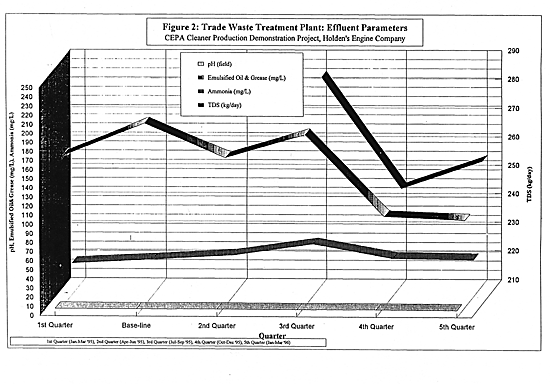
The data obtained from HEC, which quantifies these parameters
has been summarised in Appendix A and charts are presented as
Figure 1 and Figure 2. The data has been averaged
on a quarterly basis to allow for facility downtime which usually
occurs in December, January, April and September. The quarters
are as follows:
| January to March 1995; |
| April to June 1995; |
|
July to September 1995; | |
| October to December 1995; and |
| January to March 1996. |
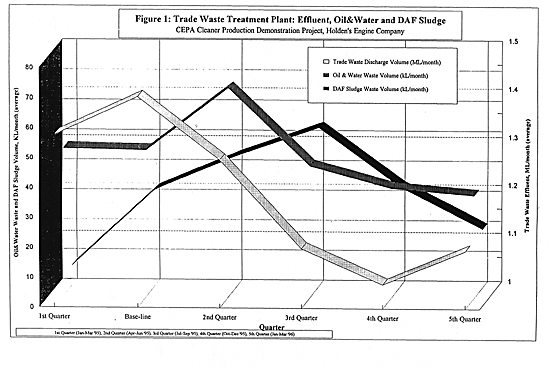
The trade waste effluent flow, oil & water waste and Dissolved
Air Flotation unit (DAF) sludge waste streams are indicators of
the volume of washing machine and coolant effluent discharged
to the TWTP. A chart presenting trade waste effluent flow and
liquid waste disposal data is attached as Figure 1.
Trade Waste Effluent Volume
Trade waste effluent data indicates that there is a downwards
trend in the volume of effluent discharged from HEC at an average
reduction of 6% per month. At a charge of 48.5 cents per kilolitre
of trade waste discharged to sewer, a saving of $1,654 was realised
for the period of the Project (this saving is the equivalent of
at least three months of discharge costs, or a 25% saving). The
savings are indicative of Castrol and HEC's initiatives to reduce
coolant waste by improved management of coolant reticulation systems
in the facility.
Emulsified Oil and Grease in Trade Waste Effluent
The emulsified oil and grease content of effluent is on the decline
and at 94.4 mg/L for the final quarter (5th quarter) is significantly
lower than the base-line figure of 200 mg/L. The oil and grease
content of effluent is indicative of the efficiency of the emulsion
splitting stage during waste treatment. Castrol and HEC personnel
advised that since August 1995, there have been no major coolant
system dumps, resulting in a reduction of the amount of coolant
waste which is ultimately treated in the emulsion splitting stage.
Therefore, the chemical management program did result in lower
wastewater treatment costs. It should be noted however that there
is a constant bleed of coolant from most systems which contributes
to the volume of coolant requiring treatment even if coolant system
dumps do not occur.
Castrol and HEC are currently investigating optimisation of the
effluent treatment process to further reduce the use of dosing
chemicals, since there is evidence that current dosing chemicals
have resulted in increased volumes of DAF sludge waste.
Total Dissolved Solids Content of Effluent
Data for total dissolved solids in effluent have not shown a distinct
trend during the Project. The trade waste discharge limit for
TDS is 200 kg/day, however this is not strictly enforced by South
East Water because many Victorian manufacturing and chemical processes
are unable to meet such a limit. HEC exceed this limit for the
3rd, 4th and 5th quarters: 283 kg/day, 244 kg/day and 254 kg/day
respectively.
Sources which contribute towards TDS in effluent from HEC include:
- washing machine wastewater [large volume, low concentration];
- additives in coolant solution (anti-corrosion chemicals and biocides [small volume, low concentration]); and
- brine solution occasionally used in the treatment of emulsified wastewater [low volume, high concentration].
Castrol and HEC have initiated some reduction in the volume of
washing machine wastewater which is disposed to the TWTP, and
the volume of coolant waste requiring emulsion splitting treatment
has also decreased. However, monitoring of TDS in effluent has
not demonstrated that reductions have occurred.
Oil and Water and DAF Sludge Waste
An increase in the volume of oil & water waste and DAF sludge
in the first half of the project (2nd and 3rd quarters) was of
particular concern to Castrol and HEC, especially in light of
the positive indication of a downwards trend in trade waste effluent
discharge volume for that period of time. Further investigation
determined that excessive dumping of coolant in the first half
of the project significantly increased sludge and waste oil.
Avoidance of coolant system dumps saw significant reduction in
subsequent quarters.
The volume of DAF sludge waste is also influenced by its water
content, reported by HEC to be about 70%. Castrol and HEC's investigation
into improved chemical dosing during effluent treatment later
produced a 1 third reduction in unit sludge volumes, saving $25,
000 per year.
Trends observed during the second half of the Project indicated
the following:
- a 30% reduction in disposal charges for DAF sludge and oil & water waste between the 3rd and 4th quarters; and
- a 24% reduction in disposal charges for DAF sludge and oil & water waste between the 4th and 5th quarters.
These reductions are significant and indicate that liquid waste
discharges are being reduced as a result of cleaner production
initiatives. As a conservative estimate, we have projected that
a 10% reduction in liquid waste discharges is achievable in the
next year.
In summary, the trade waste analysis data could not provide a
complete picture of the effect of the Chemical Management Program
on wastewater discharge. Some improvements have been monitored,
however based on discussion with HEC and Castrol on the Chemical
Management Program, other production changes, such as increased
production, changes in maintenance practices and changes in effluent
treatment practices in the TWTP itself have impacted the waste
water discharges.
3.3 OTHER INITIATIVES
In parallel, to the main Cleaner Production Program implemented,
HEC undertook a number of other initiatives which reflect a cleaner
production approach.
HEC installed a "swarf drier" which will enable 3,000
tonnes of cast iron "swarf" (metal shavings) to be recycled
in the company's foundry rather than going to disposal. Swarf
is generated from machining rough castings, such as engine blocks,
during production.
Prior to the installation of the swarf drier, HEC could not recycle
its cast iron swarf because the metal shavings were too wet and
oily from the coolant used during machining. The drier acts like
a furnace, burning any excess water and oil produced from coolant
off the metal shavings, leaving dry swarf to be re-melted for
castings. Once fully operational, this system will result in
cast iron cost savings greater than $500,000 every year.
The company has also looked closely at energy consumption. By
reducing gas consumption for manufacturing and heating, HEC has
achieved a 15% cost saving, worth $240,000 each year. Simple
measures, such as reducing pressure and temperature in the boiler
house and securing doors to batch ovens and covers on ladles,
have saved a total of 70 million megajoules of energy per annum.
Similar energy conservation measures - such as replacing fluorescent
lights with sodium halide and daylight fittings in offices, using
high-efficiency motors, and computerising a control system for
air compressors - have also cut the company's expenditure on electricity
by $1.3 million per year.
Overall, though focusing on cleaner production techniques, including
"housekeeping", securing oven doors, improved technologies,
process changes like reducing boiler temperature, and more efficient
monitoring with computerised control systems, HEC has calculated
that the company has reduced carbon dioxide emissions by 28,850
tonnes per annum.
The costs and benefits of the Project are discussed in this section.
Economic benefits are summarised in Table 2.
| Improved Coolant Management (incl. installation of coolant recycling unit) | 35,000 L | 100,000 L (at TWTP) | $100, 000 | ||
| Coolant Exchange | 10,000 L | 50,000 L (at TWTP) | 104,000 L | 163,000 L | |
| Fungal and Bacterial Resistant Coolant | 1,850 L | 6,800 L | |||
| Trade Waste Discharge Savings | 13,800 L | ||||
| Liquid Waste Disposal Savings | 120,000 L | ||||
| TOTAL Cost | |||||
- Improved Coolant Management:
| Overall coolant savings from improved coolant management and the new coolant recovery system amount to about 35,000 litres per year at a chemical purchase saving of $84,000 and treatment/disposal cost saving of $12,000 per year. The new coolant recovery system cost HEC about $68,000 fully installed |
- Coolant Exchange:
| Coolant "swapping" has achieved coolant purchase savings of $5,000 and liquid waste treatment cost savings of $3,000 for a single coolant system. Thus each time the coolant is "swapped", an immediate saving of about $8,000 is realised for this system. An estimated projected additional saving of at least $32,500 in coolant purchase costs and $19,500 in waste treatment/discharge costs, per year, is possible if this practice is undertaken the smaller (less than 16,000L capacity) coolant systems. |
- Fungal and Bacterial Resistant Coolant:
| Introduction of coolant resistant to fungal and bacterial infection does not require the addition of biocide chemicals. This has resulted in a saving of approximately $30,000 in biocide costs per year for the period of the Project, on only two coolant systems, and reduces the release of these chemicals to the environment via trade waste. An estimated projected additional saving of up to $110,000 per year is possible if microbial resistant coolants are used in the larger (greater than 20,000L capacity) coolant systems. |
- Overall Improved Chemicals Management, Savings in TWTP Discharges:
| The trends observed during the Project indicate that the Chemical Management Program has achieved an average 6% reduction in trade waste discharge (to sewer) for each month, which represents a saving of $1,654, (or the equivalent of a 25% saving in disposal charges). Although no savings were observed in the disposal of DAF sludge and oil & water waste, the last two quarters of the Project indicate a reduction in the volume of these wastes discharged. The approximate cost to HEC for disposal of oil & water and sludge waste amounts to $126,400 per year (based on the baseline figure of 81 kilolitres per month). Provided that the latest trend of reduced oil & water and DAF sludge waste volumes do not change significantly, then at least a 10% decrease in waste volume can be achieved and HEC can potentially save at least $25,000 per year in liquid waste disposal costs. |
4.0 REVIEW OF PROJECT
The Project undertaken at HEC was very successful in its demonstration
that chemical management and associated process improvement can
achieve cleaner production within a large operation and reduce
expenditure on waste treatment and disposal. The Chemical Management
Program at HEC, although in its infancy, has demonstrated that
a small team of experts (Castrol) along with the assistance and
co-operation of HEC personnel (both production personnel and supervisory
/ management personnel) can achieve cleaner production benefits
by persistent assessment of the processes and procedures in place.
Dames & Moore's role of assessing the initiatives undertaken
by Castrol and HEC, by analysing data from the Trade Waste Treatment
Plant, was useful to Castrol and HEC as supplementary information
to gauge the effects of each initiative undertaken under the Chemical
Management Program on the quality and volume of trade waste and
associated liquid/sludge waste.
The most encouraging aspect of this Project at HEC was the commitment
of HEC and Castrol personnel to achieving cleaner production objectives.
It is understood that Castrol's role within HEC is to continually
implement change to minimise waste and chemical use, which are
cornerstones of cleaner production. The introduction of chemical
management at HEC is constantly being reviewed and evaluated by
HEC and Castrol alike, but if the Cleaner Production Project recently
undertaken is any indication, the Chemical Management Program
at HEC is a significant demonstration of successful cleaner production.
5.0 CONCLUDING REMARKS
Based on the experience of implementing a Cleaner Production Demonstration
Program at Holden's Engine Company, significant environmental
and economic savings can be realised for large operations wishing
to undertake a Chemical Management Program. The Chemical Management
Program, implemented by Castrol+Plus within Holden's Engine Company's
operations, has achieved the minimisation of chemical use in a
number of production areas with the flow-on effect of reduced
chemical treatment of waste and disposal charges associated with
waste. The Chemical Management Program is on-going and is expected
to achieve even greater cleaner production initiatives in the
future.
A lesson learnt from this Project is that there is no substitute
for good data and regular communication between personnel wishing
to undertake cleaner production within their organisation, especially
if some capital expenditure is required to initially undertake
a project.
6.0 HOLDEN'S ENGINE COMPANY
PERSPECTIVE
"HECís core business and expertise is in making engines.
Consequently, it makes sense to outsource activities in which
HEC has only limited expertise, such as chemicals management,
to an organisation which has more expertise in the field.
After over a year of operation as Chemical Manager for HEC, Castrol
is now operating profitably, resulting in significant savings
to HEC, particularly in waste disposal costs. These savings highlight
the cleaner production results achieved by the Chemicals Management
Program.
The current three year contract with the Chemical Manager includes
a 6% per year contract cost reduction clause which encourages
further cleaner production initiatives by the Chemical Manager.
One of the concepts of the Chemical Management Program is the
concept of shared risks and rewards. Negotiations are currently
underway to determine an equitable means of achieving this. This
means the sharing of profits resulting from initiatives and projects
between HEC, the Chemical Manager and second tier chemical suppliers
where applicable.
The financial success of the new Chemical Management Program at
HEC has secured top HEC management commitment to continue with
cleaner production initiatives. As a result of the implementation
of a pilot chemical management program is currently underway at
Holden Engine Company'í Commodore production plant in South
Australia.
Another cleaner production initiative currently being investigated
by HEC is a waste management program to operate similarly to the
Chemical Management Program.
The Chemical Management Program has also assisted to achieve senior
management support for the implementation of an environmental
management system is accordance with ISO 14001 and with GM corporate
guidelines. With this EMS in place, area managers will become
better trained and more focused on the environmental impact of
activities occurring in their areas of responsibility and will
rely less on audits and recommendations of outside authorities
to ensure appropriate environmental performance.
The Cleaner Production Demonstration Project has quantified the
successes achieved by the Chemical Management Program and has
demonstrated the reduction achievable in trade waste discharges."
Don Campbell
Senior Environmental Engineer
| DAF | Dissolved Air Flotation. Refers to the type of treatment used in the Trade Waste Treatment Plant. |
| Biocide | At HEC, biocides are added to the coolant mixture to reduce bacterial and fungal growth |
| TWTP | Trade Waste Treatment Plant. |
| Swarf | Metal shavings, "sawdust" and particles resulting from metal component machining and cutting operations. |
| MAZAK | The name used for a group of CNC (computerised numeric control) machines which are used to machine fly wheels, disc brakes and steering knuckles. |
| TDS | Total Dissolved Solids |
| Floc | A term used for the separation of dissolved solids from a solution. A "floc" is the solid substance which separates out (either floating or settling) in the solution. |
| Trade Waste | Trade waste is the effluent discharged from HEC's Trade Waste Treatment Plant into the public sewerage system. Other liquid/solid wastes from the TWTP include the oil/water waste from emulsion splitting and the sludge waste from the dissolved air flotation unit. |
TABLE 3 (Material to be provided later)
TRADE WASTE TREATMENT PLANT EFFLUENT DATA
TABLE OF CONTENTS | Appendices
 |