
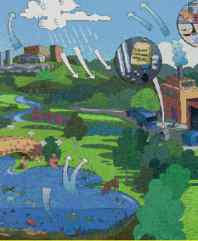
 There is a worldwide cycling and recycling of mercury through the environment, called the biogeochemical cycle of mercury. The cycle has six steps, as shown in the adjoining diagram:
Elemental metallic mercury ("mercury zero"), released to the atmosphere in vapor form, can be transported very long distances. Eventually, wet and dry deposition processes return it to land or water surfaces in the form of compounds.
Wet depositions of mercury by precipitation (rain, snow, etc.) is the primary method of mercury removal from the atmosphere (perhaps 66 percent of the total). Mercury can also be removed from the atmosphere by sorbtion of the vapor onto soil or water surfaces.
The particular form of mercury and its compounds strongly influence the movement and partitioning of mercury among surface waters and soils. Ninety seven percent of all the gaseous mercury dissolved in water is the elemental form -- "mercury zero". Volatile forms of mercury, such as the metallic liquid and dimethyl mercury, will evaporate into the atmosphere. Solid forms particulates in the soil or the water column, and once in the water column are transported downward to the sediments.
 To Mercury in the Environment Main Menu To Mercury in the Environment Main Menu
|