Glossary

Either select a word from the Word List or scroll through this file.

To Table of Contents © Copyright

Word List

A abiotic acid acute toxicity
alkalinity alloy amalgam
anthropogenic anthropogenic mercury emissions antifouling
atmosphere
B base benthic benthos
bioaccumulation biocide bioconcentration
bioconversion biogeochemical cycle biohazard
biomagnification biomass biosphere
biota
C calorie carcinogenic catalyst
chlorophyll chronic toxicity combustion
condensation conductivity crematory
D DDT (dichlordiphenyltrichloroethane) degassing degradation
degreaser discharge ductility
E ecosystem effluent emission
environmental release erosion evaporation
excretion
F fauna felting process fermentation
fertilizer flora fluorescence
food chain fossil fossil fuel
fungi fungicide
G gingivitis
H half life heavy metal herbicide
humic humus hydrograph
hydrologic cycle hydrosphere hydroxide
I igneous incinerator inorganic
insecticide ion
L lagoon landfill latent heat
lethal dose 50% (LD50) lethal dose (LD ) lime
lithosphere
M manometer mantle mercury (Hg)
mercury two mercury zero metabolism
metal methylmercury
N natural mercury emissions neurotoxin nitrate (NO3)
nitrite (NO2)
O opacity ores organic
oxidation
P paralysis pathogen pathology
PCB (polychlorinated biphenyl) permeability pesticide
pH pharmaceutical photochemistry
photosynthesis plankton poison
point-source pollution (PS) pollution prevention pollution reduction
porosity parts per million (ppm) precipitation (ppt)
predatory fish prenatal preservative
R reduction refuse root zone
runoff
S salinity salt saturated fat
sediment smelting sorb
soil moisture content (mc) solvent storage
T TCDD teratogenic textile
threshold toxic toxicity
turbidity
U uptake
V valence volatilization
W wastewater
X x-rays
Z zooplankton

abiotic
a system characterized by the absence of life or living organisms.

Top of Glossary Page

acid
a sour substance, typically soluble in water, which neutralizes bases to form salts. A compound containing hydrogen atoms (H) which are capable of being replaced by a positive element or radical. A substance which gives up H to another substance.

Top of Glossary Page

acute toxicity
any poisonous effect produced within a short time after exposure to the toxic compound, usually within 24 to 96 hours

Top of Glossary Page

alkalinity
the total measurable bases (OH, HCO3, CO3) in a volume of water; a measure of a material's capacity to neutralize acids.

Top of Glossary Page

alloy
a substance composed of two or more metals.

Top of Glossary Page

amalgam
an alloy that consists chiefly of silver mixed with mercury and variable amounts of other metals and is used as dental filling.

Top of Glossary Page

anthropogenic
man-made

Top of Glossary Page

anthropogenic mercury emissions
the atmospheric emission of geologically bound mercury by human activity (e.g. emission of mercury in fossil fuels such as coal)

Top of Glossary Page

antifouling
a coating process or the like that prevents the accumulation of aquatic animals and plants. Earth

Top of Glossary Page

atmosphere
the gaseous layer that surrounds the earth (air)

Top of Glossary Page

base
a substance which neutralizes an acid. A substance which furnishes hydroxyl (OH) ions and a positive ion, usually a metal. An ion which will combine with hydrogen ions. An alkali.

Top of Glossary Page

benthic
of or pertaining to the benthos

Top of Glossary Page

benthos
the bottom of the sea or of any body of water.

Top of Glossary Page

bioaccumulation Fishing for
	Bioaccumulative Chemicals
the uptake and retention of substances by an organism from its food and its surrounding environment. Chemicals that bioaccumulate become more concentrated at each successively higher level of the food chain.

Bioaccumulative chemicals can be toxic to organisms at the upper end of a food chain, such as predatory fish, loons, eagles, otters, or humans that eat fish

Top of Glossary Page

biocide
any chemical that destroys life by poisoning.

Top of Glossary Page

bioconcentration
a specific bioaccumulation process by which the concentration of a chemical in an organism becomes higher than its concentration in the air or water around the organism. Although the process is the same for both natural and manmade chemicals, the term bioconcentration usually refers to chemicals foreign to the organism.

Top of Glossary Page

bioconversion
the conversion of biomass to usable energy, as by burning solid fuel for heat, by fermenting plant matter to produce fuel, as ethanol, or by bacterial decomposition of organic waste to produce methanol.

Top of Glossary Page

biogeochemical cycle
a cycle dealing with the relationship between the chemical changes of the earth's crust of a given region and its flora and fauna, including the circulation of such elements as carbon, and nitrogen between the environment of the cells of living organisms.

Top of Glossary Page

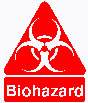
biohazard Biohazard Symbol
the health risk posed by the possible release of a pathogen into the environment.

Top of Glossary Page

biomagnification
it describes a process that results in the accumulation of a chemical in an organism at higher levels than are found in its food. It occurs when a chemical becomes more and more concentrated as it moves up through a food chain. At the top of the food chain an animal, through its regular diet, may accumulate a much greater concentration of chemical than was present in organism lower in the food chain.

Top of Glossary Page

biomass
the amount of living matter in a given habitat.

Top of Glossary Page

biosphere
all living organisms (plant and animal life)
Flowers Birds A Mink

Top of Glossary Page

biota
living organisms.

Top of Glossary Page

calorie
the amount of heat required to raise the temperature of one gram of water by one degree centigrade

Top of Glossary Page

carcinogenic
event, condition or effect that produces cancer.

Top of Glossary Page

catalyst
a substance or agent which alters the velocity of a chemical reaction but is not itself changed in the process. An enzyme is an example of a catalyst.

Top of Glossary Page

chlorophyll
one of a number of green pigments present in plant cells which are essential in the utilization of light energy in photosynthesis.

Top of Glossary Page

chronic toxicity
any poisonous effect having long duration, usually months or years.

Top of Glossary Page

combustion
the act or process of burning.

Top of Glossary Page

condensation
the process in which water vapor is cooled to the liquid phase. The water film produced is reffered to as condensate.

Top of Glossary Page

conductivity
the property of conducting heat, electricity, or sound.

Top of Glossary Page

crematory
a place where a dead body is reduced to ashes by fire.

Top of Glossary Page

DDT (dichlordiphenyltrichloroethane)
a white, water-insoluble solid used as an insecticide, and whose agriculture use was prohibited in the U.S. in 1973.

Top of Glossary Page

degassing
to free from gases.

Top of Glossary Page

degradation
to wear down, reduce to lower quality, by erosion or reduce the complexity of a chemical compound

Top of Glossary Page

degreaser
solutions that remove grease

Top of Glossary Page

discharge
(1) the flow of surface water in a stream or canal or the outflow of groundwater from a well, ditch, or spring

(2) the release of wastewater through a pipe outlet or similar apparatus to a discharge point such as a ditch or storage lagoon


Top of Glossary Page

ductility
malleable. Able of undergoing change of form without breaking.

Top of Glossary Page

ecosystem
an ecological system, a natural unit of living and nonliving components which interact to form a stable system in which a cyclic interchange of materials takes place between living and nonliving units, as in a balanced aquarium or in a large lake or forest.

Top of Glossary Page

effluent
the discharge of a pollutant in a liquid form from a containing space.

Top of Glossary Page

emission
the act of sending forth, to emanate.

Top of Glossary Page

environmental release
the introduction of a pollutant into the environment through waste-water discharge, air emission, or volatilization or leaching from soil, landfill, or other contaminated site

Top of Glossary Page

erosion
the wearing away of the land surface by running water, wind, ice, or other geological agents, including such processes as gravitational creep. Geological erosion is natural occurring erosion over long periods of time. Accelerated erosion is more rapid than normal erosion and results primarily from man's activities. Erosion is further classified by the amount and pattern of soil removal and transport as gully, interrill, rill, sheet, and splash or raindrop erosion.

Top of Glossary Page

evaporation
the process in which liquid water is transferred into the atmosphere.

Top of Glossary Page

excretion
the elimination or discharge of waste products or substances present in excess from the body.

Top of Glossary Page

fauna
the animal life of a locality or a region
An Otter

Top of Glossary Page

felting process
process where nonwoven fabrics of wool, fur, or hair are matted together by heat, moisture, and great pressure.

Top of Glossary Page

fermentation
a change which converts grape sugar into ethyl alcohol.

Top of Glossary Page

fertilizer
any substance, like manure, used to enrich the soil.

Top of Glossary Page

flora Flowers
the plant life of an area or locality.

Top of Glossary Page

fluorescence
the property of absorbing light of a particular wave length and then emitting light of a different color and wave length.

Top of Glossary Page

food chain
a group of organisms involved in the transfer of energy from its primary source, plants, as algae, insects, small fishes, larger fishes, fish-eating birds or mammals.

Top of Glossary Page

fossil
any remains, impression, cast, or trace of an animal or plant of a past geological period. The term is generally restricted to parts which have been petrified or converted to stone.

Top of Glossary Page

fossil fuel
any combustible organic material as oil, coal, or natural gas, derived from fossils.

Top of Glossary Page

fungi
any of a large group of simple plants characterized by lack of chlorophyll as the mold, mildews, mushrooms, rusts, and smuts. Most have a filamentous body and subsist on organic matter.

Top of Glossary Page

fungicide
an agent which kills or inhibits the growth of fungi

Top of Glossary Page

gingivitis
swollen of the oral cavity gums.

Top of Glossary Page

half life
the time it takes certain materials, such as mercury, to become chemically altered

Top of Glossary Page

heavy metal
any metal with a density of 5.0 or greater, especially one that is toxic to organisms, as lead, mercury, copper, and cadmium.

Top of Glossary Page

herbicide
chemicals used to kill undesirable vegetation

Top of Glossary Page

humic
of or pertaining to the humus

Top of Glossary Page

humus
dark material in the soil consisting principally of organic matter.

Top of Glossary Page

hydrograph
a graph which illustrates hydrologic measurements over a period of time, such as water level, discharge or velocity

Top of Glossary Page

hydrologic cycle
the circulation of water in and on the earth and through earth's atmosphere through evaporation, condensation, precipitation, runoff, groundwater storage and seepage, and re-evaporation into the atmosphere

Top of Glossary Page

hydrosphere
water held in oceans, rivers, lakes, glaciers, groundwater, plants, animals, soil, and air.

Top of Glossary Page

hydroxide
a compound formed by the union of a metal or a radical with one or more hydroxyl (OH) groups, as sodium hydroxide (NaOH).

Top of Glossary Page

igneous
produced under conditions involving intense heat, as rocks of volcanic origin.

Top of Glossary Page

incinerator
a crematory instrument for the combustion (incineration) of organic material, leaving only ash.

Top of Glossary Page

inorganic
not containing carbon or compounds of carbon. Not of plant or animal origin.

Top of Glossary Page

insecticide
chemicals used to control undesirable insects

Top of Glossary Page

ion
an electrically charged atom or group of atoms formed by the loss of one or more electrons, as a cation (positive ion), which is created by an electron loss, or as an anion (negative ion), which is crated by an electron gain.

Top of Glossary Page

lagoon
water impoundment in which organic wastes are stored or stabilized or both

Top of Glossary Page

landfill
a low area of land that is built up from deposits of solid refuse in layers covered by soil.

Top of Glossary Page

latent heat
the heat (energy) absorbed or released as water changes between the gas (water vapor), the liquid (water droplets), and the solid (ice) states

Top of Glossary Page

lethal dose 50% (LD50)
the dosage of a toxic substance required to kill one half of the organisms under study in a given period of time

Top of Glossary Page

lethal dose (LD)
the amount of a toxic substance required to cause death of an organism under study in a given period of time

Top of Glossary Page

lime
calcium oxide (CaO) or quicklime, prepared by heating calcium carbonate thus driving off carbon dioxide.

Top of Glossary Page

lithosphere
a general term for the outer layer of the earth. A wind blown deposit of silty soil having little or no stratification

Top of Glossary Page

manometer
a device for measuring the pressure exerted by gases or liquids. In its simplest form, it is a U-shaped tube containing a fluid (water or mercury) against which the pressure of an unknown is balanced.

Top of Glossary Page

mantle
a general term for the outer covering of earth material

Top of Glossary Page

mercury (Hg)
a silvery-colored metal, commonly called quicksilver. The term refers to any of the different chemical forms that mercury can take, including methylmercury, Hg zero, and Hg(II)

Top of Glossary Page

mercury two
"mercury two" is the mercury ion. Because it is water soluble and associates with particulates, atmospheric deposition of mercury two is relatively fast, either as dry deposition or in precipitation. Combustion sources can emit both mercury zero and mercury two. Mercury two can be produced in the atmosphere by the oxidation of mercury zero by ozone or other oxidants

Top of Glossary Page

mercury zero
"mercury zero" is the elemental form of mercury, familiar as the silvery liquid. Mercury zero can volatilize to the atmosphere at normal temperatures. Over 90% of mercury in the atmosphere is mercury zero, although other forms may be considerably higher than 10% near sources. Because mercury zero does not adsorb to particulates and is not very water soluble, it is removed from the atmosphere very slowly with a half life in the atmosphere of about a year. Mercury zero liquid or amalgam is not absorbed during digestion, but the vapor is readily absorbed by the lungs.

Top of Glossary Page

metabolism
the chemical or energy changes which occur within a living organism or a part of it which are involved in various life activities.

Top of Glossary Page

metal
any of a class of elementary substances, as gold, silver, or copper, all of which are crystalline when solid, and many of which are characterized by opacity, ductility, conductivity, and a unique luster when freshly fractured. An element yielding positively charged ions in aqueous solution of its salts.

Top of Glossary Page

methylmercury
any of several extremely toxic compounds formed from metallic mercury by the action of microorganisms and capable of entering the food chain.

Top of Glossary Page

natural mercury emissions
the atmospheric emission of geologically bound mercury through natural processes (e.g. emission of mercury from volcanoes)

Top of Glossary Page

neurotoxin
a poisonous substance which affects nervous system.

Top of Glossary Page

nitrate (NO3)
an important plant nutrient and type of inorganic fertilizer (most highly oxidized phase in the nitrogen cycle). In water, the major sources of nitrates are septic tanks, feed lots and fertilizers.

Top of Glossary Page

nitrite (NO2)
product in the first step of the two-step process of conversion of ammonium (NH4) to nitrate (NO3)

Top of Glossary Page

opacity
the state or quality of being opaque.

Top of Glossary Page

ores
a metal-bearing mineral or rock, or a native metal, that can be mined at profit. A mineral or natural product serving as a source of some nonmetallic substance, as sulfur.

Top of Glossary Page

organic
compounds that contain carbon.

Top of Glossary Page

oxidation
the removal of hydrogen from a compound. The loss of electron with an increase in positive valence of an element.

Top of Glossary Page

paralysis
loss of sensation or loss of muscular function usually due to an injury to a nerve or a lesion within the central nervous system.

Top of Glossary Page

pathogen
any disease-producing agent.

Top of Glossary Page

pathology
the scientific study of disease, including causes, symptoms, signs, and various structural and functional alteration which may occur in its course.

Top of Glossary Page

PCB (polychlorinated biphenyl)
a family of highly toxic chemical compounds known to cause skin diseases and suspected of causing birth defects and cancer.

Top of Glossary Page

permeability
the capacity of a porous rock, sediment or soil to transmit a fluid such as water. The more fluid that can be transferred, the more permeable the material.

Top of Glossary Page

pesticide
a chemical substance used to kill or control pests such as weeds, insects, fungus, mites, algae, rodents, and other undesirable agents

Top of Glossary Page

pH
a numerical measure of acidity, or hydrogen ion activity used to express acidity or alkalinity; neutral is pH 7.0, values below 7.0 are acid, and above 7.0 are alkaline.

Top of Glossary Page

pharmaceutical
a chemical drug or medicine.

Top of Glossary Page

photochemistry
the branch of chemistry that deals with the chemical action of light.

Top of Glossary Page

photosynthesis
The process which occurs in the cells of green plants in which simple sugars are formed from carbon dioxide and water in the presence of light and chlorophyll. The basic reaction by which light or radiant energy is converted to chemical energy and stored in the molecules of carbohydrates.

Top of Glossary Page

plankton
aquatic organisms of fresh, brackish, or sea water which float passively or exhibit limited locomotor activity.

Top of Glossary Page

poison
a substance, which upon contact or being introduced into an organism, impairs or prevents normal metabolic processes from taking place, thus altering the normal functioning of organs or tissues.

Top of Glossary Page

point-source pollution (PS)
pollution of water from one place in a concentrated manner that is easy to identify. Ex. leaking underground storage tank or discharge pipe from a sewage treatment plant.

Top of Glossary Page

pollution prevention (P2)
Altering a process or use of materials to reduce environmental release of mercury. Examples of pollution prevention include nonfossil-fuel energy production (e.g. wind energy), more efficient use of fossil-fuel energy, use of low-mercury coal, and use of alternative products (e.g. digital thermometers instead of mercury thermometers). According to the Federal Pollution Prevention Act of 1990, pollution prevention is "any practice which reduces the amount of any hazardous substance, pollutant, or contaminant entering the waste stream or otherwise released into the environment prior to recycling, treatment, or disposal...". Pollution prevention is also called "source reduction".

Top of Glossary Page

pollution reduction
in this program, pollution reduction is the decrease in the use and environmental release of mercury.

Top of Glossary Page

porosity
the degree to which the total volume of soil, gravel, sediment or rock is permeated with pores or cavities through which fluids (including air) can move

Top of Glossary Page

parts per million (ppm)
a common basis for reporting water analysis. One ppm equals one unit of measurement per million units of the same measurement. One ppm equals one milligram per litre. One ppm is approximately the aspirin concentration formed when one aspirin tablet is dissolved in 100 gallons of water.

Top of Glossary Page

precipitation (ppt)
moisture falling from the atmosphere in the form of rain, snow, sleet or hail.

Top of Glossary Page

Sharks are Predatory
	    Fish>
<DT><STRONG><A NAME=predatory fish

a fish living by killing and eating other fish.

Top of Glossary Page

prenatal
before birth.

Top of Glossary Page

preservative
a chemical substance used to preserve food or other organic material from decomposition or fermentation.

Top of Glossary Page

reduction
a chemical reaction in which one or more electrons are gain by the substance reduced. The addition of hydrogen atoms or the loss of oxygen atoms.

Top of Glossary Page

refuse
something that is discarded as worthless or useless; rubbish, trash, garbage.

Top of Glossary Page

root zone
the depth of soil penetrated by crop roots. Also called the vadose zone.

Top of Glossary Page

runoff
the flow of water from the land to oceans or interior basins by overland flow and stream channels.

Top of Glossary Page

salinity
the concentration of dissolved salts in water.

Top of Glossary Page

salt
a substance other than water resulting from the reaction between an acid and a base.

Top of Glossary Page

saturated fat
a type of single-bond animal or vegetable fat, as that found in butter, meat, egg yolks, and coconut or palm oil, that in humans tends to increase cholesterol levels in the blood.

Top of Glossary Page

sediment
that which settles to the bottom, as in a lake or a river.

Top of Glossary Page

smelting
fusion or melting process in order to separate metals.

Top of Glossary Page

sorb
to take up and hold either by absorption or adsorption.

Top of Glossary Page

soil moisture content (mc)
the portion of water in a soil that can be readily absorbed by plant roots. It is the amount of water released between in situ field capacity (FC) and the permanent wilting point (WP).

Top of Glossary Page

solvent
a liquid in which a substance is dissolved.

Top of Glossary Page

storage
the temporary deposit of a chemical in body tissue or in an organ. Storage is just one facet of chemical bioaccumulation. The term also applies to other natural processes, sucs as the storage of fat in hibernating animals or the storage of starch in seeds.

Top of Glossary Page

TCDD
a by-product of pesticide manufacture; a toxic compound that is carcinogenic and teratogenic in certain animals.

Top of Glossary Page

teratogenic
capable of interfering with the development of a fetus, causing birth defects.

Top of Glossary Page

textile
any cloth or goods produced by weaving, knitting, or felting.

Top of Glossary Page

threshold
the lowest limit at which a certain phenomenon will occur.

Top of Glossary Page

toxic
of, pertaining to, affected with, or caused by a poison.

Top of Glossary Page

toxicity
the quality, relative degree, or specific degree of being toxic or poisonous.

Top of Glossary Page

turbidity
a measure of water cloudiness caused by suspended solids.

Top of Glossary Page

uptake
it describes the entrance of a chemical into an organism -- such as by breathing, swallowing, or absorbing it through the skin -- without regard to its subsequent storage, metabolism, and excretion by that organism.

Top of Glossary Page

valence
the combining power of an atom; its capacity to combine with other atoms to form a molecule, expressed in terms of the number of hydrogen atoms or their equivalent with which any atom may combine.

Top of Glossary Page

volatilization
loss of a substance through evaporation or sublimation. When manure is spread on a field, ammonia-nitrogen in the manure may volatize quickly and be lost as fertilizer unless it is incorporated into the soil.

Top of Glossary Page

wastewater
water that has been used in washing, flushing, manufacturing, etc.; sewage

Top of Glossary Page

x-rays
also know as Roentgen rays. Radiant energy of short wave length produced by high speed electron striking a metal target in a vacuum.
Top of Glossary Page

zooplankton
the animals of plankton

Top of Glossary Page


© Copyright