
Previous section Environmental challenges
Mixed farming systems in the developing world: Nutrient deficits
The mixed farming systems of the developing world contain about 67 percent of the cattle and 64 percent of the small ruminants of the world. Throughout the world, animal numbers are growing in the mixed farming system, most rapidly in the humid/sub-humid regions (Annex 2). Sheep and goat numbers show the fastest growth rates in the humid/sub-humid region, underlining how human population pressure is reducing farm size and access to and use of resources.
Irrigated mixed farming systems have shown the greatest increase in productivity, particularly in the humid regions of Asia. This is clearly a result of the strong growth in demand for animal products and better access to feed resources and other types of infrastructure in Asia. Milk production is important, particularly in south Asian countries, due to the growing demand in the region and the favorable policies that many governments have created for the dairy sector. Although the growth of dairy production can place more pressure on land resources, it can also increase the use of crop by-products which in turn improves nutrient recycling and, if of high quality, can diminish methane production.
State
There is a considerable range of positive and negative interactions between livestock and the environment within the different sub-systems. These interactions can affect land quality in its physical (soil erosion) and chemical properties (soil fertility), the use of non-renewable resources, such as fossil fuels and fertilizer, and the conservation of agricultural (plant and animal) biodiversity. They are detailed below.
Soil erosion is probably the most pervasive form of land degradation in the developing world. Erosion rates are particular high in Asia, Africa and South America where they average 30 to 40 tons/ha/year, compared with an average soil formation of 1 ton per ha/per year (Pimental et al., 1995). In Africa, 60 percent of soil erosion damage occurs in the semi-arid and dry sub-humid regions where cropping and livestock co-exist (Thomas and Middleton, 1994), with strong interlocking factors of cropping, fuelwood collection and grazing.
| Box 3.2 Effect of soil erosion and nutrient export on mixed farm productivity in Ethiopia. | ||||||||||||||
|---|---|---|---|---|---|---|---|---|---|---|---|---|---|---|
The nutrient export results from the use of dung and crop residues as fuel. The Gross Discounted Cumulative Loss captures the cumulative nature of the land degradation, in which each year's erosion and nutrient loss is followed by another, adding layers of losses and hence cost on top of each other. |
||||||||||||||
| Source: Bojo and Cassells, 1995. |
Soil erosion is even more damaging on sloping lands. Poorly managed sloping terraces under crops and degraded rangelands can lose up to 100 MT/ha/year. Conversely, well managed pasture land loses 7 MT/ha/year or less and well managed forest land losses range from 0-10 MT/ha/year. Bojo and Cassells (1995) quantified these losses in the degraded Ethiopian Highlands (Box 3.2). Their results showed the effect of including pastures in those environments as a means of reducing erosion.
Soil fertility. Livestock play a significant role in maintaining soil fertility. In partially closed mixed farming systems, livestock can replenish a substantial share of soil nutrients, and therefore reduce the need for inorganic fertilizer, with corresponding savings for farmers in terms of cash outlay, for the country in foreign exchange, and for the world in non-renewable resources. The total value of this contribution is not known, although approximate figures are given by Jansen and de Wit (1996) for the irrigated mixed farming systems of Asia. Assuming manure production of about 1 ton dry material per year per Tropical Livestock Unit1, and an effective availability2 of 15 percent of the nutrients in the case of stall fed and half that amount for grazing animals, the amount of nutrients under stall fed conditions is about 8 kg N and 6 kg P per year per TLU. Under those assumptions, livestock in the mixed irrigated farming system can supply between 2 and 10 percent of the nitrogen requirements for rice, and about 40 to 120 percent of the requirements for phosphorus in cassava (Table 3.1).
1 A tropical Livestock Unit
(TLU) is an animal unit used to aggregate different classes of livestock. One
TLU equals and animal of 250 kg liveweight.
2 The balance is lost through evaporation, leaching and, in many
arid areas, through use as fuel.
As can be clearly seen from Table 3.1, nitrogen is the most depleted nutrient, with the amount lost varying, depending upon the technology used in collection, storing and application practices. How farmers approach these three factors largely determines the effectiveness of the recycling process and therefore provides an avenue for intervention. As shown, stall feeding significantly increases the amount of nutrients available from manure.
To demonstrate the importance of these contributions, an estimate was made of the amount of fertilizer that would be required to replace the manure that is used in the irrigated system of the humid tropics. The value of this is estimated to be between US$ 700 to US$ 850 million per year, depending on various assumptions (Table 3.2).
The economic benefits of improved soil structure as a result of adding soil organic matter from manure are more difficult to estimate. Adding manure to the soil increases cation exchange capacity, and improves soil physical conditions by increasing the water-holding capacity and improving soil structure stability. When adding the manure output from pigs and ruminants together, livestock may contribute up to 35% of the soil organic matter requirements. This is a crucial contribution because this is the only avenue available to many farmers for improving soil organic matter.
| Table 3.1 Estimated contribution of livestock to crop nutrient requirements in irrigated systems in Asia (% N and P removed by crops). | ||||
|---|---|---|---|---|
| System | Rice | Cassava | ||
 |
N | P | N | P |
| Pigs | 2 | 21 | 4 | 42 |
| Ruminants-grazing | 4 | 19 | 10 | 38 |
| Ruminants-stall-fed | 8 | 38 | 20 | 75 |
| Pigs+Ruminants-grazing | 6 | 40 | 14 | 79 |
| Pigs+Ruminants-stall-fed | 10 | 59 | 24 | 117 |
| Assuming rice yields of 4 tons per ha, and cassava yields of 10 tons per ha. | ||||
| Source: Jansen and de Wit, 1996. | ||||
Non-renewable resources. Draught animal power, in addition to other economic benefits, provides an important source of energy in the mixed farming systems of the world and helps to reduce dependence on non-renewable fuel resources. In developing countries, animal power is used to cultivate about 52 percent of the 480 million hectares of cropland (FAO, 1994). Draught animals provide between 25 to 64 percent of the energy needed for cultivation in the irrigated systems of the world. Worldwide 300 million draught animals are used in smallscale agriculture, while 30 million tractors would be needed to make the same contribution. This is equivalent to an US$ 200-300 billion investment in tractors plus a $5 billion annual fuel cost. Assuming that approximately 50 percent of the arable land is cultivated in the world's irrigated areas with draught animal power, complete replacement by tractors would require annually 888 million litres of diesel at a cost of US$ 222 million, and US$ 429 million for depreciation of the equipment (Jansen and de Wit, 1996).
The value of animal manure for cooking fuel is more controversial. Dung cakes are the main source of household energy for millions of poor households in the developing world. It is often argued that using dung for fuel removes soil nutrients and therefore carries high opportunity costs (Mearns, 1996). However nitrogen is the only major nutrient that is lost because the remaining ash is high in phosphorus and potassium.
| Table 3.2 Amount and value of manure in fertilizer equivalents in Asia's irrigated areas. | ||
|---|---|---|
|
Nitrogen | Phosphorus |
| Manure kg/ha | 5.7 - 9.8 | 7.9 - 11.7 |
| Fertilizer Equivalent (kg/ha) | 16.3 - 27.9 | 7.9 - 11.7 |
| Financial Value (US $/ha) | 6 - 10 | 2 - 3 |
| Total Economic Value (US $ mill) | 404 - 697 | 124 - 183 |
| Source: Jansen and de Wit, 1996. | ||
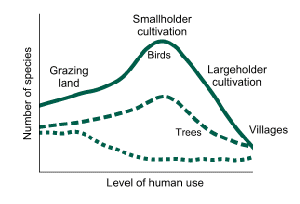
Biodiversity. In mixed farming systems, livestock-environment interactions can be a key focal point. As human population pressures increase, some types of wildlife or plant diversity can be lost while other types of biodiversity may actually increase. Reid et al. (1995) demonstrate how the number of tree, bird and mammal species changes as human use of the resource base intensifies (Figure 3.2).
These results are important for demonstrating the dynamic nature of ecological systems. They also show that man's agricultural activities must be balanced with the environment's capacity to sustain them.
An often overlooked component of biodiversity is soil micro-flora and fauna. Arthropods, with 90 percent of all species, dominate biodiversity (Pimental et al., 1992). For example, in a New York alfalfa “ecosystem” Pimental et al., (1992) reported 600 species of above ground arthropods. Livestock and manure have a beneficial effect on this biodiversity. For example, in mixed farms in Japan, the species diversity of the micro-fauna under grass more than doubled when manure was added to the land (Kitazawa and Kitazawa, 1980).
| Figure 3.2 Changes in biodiversity as human use intensifies. |
|---|
 |
In forest and communal grazing areas, adjacent to mixed farming areas, plant and animal biodiversity is decreasing because of over-grazing. There are many examples quoted in the literature confirming this trend, for example, in Syria, Rajastan, and West Africa. It is not clear, though, whether these are irreversible, long term changes. For example, Thomas and Middleton (1994) report that no systematic pattern of vegetation change could be detected in a 27-year vegetation survey of 77 villages in the Sudan. However, wildlife biodiversity is disturbed if land is fragmented and river sides are cultivated. Finally, the mixed farming areas of the world contain the main centres of domestic animal genetic resources (local livestock breeds) of the world. Urgent steps to safeguard that future capital are proposed in Chapter 5.
Land. Human population pressure, poverty and infrastructure are, as in grazing systems, the most important fundamental driving forces affecting the environmental impact of mixed farming systems in the developing world. And in that respect, the mixed farming systems are entering a dynamic period of growth and change because they cover some of the countries with the highest birth rates in the world (e.g., Uganda, the Sahelian countries, Ethiopia, Nepal, Bangladesh). Human population pressure affects soil fertility. In many parts of Africa and in the mountainous areas of Asia and Latin America, farmers attempt to maintain soil nutrient balance with, at best, small inputs from outside. Poverty and poor infrastructure usually prevent them from buying commercial feed and fertilizer (Box 3.3). Nutrient balance depends, therefore, on the ratio between arable and non-arable land. This also varies widely according to the climatic conditions. For example, in West Africa, the ratio was about 10 to 40 hectares of dry season grazing and 3 to 10 hectares of wet season grazing to provide adequate nutrients for one hectare of millet cropland (Williams, et al., 1995).
However, with increasing population pressure more and more grazing land is converted into cropland, the crop/grazing land ratio narrows, and the nutrient flow into cropland decreases. For example, cropland has increased in the Machakos area of Kenya from 35 percent of the higher potential area in 1948 to 81 percent (English, et al., 1993). In Northern Mali, the rate of increase of the arable cropping area was the same as the 2.6 percent rate of annual population growth over the last twenty years (Powell, 1995). This trend can lead to increased competition for cropland and grazing on the open rangelands, which in turn, can lead to privatization of crop residues and rangelands. For example, the common property lands in India, have decreased since 1960 by 50 percent, so that in 1992 they constituted only 15 percent of the total area (Jodha, 1992). Population pressure also causes farmers to push cultivation out into more resource limited areas, causing soil erosion. Mabbutt (1980) reports, for example, that in Niger millet fields are appearing 100 km north of the recommended limit to cultivation, increasing the risk of crop failure and leaving soil exposed and at risk of erosion. Livestock are moved to the most marginal areas.
| Box 3.3 Farmers balancing their systems. |
|---|
|
Globally mixed farmers have a history of attempting to optimize manure use in an effort to maintain soil fertility. Such efforts, however, are dependent upon access to livestock, feed resources for livestock, and the ability to store and apply manure. The examples presented below detail how well such efforts work and the potential problems involved in attempting to balance soil nutrient levels. In Nepal, farmers know livestock are essential for maintaining soil fertility. Quantities of 3 to 20 MT/ha of manure are applied, with irrigated fields receiving larger amounts. Yields of 1.6 and 1.3 MT/ha respectively for a crop of maize followed by wheat can be sustained with 21 MT/ha of manure application. In these areas total livestock densities range from 9.8 to 16.7 livestock units/ha of cultivated lands. Six livestock units are needed to provide sufficient farmyard manure for one year to grow one hectare of rice-maize-wheat. This quantity of manure is presently not available, due to partial collection and inefficient storage. In Indonesia, upland farmers apply manure on vegetables, rice, maize and cassava. Inorganic fertilizer applications are low. Maize and cassava grown on valley bottoms show a negative N, P, and K balance. The average density of cattle in upland Java is 2 head/ha which yields 2.5 MT/ha per year of dry farmyard manure. In Kenya, a typical subsistence farm would havea negative nitrogen balance of about 50 kg nitrogen/ha and is about self-sufficient in phosphorus. A move towards commercial dairy production would increase the outflow. But with the cash generated from the dairy cattle a nutrient balance can be achieved through a combination of manure and commercial fertilizer. Nutrient balance studies (Ransom et al., 1993) demonstrate how farmers strategically use commercial fertilizer on coffee and use manure on maize fields to achieve a nutrient balanced system. On sampled farms manure application ranged from 3,000 to 13,000 kg/ha/year. Commercial fertilizer use was not consistent as manure was used alone in 5 out of 7 years. |
Unless nutrients are replenished from outside sources, soil fertility continues to decline as the ratio between crop and grazing land declines. This is typically the case of many mixed farming systems in the tropics. Reported losses range from about 15 kg N/ha/year in Mali, to more than 100 kg N/ha/year in the highlands of Ethiopia. Downward spirals of declining soil fertility, overgrazing, and increased erosion and losses in soil micro-flora and fauna are the result and will cause, ultimately, significant decreases in agricultural productivity and political stability. The Rwanda example clearly underscores the need for a balance between crop activities, animal inputs and human population pressure, to avoid the collapse of the farming systems, impoverishment and even civil war (Box 3.4).
In irrigated mixed farming, grazing is more likely to be contained within the system although the source of feed supply is likely to shift increasingly from non-arable grazing to grazing of crop residues and the use of fallow land. Inorganic fertilizers are used to overcome soil nutrient deficiencies.
The main feature of the irrigated areas has been the dramatic intensification of crop production as a result of the Green Revolution. With the introduction of improved “dwarf” varieties, the quality and quantity of crop residues decreased, but cereal production and total farm income increased. This has decreased the amount of feed available for ruminants, but increased the supply of cereals available for intensive production. Moreover, rising incomes as a result of the Green Revolution increased demand for livestock products. The two trends together promoted the development of intensive industrial units which, combined with the high fertilizer use in the Green Revolution areas, has led to increasing concerns about nutrient loading in regions such as the Punjab in India. In addition there are environmental concerns from the crop sector about salinization of soils, increased erosion rates around irrigation areas and increased use of pesticides.
The Green Revolution has also had an effect upon the use of draught power, one of the other major links between crops and livestock. Off-farm employment increases labour costs and, if the time available to prepare land becomes shorter, tractorization becomes more important, decreasing the use of buffalo and cattle for traction. For example, in India the number of bullocks used for animal power has decreased from 85 million in 1960 to 60 million while, over the same period, the number of tractors increased from 30,000 to 1.4 million. Only about 30 percent of the total arable land in India is still cultivated by animal power (World Bank, 1995).
| Box 3.4 Mixed farming in Rwanda. |
|---|
|
Prior to the colonial period, Tutsi and Hutu, the major ethnic groups of Rwanda, had a working relationship which balanced the nutrient flows in the farming system. This was accomplished by the Hutu herding Tutsi cattle in return for receiving excess male offspring, manure and milk. As a result the Hutu farmland maintained or increased in soil fertility. 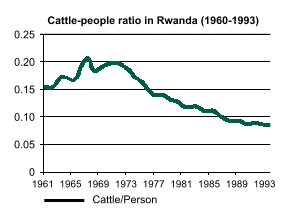
In the 1940's human and animal populations started increasing, and land previously reserved for grazing was converted into cropping lands. For example, from 1948 to 1991, population density in the Gikongoro province increased from 100 people/km2 to 287 people/km2. Farm size became smaller and livestock forage was reduced. Livestock ownership from 1967 to 1993 decreased from 1 in 2 households owning cattle to 1 in 4. These changes resulted in a reduction in nutritional quality and access to food since fewer animal products, pulses or cereals were being produced and people were relying more on tubers. This led to continuous cultivation and increased vulnerability to soil erosion; reduced pastures resulted in fewer animals and less manure; and farmers were forced to try buying manure. Over 40% of survey respondents cited lack of manure as a major reason for declining soil fertility. This combination of poverty, population pressure and resource degradation led to the eruption of one of the worst civil wars in modern times. Livestock provided an important and stabilizing component of the farming system by maintaining soil nutrients. Their increasing absence contributed to the destabilization of a previously balanced system. While it is certainly not clear whether this drama could have been avoided, one might assume from this analysis that improved incentives and technologies for smallholder development, including, for example the introduction of high yielding small ruminants, could have reduced the downward spiral in resource degradation. |
Biodiversity. Increased pressure and intensification of livestock production can cause both positive and negative effects. When livestock are used to reduce dependence on chemical methods to control weeds and insect pests, biodiversity losses are reduced (Box 3.5). On the other hand, excessive grazing pressure on communal areas adjacent to mixed farms has a negative effect, causing losses in biodiversity. There are many documented examples of the effect of livestock grazing on plant and animal biodiversity, especially on open access grazing areas. Overgrazing leads to a change in the composition of plant species. Fewer perennial varieties survive but annuals, of less nutritive value as fodder, become more abundant. This can have a long term negative effect on the value of grazing land and may lead to soil erosion as well as loss of biodiversity. In addition, intensification of production, following increasing population pressure leads, especially in dairy production, to the replacement of local livestock breeds by a small number of exotic breeds. The significant increase in tractorization, especially in Asia, has had the same effect, because the hardy, strong dual purpose traction/dairy breeds have been replaced with specialized dairy breeds (Chapter 5).
| Box 3.5 Livestock and reduced chemical dependence in agriculture. |
|---|
| Rubber production in South East Asia is practised both on plantations and smallholder farms (2 to 4 hectares in size). In both cases, weeds are controlled by spraying. Rubber producers in Malaysia and Indonesia spend approximately US$ 150 million and US$ 38.8 million, respectively, trying to control the weeds which compete with rubber tree growth. Researchers in both countries have found 60 to 70 percent of the weeds that grow under rubber can be used to support profitable sheep enterprises. Sheep provide much-needed cash to rubber producing smallholders. Environmentally, by combining sheep and rubber production, herbicide use is reduced by 18 to 38 percent. Furthermore, by using sheep in this manner, fertilizer costs are also reduced. |
| Source: T. Ismail and C.D. Thai,1990. |
Policies have often limited the beneficial impact of crop-livestock integration and exacerbated its negative environmental effects. These policies have been instigated in some countries by a desire to achieve self-sufficiency, especially in cereals, and in others by the desire to provide cheap food for urban areas. To achieve self-sufficiency, markets were protected and subsidies were provided on inputs such as fertilizer, feed, fuel, etc. in order to increase production. This created disincentives for the use of on-farm products such as crop-residues, animal draught power and manure and contributed to a decline in mixed farming, with subsequent negative effects on the environment. More specifically:
The policy of providing cheap food to urban centres has at the same time discouraged intensification, in some cases to the detriment of agricultural production as a whole and livestock in particular:
Response: Technology and policy options
A fundamental requirement to achieve environmental sustainability of the natural resource base is to accept change and flexibility in the respective production systems and overall landscape (Levin, 1995). Agriculture, and crop agriculture in particular, seeks to stabilize production and limit environmental change thereby reducing the flexibility of the eco-system. But any ecosystem which supports the production of food, can be enhanced by the integration of livestock as a mechanism to promote system flexibility. Mixed farming, with careful attention to the nutrient balance, is therefore probably the most environmentally desirable system, and should be the prime focus of agricultural planners and decision makers. The challenge will be to identify the technologies and policies, which generate the sustained and accelerated growth needed to satisfy the world's booming demand for meat and milk. This challenge will be enormous. Past global growth of the meat and milk output of the mixed system has remained behind the increase in global demand. Will the growth in demand levels continue to rise beyond the capacity of mixed farm systems to meet national demands and therefore result in an immediate transition to highly intensive industrial systems? This study argues that, for environmental reasons, it is important to promote mixed farming in order to satisfy, as far as possible, global demand for meat and milk.
| Box 3.6 Positive effects of population pressure. |
|---|
| The Machakos case. Human pressure and intensification can also work positively. Tiffen et al., (1992) showed clearly that despite a 500 percent population growth over the last 60 years in the semi-arid Machakos district in Kenya, the natural resource base improved. The key factor leading to this success was dynamic market development making farming profitable, generating off-farm employment and supplying the capital for investmens in soil and water conservation. Horticulture and smallholder dairy production are the main activities generating the cash for resource conservation, such as terracing. The famine predicted in the 1930's for the Machakos district never occurred. |
The key enabling factor seems to be access to inputs and attractive markets, as illustrated by the Machakos case study in Kenya. Here, a dynamic market and access to inputs has led to a fully sustainable development of a resource poor area, in which the population had quintupled over the last six decades (Box 3.6). Use of livestock in such intensive situations includes a shift in species from cattle to sheep and/or goats. In such intensive situations, sheep and goats are kept where difficult access to markets and milk processing facilities make keeping cattle a less attractive option (Cleaver and Schreiber 1994). Integrated crop-livestock systems have an immense potential to contribute to the required growth in productivity in the highland areas of Latin America and the semi-arid areas and highlands of sub-Saharan Africa where the population density is already high.
In spite of all the advantages of mixed farming, current trends point to specialization in either crop or livestock production, whereby the rate of change in any particular situation will depend on existing infrastructure, relative price ratios between the different inputs and outputs, and economies of scale. The development path that has been followed in the developed world and east Asia confirms this trend.
Technology. In mixed farming systems, there are exciting opportunities for technological change. Applied research and extension are of critical importance if the environmentally friendly factors of the system are to be maintained, although McIntire et al., (1992) make the point that African farmers are well aware of the technologies involved. The challenge will be to convince farmers about the value of technology. In the nutrient deficient systems of the developing world, the emphasis should be on control of soil erosion and improving nutrient recycling. Some examples are:
Improvement of soil cover through the use of alternative crops for mulching, and introduction soil management techniques such as conservation tillage, bench terracing, strip cropping, contour farming, etc.;
Improvement of feed production and quality to reduce the pressure on grazing areas and improve internal nutrient transfers. Technologies to do so include:
Reduction of nutrient losses from manure and improved efficiency of their application by:
Increased production efficiency, and thereby farm income, resulting in improved purchasing power for soil improvement and conservation methods. They include:
Policy. Clearly, for optimal development of mixed farm systems, a more open market economy is needed. In an open market there should be reduced subsidies for feed, fertilizer and mechanization. Phasing out of subsidies will promote a closer integration of crop and livestock systems in many parts of the world. It will enhance the use of home grown feeds, organic fertilizer and animal traction. To capitalize on free market transitions, better extension, improved financial institutions, security of tenure and, above all, better infrastructure are required.
The greater reliance on market forces needs to be accompanied by policies which seek to provide, for the most densely populated areas, the highest priority for employment generation outside the sector. This can be accompanied by market development for intensive crop and livestock production, such as horticulture and, in livestock, in industrial pig and poultry and possibly small ruminant production. This will enable adequate flows of nutrients in to the system and a rebuilding of environmental sustainability.
For the less critical, but still densely populated areas, markets and infrastructure are still important. For those systems, closer crop-livestock integration will help to reduce eventual nutrient deficits, but markets will always be required to supply external inputs. Technology and market policies should encourage rotations that maintain soil fertility and find synergies between crop and livestock activities.
Next section Mixed farming systems in the developed world: Nutrient surpluses