
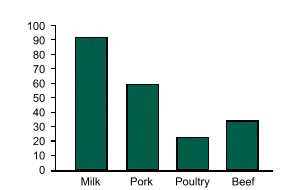
Mixed farming systems, the largest category of livestock system in the world, cover about 2.5 billion hectares of land, of which 1.1 billion hectares are arable rainfed crop land, 0.2 billion hectares are irrigated crop land and 1.2 billion hectares are grassland. Mixed farming systems produce 92% of the world's milk supply, all buffalo meat and approximately 70% of the sheep and goat meat (Figure 3.1). About half of the meat and milk produced in this system is produced in the OECD, Eastern Europe and the CIS, and the remainder comes from the developing world. Over the last decade, meat production from this system grew at a rate of about 2 percent per year and thus remains below global growth in demand.
Environmental challenges
Mixed farming is probably the most benign agricultural production system from an environmental perspective because it is, at least partially, a closed system. The waste products of one enterprise (crop residues), which would otherwise be loaded on to the natural resource base, are used by the other enterprise, which returns its own waste products (manure) back to the first enterprise. Because it provides many opportunities for recycling and organic farming and for a varied, more attractive landscape, mixed farming is the favourite system of many agriculturalists and environmentalists.
| Figure 3.1 Share (%) of global production produced by mixed farms |
|---|
 |
In many situations crop and livestock production is largely in balance with nature. There are important exceptions, such as some mixed farming systems of the tropical highlands of Asia and Central Africa which, partly because of overgrazing, are amongst the most eroded and degraded systems of the world. On the other end of the development spectrum, heavy use of feed and fertilizer in the industrial world and in some of the fast growing economies of East Asia, has led to nutrient loading, habitat destruction and water pollution. In this context, it has to be remembered that integrating crops and livestock neither generates new nutrients (with the exception of nitrogen fixation by leguminous plants) nor reduces nutrient surpluses.
In order to understand the environmental impact of livestock it is important to understand how mixed farming systems evolved. A brief description follows.
The evolution of the mixed farming system
As rural population pressure increases, both crop and livestock farmers need to intensify production. McIntire et al., (1992) show that, as population pressure increases, the two activities often become integrated. Traditional soil protection techniques, in particular the long fallow periods which protected against erosion and allowed soil nutrients to recharge, are no longer possible (Kjekshus, 1977). If farmers cannot resort to external inputs, the integration of livestock and crop activities represents their main opportunity for intensification. Mixed farming has therefore become the basis for modern agriculture. Mixed farming systems provide farmers with an opportunity to diversify risk from single crop production, to use labour more efficiently, to have a source of cash for purchasing farm inputs and to add value to crops or crop by-products. Combining crops and livestock also has the potential to maintain ecosystem function and health and help prevent agricultural systems from becoming too brittle, or over connected, by promoting greater biodiversity, and therefore increased capability to absorb shocks to the natural resource base (Holling, 1995).
Environmentally, mixed farming systems:
Under different sets of pressures and opportunities, several developments are possible, depending on resource endowment and market access. Initially, and if market opportunities open up, the symbiosis between crops and livestock can intensify (Christiaensen et al., 1995 and Box 3.1), and the nutrient balance can be maintained. This chapter's case study (Box 3.6) on the long term evolution of a mixed farming system in the semi-arid regions of Kenya illustrates this development.
| Box 3.1 Population pressure and the evolution of the cassava-livestock system in sub-Saharan Africa. |
|---|
| Population pressure and the evolution of the cassava-livestock system in sub-Saharan Africa. A comparative analysis of cassava-livestock interactions in six countries, covering seven regions in sub-Saharan Africa, clearly shows that as population intensity increases, crop-livestock interactions intensify as organic fertilizer and the use of cassava as a livestock feed gain importance. For example, in the densely populated areas of Nigeria, between 77 and 100 percent of the animals were fed farm-grown cassava, whereas in the sparsely populated areas of Zaire and Tanzania, this varied between 8 and 50 percent. Livestock thus help to conserve a better nutrient balance within the system, and reduce the threat of nutrient loss. |
| Source: Christiaensen et al., 1995. |
If pressure increases further, crop-livestock systems can separate into specialized crop or livestock activities. If there are no improved market opportunities, which is the case in many developing countries, and as human population pressures continue, the arable land part of the system will experience increased rates of nutrient depletion (and therefore flora and fauna biodiversity loss) and soil erosion. This can, in turn, lead to a downward spiral of mono-culture with lower quality food crops, increased under-nutrition and famine (Cleaver and Schreiber, 1994). This development path is illustrated in this chapter's case study on Rwanda in Central Africa (Box 3.4).
However, if urban incomes rise, more market opportunities open up and farmers become more integrated into the market economy, allowing them to specialize, take advantage of economies of scale and develop greater levels of expertise. Finally, under very strong demand, and often encouraged by input or price subsidies such as exist in many developed countries and in the fast growing economies of East Asia, excessive importation of nutrients can lead to soil and water tables being overloaded with nitrogen or phosphorus. The case study on Brittany in France illustrates this condition (Box 3.7).
The challenge for the mixed farm sector will therefore be to maintain a nutrient and energy equilibrium through crop-livestock integration and at the same time allow sustainable productivity growth. The mixed farming system, more than any other production system, operates under a wide range of environmental and economic conditions and requires regional solutions and practices. However, there is one overriding criteria in determining the size and nature of the system's impact on the environment, and this is the nutrient balance. This balance is determined by the nutrients (N, P and K) brought into the farming systems by inorganic fertilizer, feed, nitrogen fixed by leguminous plants and transfer from grazing areas outside the farm, and the amounts exported in animal products or lost from the land to the air or groundwater. A positive balance of nutrients will have a completely different effect (and will require different measures) than a nutrient deficient system. In this analysis, the mixed farming systems are classified either as nutrient deficient systems, which occur mainly in the developing world, or as nutrient surplus systems, mostly found in the industrialized world and increasingly in the fast growing economies of East Asia.
Next section Mixed farming systems in the developing world: Nutrient deficits