
Previous section Grazing systems and tropical rainforests
Grazing systems in temperate zones
| Box 2.10 Does intensification reduce grazing pressure? |
|---|
| Many development projects have been based on the assumption that intensification reduces grazing pressure. However, there is no empirical evidence that this is the case. Social forestry projects in India, for example, promoted stall feeding with improved crossbred cows, but there is no evidence that this decreased the number of traditionally managed animals in the forest. Similarly, stratification of production in, for example, North Africa and the Middle East, has not shown a clear reduction in grazing pressure in the young lamb production areas. It appears that intensified production alone does not reduce grazing pressure, and institutional and incentive changes (such as access to common grazing resources) need also to be changed. |
Grazing systems in the temperate zones cover about 440 million hectares, or 13 percent of the world's pasture lands. They contain about 2 percent of the world's cattle and 10 percent of the small ruminants. They are mainly based on natural permanent pastures, and occur mostly in China, northern USA and South America and the CIS. They contribute about 5 percent of the global beef supply, 12 percent of mutton supply and 3 percent of the global milk supply.
State
Most grazing areas in the temperate zones are in relatively good vegetative condition. They were originally formed by the grazing of wild animals and, because livestock grazing is not fundamentally different, there is no convincing evidence that the change from wild to domestic grazing has, in general, had any long term detrimental effect. Long term stocking trends both in the USA and Australia show an initial high stocking rate in the late 19th century and early 20th century, falling off after a period of about ten years, to a lower level which is then sustained over the following decades. This indicates a fairly stable eco-system. Indeed, independent observers argue that rangelands in the western United States are now in a better ecological condition than at any other time in this century (General Accounting Office, 1988). For example, in 1987 there was half as much “poor” rangeland but double the area of “good” rangeland as in 1964 (USDA, 1988). In this equilibrium environment, there is ample experimental evidence (Blackburn et al., 1982) that there is no difference in erosion and water infiltration between light, moderately grazed and un-grazed areas. In addition, there are some excellent examples of how grazing with domestic stock can improve biodiversity (Box 2.11) and how grazing can reduce fires andpromote seedling establishment by reducing biomass accumulation. Box 2.12 demonstrates how livestock can be used to reduce the amount of petroleum based herbicides.
| Box 2.11 Riparian health, sheep and elk. |
|---|
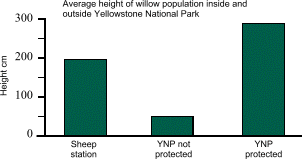
| Riparian health is an important issue driving the monitoring and use of public grazing lands. However, it is often overlooked that any species of wildlife or livestock can overgraze these critical areas. A key example of such a situation exists today in Yellowstone National Park (YNP), the crown jewel of the US park system. It has recently been demonstrated that elk are severely overgrazing riparian areas in YNP. In a study comparing riparian areas in Yellowstone National Park and on the summer range of the US Sheep Experiment Station (approximately 30 miles from YNP) it was shown that grazing of sheep had a more benefical impact on riparian health, as measured by willow populations, a key indicator species. Furthermore, as a result of healthier willow communities on the Sheep Station, beaver populations are also in better condition. This work demonstrates that any grazing animal can cause environmental instability and/or degradation and that by using an appropriate livestock species environmental health can be maintained or increased (Kay and Walker, in press). |
 |
However, there are regions where the vegetative condition of temperate grazing land is less satisfactory, notably in the CIS and Asia, western Europe and the western United States. Grasslands in the CIS are often heavily overgrazed. This is caused by the significant preference given under the previous command economy to industrial, mechanized production, with a strong dependence on feed grains. Meadows and grazing animals did not fit well in such systems and therefore received scant attention. Although incentives have changed, there is still a dearth of appropriate technology to improve pasture lands in the CIS and overgrazing, resulting in increased erosion and reduced water infiltration, is still a common phenomenon. Overgrazing in the temperate, high altitude pastures of Central Asia is particularly severe after the transition to a market economy (Schillhorn van Veen, 1996). Zhong (1993) estimated that, in Mongolia, 40 percent of the country's 65 million hectares is degraded, especially on state farms.
Many grazing areas of western Europe and the eastern USA are over fertilized. The highly subsidized and guaranteed milk price under the Common Agricultural Policy (CAP) of the EU in the seventies and eighties encouraged strong intensification, and this led to very high nitrogen fertilizer use on pastures. For example, in the eighties, the average nitrogen application on grassland in the Netherlands was about 500 Kg N per hectare per year (two-thirds inorganic and one-third organic), whereas the average N outflow in milk and meat did not amount to more than 82 kg N per hectare per year (Steenvoorden, 1989) As a result, these meadow soils are now overloaded with nutrients, especially nitrogen and phosphorus, contaminating ground and surface water.
| Box 2.12 The control of the leafy spurge. |
|---|
| Leafy spurge is an aggressive perennial weed that typifies the impact of noxious weeds. It has now infested about 600,000 hectares in the western USA, greatly reducing the habitat for cattle, bison, and deer. In North Dakota alone it has cost the state US $75,000,000. However, grazing by small ruminants, especially goats, can greatly reduce this pest and improve plant and animal biodiversity, and this is becoming increasingly popular as the sole acceptable control method. |
| Sources: Walker et al., 1994 and Bureau of Land Management, 1994. |
In the western USA, there is currently strong concern about the impact of grazing along the banks of rivers and streams: the riparian areas. Such stream sides, which normally comprise less than 5 percent of the total area, receive often 20-30 percent of the use and therefore water quality (increased nitrates and phosphates), plant biodiversity, and trout yields may be impaired (Sheehy et al., 1996) . It is estimated that more than 50 percent of riparian areas are seriously damaged (Armour et al., 1994). On the other hand, there is ample evidence that nutrient leakage into streams is minimal where streamside pastures remain in good condition (Sheehy, et al., 1996).
Driving forces
Policies continue to drive livestock production into degrading temperate grazing systems:
Response: Technology and policy options
The first priority in reducing the environmental impact of the over-fertilized grazing systems in the EU and USA, and enhancing their environmental condition, is to phase out the current system of milk and meat subsidies. The current shift in EU policies to replace the subsidies on these products by subsidies on farmers' income, and tie this to landscape maintenance, is a very positive development. In addition, much can be done to achieve a better nutrient management. Work in the Netherlands (Box 2.13) shows clearly the possibility of reducing input levels by introducing a ley farming system with more farm grown fodders, careful application techniques and lower nitrogen inputs, without substantial reduction of the output. Experience from Europe and the USA shows that farmer education is a key factor in arriving at better nutrient management. The introduction of a mineral balance at farm level has helped farmers to recognize the excess nitrates and ammonia which are emitted (Aarts, 1996). Experience with farmer study groups in the Netherlands, clearly shows that it is possible to decrease the nutrient loading by 25 to 50 percent with an improved financial result on many farms (Aarts, ibid). Similar results are emerging from the USA, where, under the motto “it is better that we do it now voluntarily, than have it imposed by the Government” , farmers, for example, in the Chesapeake Bay area, are drastically reducing their fertilizer input levels (O'Connell, personal communication).
| Box 2.13 Reducing inputs, without losing production: The “Marke” experience. | |||||||||||||||||||||||||||||||||
|---|---|---|---|---|---|---|---|---|---|---|---|---|---|---|---|---|---|---|---|---|---|---|---|---|---|---|---|---|---|---|---|---|---|
|
The experimental farm “the Marke” located on sandy soils in the eastern part of the Netherlands, aims at testing how, through very careful nutrient management, the emissions in nitrates, ammonia and phosphates can be brought within the future Dutch policy requirements, without reducing output. Below are the results:
This work clearly shows that it is possible, with better information, to reduce inputs to about one-third, with only a 10 percent decrease in output. Key technological inputs are: changes in the farming systems to allow for crops with can use manure more efficiently, much lower N percentage in the feed, and a higher production per cow (with low fat percentage). This case highlights the need, and current move, towards more knowledge intensive agriculture, whereby knowledge replaces physical inputs. |
|||||||||||||||||||||||||||||||||
| Source: Aarts, 1996. |
A greater reliance on market mechanisms, combined with a less restricted use of wildlife, are essential elements in the management of riparian areas in the western USA. Once such land is available to the highest bidder (be it private conservation organizations or livestock ranchers) and exploitation of wildlife is attractive, more land would go into wildlife or combined livestock-wildlife production, and grazing pressure would be more evenly spread. Some regulation of the riparian areas might be necessary and community-based landscape objectives and values (rather than interference by federal agencies and national environmental pressure groups) would probably be more effective.
Research needs. For the Central Asian and Russian grasslands, there is a need to increase research on pasture management. The changed incentive framework fosters the use of farm-grown grass and fodders, but there is a large gap in skills and tradition in applied grassland research. More research is also needed on better land use policies for the temperate summer pastures of the Central Asian highlands.
For the highly intensive grazing systems, further research in nutrient management is clearly essential. Experience in the Netherlands clearly shows the potential for such research. It should be multi-disciplinary and involve the different animal science disciplines (breeding, nutrition and pasture agronomy), environmentalists and socio-economists. It should look critically at input-output management and the relationship between cause and effect.
Regardless of the environmental setting, there is a clear need for better monitoring tools which can effectively document the current status of grazing lands and project possible changes in these lands as weather or usage patterns change.
Next section Conclusion