
Previous section Grazing systems in the semi-arid and sub-humid tropics
Grazing systems and tropical rainforests
Tropical rainforests cover about 750 million hectares, with half of that area located in four countries: Brazil, Zaire, Indonesia and Peru. These rainforests are estimated to contain 50 percent of the world's plant and animal species. For this system, the interaction of livestock production and biodiversity is therefore the main focus in this study although there are also significant effects on land and air quality. Ranch encroachment in tropical rainforest has probably, more than anything else, typified the negative effects of livestock development and, while generally the effects have been negative, even here positive examples exist (Box 2.9).
State
Land. The transformation from tropical forest to crop and pasture land brings about substantial losses of soil fertility and soil erosion. Furthermore, in many tropical rainforest areas, pastures can only be sustained for a short period of up to ten years. Soil nutrients are rapidly depleted after clearing and grasses are soon replaced by less useful vegetation. Natural regeneration of forests is quite difficult, especially in large degraded areas. More than 50 percent of the pasture areas in Amazonia have now been abandoned in a degraded state. For the total area of tropical forest, WRI (1994) estimates that 427 million hectares are degraded, most of it as abandoned pasture or fallow after shifting cultivation.
| Table2.9 Competition and symbiosis between livestock, forests and people in Africa. |
|---|
|
In the eastern area of the Central African Republic, the incursion of Fulani pastoralists with their cattle in the tree parklands of the Zande people leads to:
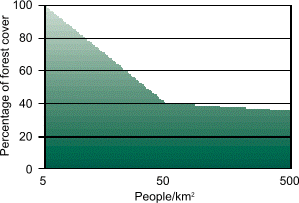
On the other hand, farmers in the Kissidougou area of Guinea developed a symbiotic rainforest-livestock system. Livestock here are used to clear up undergrowth in the forest, which could then be used for fuelwood and shade for the perennial crops. The population density increased over the last two decades from 10 to 60 persons /km2, but here a positive relationship emerged between population density and forest cover. |
| Source: Carrera and Toutain, 1996. |
Plant and animal biodiversity. For the rainforests, data on biodiversity losses are dramatic. Since 1950, about 200 million hectares of tropical forest have been lost, with the result that of some unique plant and animal species, in one of the world's richest sources of biodiversity have become extinct. Forest areas of Central America have declined from 29 to 19 million hectares, since 1950, although, since 1990, the rate of deforestation in this region has fallen. In Central America in the 1980s rainforests disappeared at the rate of 430 thousand hectares per year but this declined to 320 thousand hectares over the period 1990 to 1994. In South America, the deforestation rate in the 1980s was about 750 thousand hectares per year. It is not known, whether this rate has declined over the last years. Table 2.2 gives quantitative information on the rate of degradation, and the current area of remaining tropical rainforest.
Much of the deforested areas in Latin America went into ranching, sometimes after initially being cropped. In Central America, pasture areas have increased from 3.5 million to 9.5 million hectares, and cattle populations have more than doubled, from 4.2 million head in 1950 to 9.6 million in 1992 (Kaimonitz, 1995). In Brazil, about 70 percent of the deforested areas are converted into ranching. In Asia and sub-Saharan Africa, the decline in the forest area is mainly the result of crop expansion and not livestock related.
Driving forces
Land use. Livestock ranching has often been regarded as the driving force behind the deforestation of tropical rainforests. However, there is increasing evidence that livestock ranching in deforested areas is merely the most obvious symptom of a much more complex degradation process with a variety of driving forces. They are detailed below.
Road construction leads to accelerated deforestation, and is possibly the single most important direct cause of deforestation. For example, Ledec (1992) found that in Panama, for each kilometre of an all-weather road, between 400 and 1,000 hectares of forest were cleared. Roadside ranchland was sold in Nicaragua at about three times the price of comparable land one day's walk away (Maldidier, 1993). In Rondonia, Brazil, the paving of an existing road was the main factor in clearing 100,000 km2 of rain forest, and focused, in the early eighties, the world's attention on this relationship (Myers, 1981). Livestock ranching, with little supervision requirement and few bulky inputs became an attractive activity along these new roads.
Arable farming, in the rainforest areas, usually takes the form of “slash and burn” agriculture, especially in the forest areas of sub-Saharan Africa and Asia. Several studies (Bruenig, 1991) describe this as the most important mechanism of deforestation in these areas. Overall the area cropped increased over the last two decades. When population pressure is low (less than 30 people per km2), and the area deforested is relatively small, secondary forest climax vegetation can return, thus limiting longer term soil erosion. If population pressure increases further, a downward spiral of declining soil fertility and crop yields emerges. In Central and South America, the total area under crops has remained stable, but slash and burn cultivation continues at the primary forest frontier, and is compensated by desertion of earlier depleted cropping areas, or their conversion into pasture. This conversion of crop land to pasture is common practice, as many ranchers use a crop of corn to generate income for future ranching.
In Indonesia, transmigration projects (moving people from the over populated areas of Java to the lesser populated outer islands) have often been cited as the principal cause of deforestation. Again, cropping is the first land use and livestock are introduced quite late in the farming system and mainly in environmentally friendly stall feeding systems. Animal agriculture is therefore not one of the leading causes of deforestation. In sub-Saharan Africa, crop production, and especially the expansion of permanent plantation crops, such as oilpalm and rubber, have been major causes of deforestation. Very little tropical rainforest has been converted into ranches on this continent. Forest over-exploitation is also an important factor in deforestation, especially in Asia and Africa, where about 20 percent of the areas are over-exploited. Such over-logged areas are then easily converted into shifting cultivation areas. Logging is not important as a cause of over-exploitation in South America (Sharma et al., 1993).
Relative importance of different pressure factors in deforestation. As in the case of desertification, there have been several quantitative estimates on the individual importance of these factors. However, unlike in the case of desertification, the direct cause is easier to ascertain, making these estimates more relevant. Nevertheless, there are some overlaps, especially as logging is often a precursor for cropping, which in turn often precedes ranching. This means that even in tropical rainforests the cause of environmental damage is hard to apportion. For the record, Table 2.3 provides some estimates. Overall, “slash and burn” agriculture is said to cause 60 percent of the deforestation (Bruening, 1991).
Policy pressures. Probably more than for any other livestock-environment interaction, inappropriate incentives, land tenure and institutional policies have played a major role in deforestation, land degradation and erosion of biodiversity in the humid tropical areas.
| Figure 2.1 Population density and forest coverage in the humid zone. |
|---|
 |
| Source: Unasylva, 1993. |
Inappropriate incentives from governments and international agencies in support of livestock development, played an important role in the destruction of the Latin American rainforests. Especially in the seventies, the livestock sector secured a disproportionate share6 of credit at subsidized rates and with lenient re-imbursement conditions and control. Most of these loans were invested in land or deforestation, and in turn raised land prices even further. However, it appears that the role of subsidized credit is limited. For example, Ledec (1992) showed that only 7 to 10 percent of the deforestation in Panama could be attributed to subsidized credit. A similar picture emerges from Brazil. The large ranches greatly benefited from investment subsidies (up to 75 percent of the investment costs), tax holidays, and subsidized interest rates. However, the large ranches caused only a small part of the deforestation (up to 30 percent in some states, mostly less) and most ranching in Amazonia is in the hands of medium to small size ranchers, who have had less easy access to these subsidies (Hecht et al., 1992).
6 Between 25 and 45 percent of the total agricultural loans, more than double the share of livestock in the sector. This benefited only the bigger ranchers (Kaimonitz, 1995).
| Table2.3 Some estimates of the main causes of deforestation (percent of total deforestation). | |||
|---|---|---|---|
| Region | Crops | Livestock | Forest exploitation |
| South America | 25 | 44 (70 in Brazil) | 10 |
| Asia | 50-60 | Negligible (Philippines & Indonesia to some extent) | 20 |
| Africa | 70 | Negligible | 20 |
| Source: Bruenig, 1991. | |||
Beef exports to the USA, frequently quoted as one of the main causes for ranch development in Latin America (the “hamburger connection” was coined on that premise), were important in Central America in the 1960s and early 1970s, when international beef prices were high (Myers, 1981). But the Amazon area never produced more than 5 percent of the total beef supply of Brazil, and that production was not exported. Furthermore, declining global prices in the eighties, and increased protection in the USA market, especially following NAFTA, have reduced exports from the other Latin American countries. However the fall in prices seems to have had only a limited effect on deforestation. It may have pushed traditional livestock ranches into cropland, but it has not halted expansion in the frontier zones. Ranchers have had very few alternative opportunities.
Regarding land tenure, the key phenomenon was the land grab in rainforests, which occurred as a result of a general increase in land prices in Central and South America over the last decades (Kaimonitz, 1995). “Money laundering, labour remittances and a hedge against inflation” kept prices above the productive value (Shearer et al., 1993). The almost permanent price increase made land a safe investment and led to increased speculation. Finally, recent government settlement programmes and the establishment of internationally funded protected reservation areas, raised prices further. A large part of the expansion of pasture land may therefore have had more to do with land speculation than with cattle raising per se. Deforestation for ranching thus became more a titling strategy than one based on an economic activity (Jones, 1990). Indigenous users and tenure rights, although existing, played practically no role in the protection of the tropical savannas and forests.
Institutional requirements concerning land titling procedures reinforced these trends. Several Latin American countries actually prescribed occupation, and thus deforestation, as a condition for giving out ownership titles. As clearing land for ranching was much easier than establishing proper cropland, ranching became the preferred occupation to fulfill the title requirements. Furthermore, land clearing discouraged squatters. For example, Edelman (1992) reported that practically all 13 squatter invasions that occurred in one particular area of Costa Rica, took place in heavily forested areas, and not in ranching country. Ranchland was psychologically better protected. Finally, some governments even encouraged deforestation for livestock production by colonization schemes.
Response: Technology and policy options
Many causes for ranching encroachment in rainforest areas have disappeared. Subsidized credit for ranching has been phased out almost everywhere and the overall volume of credit to the sector has declined. In addition, some of the more exogenous factors turned against ranch expansion. Meat exports from Central and South America have declined dramatically and world market prices for beef have dropped over the last decade. All these measures reduced investments by large and urban investors in ranching, and brought down the overall rate of deforestation. However, these changed incentives had little effect on the small and medium producer, and deforestation for crops and smallholder ranching continues. A new look at the policy instruments for these farmers is thus required, as additional action is necessary to halt the still on-going conversion of rainforest into ranches. The following measures have been suggested (Kaimonitz, 1995):
Next section Grazing systems in temperate zones