
 PAPER
PAPER
Accepted for the
1998 Waste Management Conference,
Tucson AZ, March
2-6, 1998
Abstract
INTRODUCTION
Many manufacturing operations, equipment uses,
and decontamination operations depend critically on the final cleanliness of
surfaces. These surfaces include, for example, those of mechanical and test
devices, optics, electronic components, scrap equipment, D&D wastes, and the
surfaces of containers.
Surfaces can become contaminated with adsorbed films, particulates, and gases. Soils may be categorized as organics, inorganics, and particulates. Organic soils (films) of concern include oils, greases, and waxes. Inorganic (ionic) contaminants include acid residues (e.g., carboxylates, sulfates, chlorides, bromides, lactates, nitrates, sulfates, fluorides), and base residues (e.g., ammonium, sodium, and potassium hydroxides plus amine and polyamine salts). Particulate matter includes airborne dusts of all types and colloidal silica from degraded deionized water. Gases and airborne materials can also contaminate surfaces.
Substrates of interest include metals, composites, ceramics, optical surfaces, and electronic components including semiconductor wafers. Metals of interest include, for example, aluminum alloys, stainless steel, titanium, copper, uranium, and plutonium.
Chlorofluorocarbon (CFC) and chlorocarbon solvents are excellent for removing a variety of dirt from surfaces. Unfortunately, CFCs and chlorocarbon solvents have deleterious effects on the ozone layer, are greenhouse gases, and have various toxic effects. Due to their ozone depletion potential (ODP), the Montreal Protocol and its amendments, as well as other environmental regulations, have dictated the phaseout of ozone-depleting solvents such as CFC-113 and 1,1,1-trichloroethane [1-4]. Additional environmental regulations have required reduced emissions of volatile organic compounds (VOCs).
Analytical methods for testing cleanliness of parts and determining organic contaminants in wastes have also relied on CFCs and chlorinated solvents [5]. Although alternatives have been recommended, they do not perform as well as the original solvents and some analyses, such as the infrared analysis of extracted hydrocarbons, cannot be performed with the substitute solvents.
CFC-113 solvent has been used for several critical applications in the nuclear weapons complex. The method for cleaning highly enriched uranium (HEU) specifies CFC-113 for washing oils and greases from uranium chips [6]. Plutonium has also been cleaned with CFC and chlorinated solvents. While much ferrous and nonferrous parts cleaning has now been converted to aqueous-based cleaning agents, aqueous-based agents cannot be used for cleaning reactive metals such as uranium and plutonium. Also, electronic components in equipment can be damaged by aqueous-based cleaning agents. CFCs have been used extensively as precision cleaning solvents by nuclear electric power facilities and in laboratory operations and analyses. In 1990, of the 140,000 ft3 of mixed waste generated in the United States, perhaps as much as 10% was CFCs, including 27% of the waste from the nuclear utility industry [7]. Solvents have been identified by EPA as one of the primary areas for waste reduction for nuclear powered electrical generating stations [8].
Several new cleaning solvents and techniques have appeared in response to the phaseout of CFC and chlorocarbon solvents. Various hydrocarbon and oxygenated hydrocarbon solvents have been introduced or their use expanded, but these compounds are flammable and do not clean as effectively. Isopropyl alcohol (IPA) can be used in many cases, but elaborate engineering is needed to minimize the flammability risk. As a result, systems designed for IPA cleaning in non-radioactive operations are expensive (on the order of $100,000). Flammability is a particularly critical safety concern in nuclear operations, causing capital and operating cost increases well in excess of those encountered in non-radioactive operations. Additionally, in IPA cleaning large volumes of IPA are often used as final rinse and dry, generating large volumes of waste. This can be quite expensive in nuclear operations, due to the cost of disposing of radioactive wastes. Hydrofluorocarbons (HFCs) have zero ODP but poor cleaning effectiveness. Supercritical carbon dioxide systems have been introduced, but they require pressurized equipment and are limited in size. Improving surfactants and equipment has expanded applications of water-based cleaning systems, but these systems tend to leave residues and are not suitable for all materials. Plasma cleaning is being developed as a solvent-less process, but it requires sophisticated equipment and is also not suitable for all materials. Some applications of alternative cleaning processes have been cost-effective. However, many alternative solvents and methods are expensive to implement and give incomplete cleaning or leave residues that compromise product quality.
The trend in solvent waste regulations is toward tighter restrictions and higher costs. As a result, the already high costs of monitoring, collecting, and disposing of wastes are likely to continue to rise. Closed-loop systems are becoming more attractive for many uses because they prevent emissions and allow virtually complete recovery of solvent, thus minimizing wastes and allowing cost-effective use of more expensive solvents.
Conventional wet-chemistry surface cleaning processes in use today (such as squirt-bottle rinsing, immersion, spraying, and flushing under a running tap) lack the precision, cleanliness, and parametric control that is so critical for high-performance processing. In addition, current processes may at times expose workers to toxicity and flammability hazards, and may generate large quantities of waste. New solvents and methods of cleaning are needed to eliminate these concerns. At this time no surface cleaning method exists that has excellent cleaning ability, high reproducibility, low environmental impact, zero flammability hazard, low toxic hazard, engineering simplicity, and low cost.
FIC SOLVENTS
ETEC is developing a new class of nationally
and internationally patented solvents, fluoroiodocarbons (FICs), in projects
sponsored by the US Air Force Wright Laboratories MLBT and NASA KSC. The effort
for Wright Laboratories MLBT is developing new environmentally-safe nonaqueous
solvents for removal of engine oils, hydraulic fluid, and perfluorinated grease
in Air Force ground maintenance operations. The effort for NASA is developing
nonaqueous solvents for critical cleaning operations on oxygen and other
aerospace propellant systems.
Fluoroiodocarbons have many of the attractive properties of chlorinated and chlorofluoro solvents, but since they contain one or more atoms of iodine they decompose much more easily in the environment. The main FIC of interest has been shown to photolyze completely in the atmosphere within 2 days, so FIC solvents will not be a long-term atmospheric hazard. However, as long as they are not exposed to significant amounts of UV light, they are quite stable at typical storage and use temperatures.
FICs have low environmental impact. Because of their zero ODP, they are not subject to phaseout under the Montreal Protocol as amended. FICs also have extremely low global warming potential (GWP), which means that they will not be as subject to any use limitations based on GWP.
Toxicity studies have shown that the main FIC of interest in solvents is not mutagenic in the Ames test and not clastogenic in the human lymphocyte chromosome aberration test. 28-day rat subchronic inhalation (6 hrs per day) exposure tests showed no effect from the main FIC of interest at 1,000 ppm exposure, and only small effects (low weight and enlarged livers in the males) even at 10,000 ppm exposure. Beagle dog cardiac sensitization inhalation tests showed a No Observable Adverse Effects Limit (NOAEL) of 0.4% (4,000 ppm), and a Low Observable Adverse Effects Limit (LOAEL) of 0.6% (6,000 ppm).
Although the cost of the FIC solvents is greater, they can be used in closed-loop systems to clean items with less solvent and decreased emissions. The two best cleaning solvents identified in testing have been designated Ikon Solvent P and Ikon Solvent M. An application for approval of Ikon Solvent P has been submitted to the EPA's Significant New Alternatives Policy (SNAP) Program.
COMPATABILITY
FICs are highly compatible with most common
materials of construction. The primary FIC solvent of interest has been tested
for compatibility with a variety of common materials of construction, based on
the methods described in the American Society for Testing and Materials (ASTM)
Standard D471-79 (for polymers) and Method D2251 (for metals).
Polymer types tested were Buna-N� rubber, butyl rubber, ethylene-propylene rubber (EPR), fluorosilicone rubber, neoprene rubber, silicone rubber, PTFE Teflon�, polyurethane, and Viton�. The FIC solvent was not compatible with Buna-N( rubber, silicone rubber, and polyurethane. The failures were of the nature of excessive swelling and weight gain, rather than any dissolution or decomposition of the polymer.
Metals tested were aluminum alloys 2024, 5052, 6061, and 7075T6; stainless steels 303 and 416; titanium; mild steel; cast iron; magnesium; copper; brass; bronze; acid-core solder; plumbing solder; and rosin core solder. The FIC solvent had excellent compatibility with all metals tested except mild steel. The mild steel showed significant oxidation, but the oxidation could be due to air and moisture that were not rigorously excluded. Metals and alloys such as titanium, aluminum, and stainless steel are used extensively in nuclear process equipment, and FIC solvents are compatible with all of these materials. Based on the compatibility test data with other metals, we would expect FIC solvents to be compatible with uranium and plutonium, but this has yet to be tested.
FICs are compatible with other common solvents, water, adsorbents, and plastics at normal temperatures. FICs are not expected to be compatible over long storage periods with strong bases or zero valence alkali metals, and it is suggested they not be exposed to bulk fine metal powders due to possible catalytic decomposition effects. No studies have been conducted on the effects of ionizing radiation on FICs, other than the known effect of UV light in decomposing FICs.
CLEANING ABILITY
One by three inch coupons of substrate
material were intentionally soiled with one of six representative soils:
Braycote� 601 EF (a perfluorinated grease) ; Krytox� 240 AC (a perfluorinated
grease); Amoco Rykon� Grease No. 2EP (a hydrocarbon grease); Dow-Corning DC-55M
(a silicone grease); Royco 782 Superclean Hydraulic Fluid MIL-H-83282 (a
fire-resistant hydraulic fluid containing phosphate esters); and Tribolube� 16.
Soiling levels were from 1.0 to 5.0 g/ft2. Each coupon was carefully
weighed, then cleaned, air dried, and reweighed to determine soil removal
effectiveness.
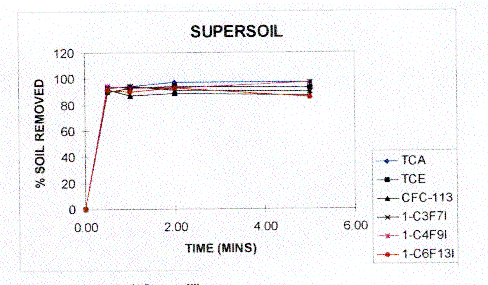
The FIC solvents were found to have excellent cleaning abilities, comparable to and in some cases better than CFC-113. In particular, they remove perfluorinated greases (i.e., Krytox� 240, Braycote� 601 EF, and similar) better than CFC-113, as shown in Figure 1. Figure 2 shows that a supersoil composition made up by combining the soiling agents was removed as effectively by the FIC solvent as by CFC-113.
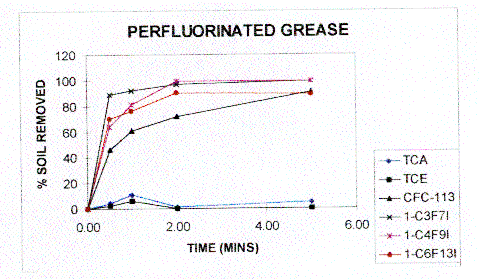
Figure 2. Removal of "Supersoil"
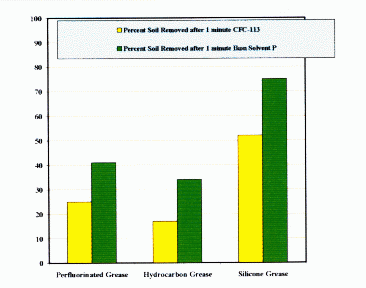
Continued cleaning tests examined the ability of the FIC solvents and CFC-113 to remove a soil when the solvent was already saturated with that soil. Braycote� 601, Rykon� Grease No. 2, and Dow-Corning DC-55M were chosen as representative soils. The results of these tests were even more encouraging than the tests with clean solvents. As shown in Figure 3, Ikon Solvent P consistently removed the three soils from 316 stainless steel significantly faster than CFC-113, indicating superior cleaning ability over extended use applications.
The SPECIAL� system consists of three interconnected subsystems contained in a bench-top nitrogen-purged glove-box-type enclosure. The three subsystems are:
SPECIAL� CLEANING RESULTS WITH FIC SOLVENTS
A custom-made
cleaning cell was fabricated to clean Inconel, stainless steel, and Teflon�
substrates supplied from NASA KSC. Substrate coupons were carefully weighed,
then intentionally soiled with measured amounts of the same six soils used in
the cleaning tests described above. Soil loading levels were from 0.25 to 1.0
g/ft2. The coupons were then cleaned and subsequently examined by
weighing, photomicroscopy, and ESCA. The cleaning period was one minute for
Teflon� coupons, and three minutes for Inconel and stainless steel coupons. The
coupons were dried in dry nitrogen for one minute after cleaning.
Within the experimental error, the FIC solvent displayed cleaning effectiveness equal to that of CFC-113. All coupons cleaned by either solvent had 99.7 - 99.9% soil removal.
CONCLUSIONS
The FIC-based solvents appear to be excellent
replacements for the traditional CFCs and chlorocarbons in solvent cleaning
operations. Although the cost of the FIC solvents is still high, it will
decrease as the production volume increases, and in many applications the cost
of solvent replacement is still much less than the cost of introducing,
documenting, and validating an entirely new cleaning process.
Tests in the first-generation SPECIAL� system showed that Ikon Solvent P is highly effective for cleaning soils from test surfaces, and demonstrated the feasibility of the micro-volume closed-loop system critical cleaning of components. The micro-volume closed-loop system is a perfect compliment to the FIC solvents for critical cleaning applications or applications where solvent emissions cannot be tolerated.
Although FIC solvents have not yet been tested in specific nuclear applications, such as uranium chip cleaning, all available information indicates that they would be highly effective, non-ozone-depleting solvents to replace CFC-113 in these uses. FIC solvents should also be an effective CFC-113 replacement in cleanliness and organic contamination analytical and testing methods related to nuclear parts cleaning and waste analysis operations.
ACKNOWLEDGMENTS
The funding for this work was provided by
the US Air Force Wright Laboratories MLBT and NASA Kennedy Space Center. We
would like to thank Dr. Edward Snyder of Wright Laboratories and Dr. Jamie Palou
of NASA KSC for their valuable technical support during the efforts. We would
also like to acknowledge the contribution of Ms. Kirby Olson, who performed many
of the cleaning tests.
REFERENCES