
Company: Printech
Annual Turnover: IER £32 million in 1996
Sector: Printing (instruction manuals, cartons etc.) and packaging of software for the computer industry
Country: Ireland
No. of employees: 360 full-time
Abstract | Country Overview | Sector Overview | Company Description
Driving Forces | Problem Definition | Implementation | Results | The Future
Printech International is a 360-employee printer, located in Dublin. It supplies multinational computer companies with computer manuals, and has also moved into the area of software-kitting. Printech developed a formal environmental management system mainly as a result of supply-chain pressure, and legislative pressure. The company, which is one of the first print and packaging companies in Western Europe to be certified to ISO 9002, perceived an overlap between quality, health and safety and environmental issues. An environmental committee was set up in 1993. Following on from this an environmental effects register, which formed the first part of Printech's environmental management system procedural structure, was established. The company developed this system to cover all areas of operations. In 1994 it was accredited to BS 7750 and in 1996 was certified to ISO 14001. Printech now has a system of emission control which ensures that its emissions are below the levels set by legislation. Energy costs have been reduced as a direct result of environmental management, and chemicals can now be recycled on-site. The company intends to continue improving its environmental performance, and to use this as a competitive market advantage.
Ireland is one of the smallest countries in the European Union in terms of population. The economy was traditionally based on agriculture. The economic base has changed at a rapid rate, and the tertiary sector is presently the most important sector. Tourism has become one of the most important industries, and the "green" image is used as Irish tourism's main marketing point. Information technology has also become an important sector. The development of the Irish economy in more recent years has benefited from the regional policy of the European Union, Ireland being classified as one of the lesser developed countries in the Union. The economy is highly export-oriented, given the small size of its domestic market. Over the last decade, the number of foreign multinational corporations setting up in Ireland has increased at a rapid rate. These companies, mainly American and Japanese, are attracted by the financial incentives offered by the Irish government, by the availability of a well-educated and relatively cheap labor force, and by access to the European Union market.
The printing sector in Ireland comprises mainly SMEs. There is one large printing company in Ireland with a major international presence, but the printing companies employ on average 200 people. Increasing levels of high technology are used in processing. The rapid increase in the number of computer companies setting up in Ireland over recent years has created a new market for the printing sector.
The company started operating from a small premises in Dublin's city center in 1978, and is now situated in an industrial zone in the suburbs of Dublin. It has become one of the leading players in the supply of printed and electronic media, and in total software packaging for the computer industry in Europe. Its main customers are multinational computer hardware and software companies including IBM, Apple, Dell, Lotus, Microsoft and Claris. The company is 100 per cent owned by DCC, an Irish-based industrial holding company. The DCC Group also has other computer company suppliers among its holdings. Printech has 360 full-time employees, and up to 200 part-time employees. Turnover was IER £32 million (approximately DEM 86 million) in 1996.
Printech utilizes lithographic printing, both sheet-fed and WEB press and was the first printer in Ireland to develop the computer manual niche. In addition, Printech also has a software-kitting (packaging) division. This includes sourcing materials for customers, e.g. packaging diskettes, and preparing the kits which are then sold in computer outlets. Approximately 95 per cent of Printech's products are indirectly exported. In 1993, the company opened an additional software-kitting plant in East Kilbride, Scotland, and in 1994 a small print-on-demand facility was established in Rotterdam.
In 1988 Printech became one of the first printing companies in Europe to be certified to the ISO 9002 Quality Management System Standard Specification. In 1994 it was awarded the Green Dove Award for its Environmental Management System (EMS). This was the precursor to the BS 7750 to which Printech was certified in 1994. In 1996 Printech's Environmental Management System was certified to ISO 14001.
Environmental concerns
For a number of years preceding the introduction of a formal EMS, there was a genuine concern within Printech about its various environmental impacts. Some typical examples of printing industry impacts are:
Legal obligations
Over recent years, there have been considerable changes in European Union (EU) environmental legislation. Printech wanted to address its legal obligations, such as compliance with effluent discharge license parameters, or local authority planning requirements. Integrated Pollution Control licensing, for instance, will eventually oblige most EU industries to comply with stricter industry guidelines on pollution control, with the threat of heavy financial penalties resulting from non-compliance.
Customer pressure
Printech's customer base, mainly multinational, US-based, computer hardware and software manufacturers, is renowned for being stringent with their suppliers in complying with standards of quality, reliability, and more recently, environmental regulations. For example, it was these multi-national companies who first required suppliers to have quality certification, such as ISO 9000. In 1992 the Borland software company, one of Printech's major customers at the time, sent a questionnaire to Printech regarding its environmental activities. Other customers, mainly large North American computer companies, began to make similar requests regarding Printech's environmental performance. At the time there was no system for communicating this information, and it took one month to research the answers and one week to process the information. Printech saw that they needed to be able to reassure their customers that they were minimizing the environmental impact of their activities.
Initial awareness-creation and training
In 1992 Printech representatives participated in the Environmental Business Management (EBM) Training Programme developed by the Irish Productivity Centre (IPC), the Irish affiliate of INEM. Printech had established close contacts with the IPC before 1992. Discussions with IPC representatives led Printech's production manager, John Harris, to seriously consider the importance of environmental issues for the company's future. With this commitment from the top, the company decided to participate in the EBM Training Programme. The three stages of the training program were: an awareness-creating module; an audit to allow the company to assess their status quo and their objectives with regard to EBM; and an action stage which involved the development of a plan of the steps which needed to be undertaken. The program outlined the advantages of operating an environmental management system based on a formal specification, such as ISO 14001. Printech's participants in the program recognized that this approach offered a framework within which the desired controls could be achieved.
The main areas which Printech had to deal with in implementing environmental management are as follows:
Commitment from the top
In spring 1993, environmental performance and improvement assumed priority at board level. The board decided that a formal environmental team should be appointed. Support and encouragement for the team from top management was essential. Their commitment was communicated regularly, through in-house publications, presentations and ceremonies, specially devised to give the environmental campaign an impetus and a high profile throughout the company.
The board was aware that much time and effort would need to be put in by company personnel, together with a certain amount of capital expenditure, if certification to an EMS standard was to be secured. While the question of a payback period was always given serious consideration, the consequences of non-compliance with current and pending legislation, possibly resulting in heavy fines, were also taken into account by the board.
PERSONNEL ORGANIZATION
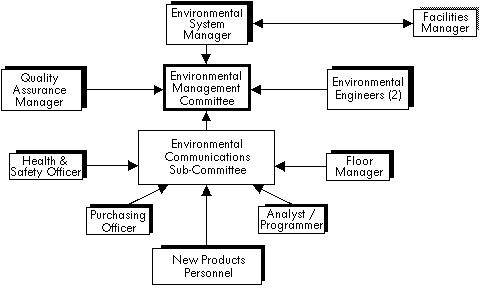
Environment committee
A committee was appointed by the board of directors, consisting of nine members. Their task was to set up an environmental management system. The committee is the internal driver of initiatives and consists of two groups; one which links with quality assurance, engineering, systems and facilities departments; and one which deals with internal communication.
ENVIRONMENTAL MANAGEMENT COMMITTEE
Printech found involving a cross section of personnel from different areas of the plant to be very beneficial to the development of the environmental program, as each member brought their own special expertise to the table. The company deliberately did not create an environmental department, as it had seen in other companies how this can lead to environmental issues being sidelined and categorized. The committee works hard to encourage environmental improvements and as its members are representative of the different departments in the company it can rely on company-wide co-operation.
Key Staff
The development and implementation of any management system requires the participation and co-operation of people in key positions in a company. It was agreed that the position of Environmental Manager should be taken on by the Facilities Manager, as he would have hands-on knowledge of those aspects of the plant with the greatest environmental impact. The rest of the environmental team was carefully chosen on the basis of their position, skills, knowledge, enthusiasm, and influence.
Another priority at that time was the appointment of a suitably qualified person whose time would be dedicated solely to the achievement of certification to BS 7750. It was felt that someone with a background in production engineering would have the necessary skills, and subsequently, one of two production engineers on the team, was appointed as full-time environmental engineer and given the task of interpreting the requirements of the standard and developing the documented system. This engineer is still involved in the day-to-day running of the system and its on-going development.
Employee motivation
The group of the Environmental Committee dealing with internal communications, focuses on educating employees about the environmental effects of their daily jobs, and letting them know what is happening in the company as a whole. The following are examples of initiatives undertaken.
Documented System
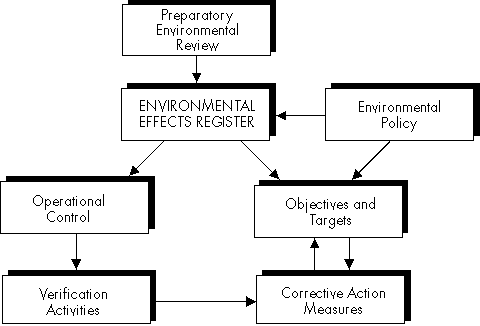
At the core of any management system is a documented structure and a set of procedures which detail how the system is run and verify that it is working correctly, and indeed, what should be done if it is not. Printech developed its documented system so that if someone walked in off the street and studied the documentation, they could understand its aim, process and, of course, its effectiveness. In other words simplicity and clarity are essential. Printech has developed two sets of documents, together with six sub sections, or "Annexes". The sequence in which Printech set up its EMS documentation is described below. The sequence in which this work is done is an important point to note.
ENVIRONMENTAL MANAGEMENT INFORMATION FLOW CHART
Preparatory Environmental Review (PER)
This was the starting point of Printech's EMS. It provided a snapshot of where the company stood once a decision had been made to implement an EMS. It involved studying all aspects of the company and how it affects the environment. The PER is a document detailing the environmental performance of the company prior to any benefits of an EMS being put in place.
Environmental Policy Statement
Once the PER was documented Printech had a much better idea of where it stood in relation to environmental issues. At this stage an environmental policy statement was drafted. This represents for Printech a pledge on behalf of top management to strive to continuously improve its environmental performance. Printech's environmental policy is signed by its joint managing directors and the single page document is prominently displayed and distributed widely in the company.
Environmental Manual
Printech's environmental manual is derived specifically from the ISO 14001 specification. It is structured according to the same principles which they used when designing their Quality Management System. Essentially this is the "road map" used to operate, or indeed change, any area of its EMS. It defines the management structure of the EMS, the responsibilities and the level of accountability of each individual.
Register of Legislative Requirements
This document details all of the legislation to which Printech may be obliged to comply with in the course of its operations. Examples are legislation on disposal of toxic or dangerous wastes, emissions to atmosphere, etc. The Printech employees who were given this task found it a daunting one as they were not legal experts. External professional advice on the matter was initially sought. However over the few years of development of the EMS at Printech, many software packages have arrived on the market, listing all the legislation which would typically apply to a particular sector, making this task a lot easier today.
Register of Environmental Aspects
The register of environmental aspects is a detailed listing of all of the company's activities which have an impact, actual or potential, on the environment. The areas covered include; emissions, energy consumption, and materials used. The extent of each effect is specified as accurately as possible. Where possible, quantitative data are provided, and the significance of the effect is assessed. The initial register was derived from the PER. The difference between the two is that the PER is a historical document which details a company's activities at a particular period in time, whereas the register of aspects is a "live" document which is regularly updated, and so, changes with time.
Procedures Manual
Once the register of legislative requirements and the register of environmental aspects have been produced, Printech began to consider how it could reduce its environmental impacts. With the knowledge gained through those two documents, and in order of priority, Printech began to put controls in place to minimize these effects. This was done by informing personnel, through clearly written procedures, about the precise way in which certain activities should be carried out, and about the documentation for recording the event. In some cases other management systems, e.g. quality, in Printech have been adjusted to take account of the requirements of the EMS. In this case the item is referenced in the environmental manual, for example:
| Management system relevant section: |
|
| Health and Safety | Emergency response plan |
| Quality assurance | Calibration |
| Maintenance | Planned maintenance, repairs |
Management Program
The environment committee systematically refers to the register of environmental aspects, identifies the most damaging effects and sets up a program to eliminate or reduce this effect. These are described as objectives and targets, of which Printech normally has up to eight open at any one time. Typical examples would be, cleaning up waste streams, or reducing energy usage or waste output. Once an objective is reached, the committee returns to the register and decides upon the next objective. In this way Printech is able to satisfy the ensure continuous improvement.
Energy
In 1994, a formal energy efficiency program was launched. The program consisted of campaign messages to employees on energy conservation, and installation of automatic lighting and dust separation systems, the latter allowing waste heat to be returned into the factory.
OTHER INITIATIVES
Computer to plate process
State-of-the-art technology is now used in the printing process, This process is the computer to plate process allows Printech to take electronic files from any platform (Mac, PC, Unix etc.) and have superb printing quality printing plates on their presses in a matter of hours. As the film output and planning/stripping stages are by-passed, considerable cost-savings are generated and the entire process is environmentally-friendly. It has led to elimination of the use of photographic films and hazardous chemicals associated with developing film. In addition the system can yield up to twenty printing plates per hour. Not only is the printed image sharper and better defined than conventional plates but savings of up to 35 per cent of valuable lead time are achieved.
Waste management
A system has been put in place, where waste paper is sorted and the majority is recycled. Printing plates are recycled for scrap metal and chemicals can now be recycled on-site.
Customer guidelines
Printech has developed five main guidelines which it provides to existing or prospective customers:
Printech has found it difficult to quantify and evaluate the costs and benefits associated with their EMS. Following the establishment of its EMS, the company was able to identify and solve a wide range of environmental problems. The main benefit to Printech is that it is aware and sometimes even ahead of planned legislation and has the controls in place to ensure compliance with environmental legislation. Printech's EMS recognizes and addresses the aspects of its operations requiring environmental control, and plans well in advance, so that compliance becomes more or less automatic.
Other results are:
The publicity which Printech's EMS has received has also been a great bonus for the company. It is regularly featured as a case study company demonstrating best environmental practice in the printing sector in various journals, publications, seminars and conferences. In October 1997, Printech showed its continuing commitment to dialogue and experience exchange, when it participated in the ECO-Baltic 2 conference, Gdansk, PoLAND and presented its experiences to companies and associations from around the Baltic Sea region.
Plans are being developed to implement environmental management at the plant in Scotland. Printech's overall objective is to maintain and enhance its position as one of Europe's most environmentally responsive print and packaging firms through a process of continuous improvement.
 This case study was developed in cooperation with the Irish Productivity Centre (IPC) for inclusion in the INEM Casebook, Case Studies in Environmental Management in Small and Medium-Sized Enterprises, the publication of which was made possible through the financial support of the German Agency for Technical Cooperation (GTZ).
IPC has developed a modular, three-part training programme in environmental business management aimed specifically at small and medium-sized enterprises (SMEs). An accompanying video introduces SMEs managers to environmental management concepts and the IPC training programme.
For more information email Mr. Norbert Gallagher, Head of Unit, Environmental Business Partnership, Irish Productivity Centre (IPC) at ipc@indigo.ie.
Contact INEM ( info@inem.org )
Page last updated 9 April 1997
Copyright © 1997 International Network for Environmental Management