| Overview: |
Typical lubricating oils that are amenable to on-site recycling include oils generated from fluid changeouts of internal combustion engines in tactical service (MIL-L-2104) and in administrative service (MIL-L-46152), steam turbine and gear oil (MIL-L-17331), marine diesel service (MIL-L-9000), petroleum-based 90W and 140W gear lube oil (MIL-L-2105), and vacuum and compressor oils.
On-site recycling of used lubricating oils is typically limited to energy recovery such as diesel fuel supplementation and burning as a boiler fuel supplement. Based upon a study performed at Red River Army Depot in 1993, oil could not be successfully reconditioned on site for reuse due to heavy metal contamination. In addition, re-additizing of treated oils by on-site processors is generally not recommended.
Diesel Fuel Supplementation
The criteria that must be used in electing on-site recycling options involves the volume of used lubricating oil generated annually. Diesel fuel on-site use includes the volume of diesel fuel used (40,000 gal/yr is required to burn 2,000 gallons of used diesel lubricating oil at a 5 percent mixture ratio), volume of diesel lubricating oil generated, diesel engine warranty, and activity policy.
Boiler Fuel
Used lubricating oils from internal combustion engines, steam turbine and gear oil, petroleum-based gear lube oil, and mechanical pump oils can be dewatered and filtered for use as a supplement to No. 6 burner fuel or used to fuel dedicated waste oil burners. To burn these used oils in a boiler, may require a permit from the state that defines the source of the fuel. The boiler must be of a special design to burn used oil and must meet federal containment limits. Technically, the Navy can burn used lubricating oil, but in practice it is not done.
Burning used lube oil as a supplement to No. 6 fuel oil will increase boiler maintenance costs. Although burning used oil as a burner fuel supplement is cost-effective, if the blend of No. 6 oil with used lube oil exceeds 50 percent, the maintenance costs will increase.
When considering burning used oil in boilers at military installations, users should coordinate with the installation Civil Engineer, Public Works officer or equivalent authority. Acceptable oil types (e.g., synthetic, petroleum-based, etc.) air emission concerns, and regulatory permit requirements should be determined. Also, users should consider the regulatory requirements of Title 40 Code of Federal Regulations (CFR) Part 279, Subpart G, "Standards for Used Oil Burners Who Burn Off-Specification Used Oil for Energy Recovery". These requirements impose restrictions on burning and specify procedures for notification, rebuttable presumption, storage, tracking, and notices.
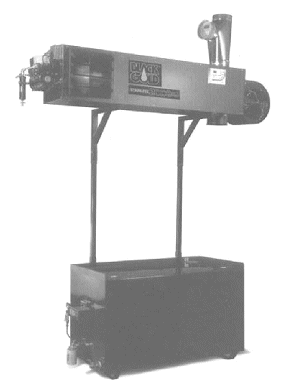
Vendors, such as Black Gold, manufacture dedicated waste oil burners that are designed to burn high carbon content waste crankcase oils, lubricating oils, automatic transmission fluids, and No. 2 heating oils. Black Gold offers turnkey systems that include everything but the fuel.
|
| Compliance Benefit: |
Recycling of used oil may allow the used
oil to fall under the less stringent regulations of 40 CFR 279 as opposed to the
hazardous waste regulations in 40 CFR 260 through 268. In addition, under 40
CFR 261.5 generators who recycle their used oil and manage it under 40 CFR 279
do not have to count the used oil in their monthly totals of hazardous waste generated.
The decrease in the quantity of hazardous waste generated monthly may help a facility reduce
their generator status and lessen the degree of regulatory requirements (i.e., recordkeeping,
reporting, inspections, transportation, accumulation time, emergency prevention and preparedness,
emergency response) applicable with under RCRA, 40 CFR 262. Recycling also helps facilities
meet the requirements of waste reduction under RCRA, 40 CFR 262; the Pollution Prevention Act
(42 USC 13101-13109); and Executive Order (EO) 13148, Greening the Government Through
Leadership in Environmental Management. Recycling used oil on site generally requires a
facility to store large quantities of used oil. Development and implementation of a Spill,
Prevention, Control and Countermeasure Plan is required under 40 CFR 112 for facilities
that store certain amounts of oil on site. In addition, the burning of used oil on site may
require an air permit under 40 CFR 70 and 71.
The compliance benefits listed here are only meant to be used as general guidelines and are
not meant to be strictly interpreted. Actual compliance benefits will vary depending on the factors
involved, e.g., the amount of workload involved.
|
| Materials Compatibility: |
The six types of lubricating oil listed (L-2104, L-17331, L-46152, L-9000, and L-2105) can and should be combined for efficiency and economy of collection. Do not mix or blend low-flash hydrocarbons with used lubricating oil. It is permissible to collect hydraulic oils (H-5605 and H-17672B) with lubricating oils provided neither are being recycled for their original use, and provided they are not contaminated with halogens.
These oils should be accumulated by the generator in clean, well-labeled, and color-coded drums. (Drums should be labeled with the words "Used Oil.") When the drum is full, the generator should complete a standard 1348-1 manifest form and request Public Works or another appropriate activity to transfer the drum to the central storage facility.
When storing used lubricating and gear oils for on-site energy recovery, users should consider the requirements of 40 CFR 279.22, "Used oil storage," which include storing used oil only in tanks, containers, or units subject to regulation under 40 CFR 264 or 265. Storage should be achieved in clean 55-gallon labeled drums, bowsers, buffaloes, above-ground tanks, or railroad tank cars. If drums are used, they should be covered so that water does not collect on top of the drum and possibly contaminate the contents. Storage containers should be placed in an area that is bermed or diked to contain spills and prevent them from reaching groundwater.
|
| Safety and Health: |
Care should be taken when handling lubricating oils.
Proper personal protective equipment is recommended. Safety precautions should be exercised when handling synthetic
aircraft oils containing tricresyl phosphate, which is toxic by ingestion and skin adsorption.
Consult your local industrial health specialist, your local health and safety personnel, and the appropriate MSDS prior to implementing this technology.
|
| Benefits: |
Potential benefits of on-site energy recovery of used oil are as follows:
- Reduced waste oil disposal.
- Reduced diesel fuel and fuel oil purchases.
|
| Disadvantages: |
- Activities that are not users of diesel fuel or No. 6 burner fuel may not realize an economic benefit.
|
| Economic Analysis: |
Diesel Fuel Supplement
Racor Industries, Inc., Modesto, California, provides a unit designed specifically for processing used lube oil for use as a diesel fuel supplement. If permanently installed, it is generally used in conjunction with a fuel reservoir or tank. It automatically blends used crankcase oil with diesel fuel. It also filters, recycles, and transfers diesel fuel and has its own waste oil holding tank and oil injection system.
The basic equipment costs of recycling used lubricating oil as a diesel fuel supplement are $8,500 to $10,000, and the total capital investment ranges from $57,000 to $80,000. These costs assume that a storage tank for the diesel fuel exists. The total capital investment includes installation materials and labor, training, and start-up materials costs. Payback period of these initial investment costs can be achieved in less than the estimated 10-year life of the equipment.
A brief summary of the costs of recycling used lube oil as a diesel fuel supplement follows:
|
Annual volume of used lube oil, gal: |
2,000 |
|
Annual volume of diesel fuel required to meet the 1:20 dilution factor, gal: |
40,000 |
|
Estimated value of diesel fuel per gallon: |
$1.00 |
|
Standard or basic equipment costs: |
$8,500 |
|
Total capital investment costs: |
$57,000 |
|
Savings Investment Ratio (SIR): |
1.543 |
|
Net Uniform Annual Savings (NUAS): |
$5,022 |
|
Investment payback period, years: |
5.3 |
Waste Oil Burners
Material and installation costs for a 200,000 BTU/Hr. (1.4 gallons per hour of waste fuel) waste oil burner is estimated to be $9,500. The waste oil burner will require a 2,000-gallon, above-ground tank to store the waste oil, at an estimated cost of $8,000. Total installed cost allowing for training and SPCC preparation (update) is estimated to be $18,700. Assuming a status quo disposal cost of $0.75 per gallon for oil, the payback period is approximately 3.5 year.
A brief summary of the costs of recycling used lube oil as a diesel fuel supplement follows:
|
Volume of used lube oil to be consumed (6,050 gallons in 6 months at 24 hours/day): |
1.4 gal/hr |
|
Waste oil furnace and vent installed: |
$9,500 |
|
2,000 gallon storage tank installed: |
$8,000 |
|
Training and SPCC preparation: |
$1,200 |
|
Energy value of waste oil (per year) (7,600 Therms/year): |
$3,200 |
|
Waste oil disposal cost (status quo): |
$0.75/gal |
|
Increased labor for waste oil handling: |
$975/yr |
|
Payback period: |
3.5 years |
Click Here to view an Active Spreadsheet for
this Economic Analysis and Enter Your Own Values. To return from the Active Spreadsheet,
click the Back arrow in the Tool Bar.
|