|
Edmond C.Akubuiro* and Norman J.Wagner
Calgon Carbon Corporation, P.O. Box
717, Pittsburgh, Pennsylvania 15230-0717
Activated carbon adsorption technology is an
important industrial process used in solvent recovery and air pollution
abatement systems. The safe use of activated carbon requires an
understanding of the conditions that might promote carbon bed exotherms. A
test method has been developed which evaluates the relative oxidative
activity characteristics of carbons containing organic molecules and their
relative potentials for resulting in carbon bed exotherms. Results indicate
that the degree of oxidizability of adsorbed organic molecule plays an
important role. However, various carbons exhibited different levels of
oxidative behavior toward adsorbed oxidizable organic solvents. The solvent
reaction initiation temperature for methyl ethyl ketone oxidation on the
carbons investigated ranged from 329 to 383 K. Observed reaction enthalpies
indicated a difference of more than a factor of 5 between the least reactive
and most reactive carbons. This test method predicts trends in carbon and
solvent reactivities similar to those determined from column studies
reported in the literature.
Introduction
Activated carbon technology is widely
employed in solvent recovery and air pollution abatement systems. Activated
carbon beds containing organic molecules sometimes come into contact with
air or oxygen, in some cases, as a consequence of their normal operations. A
number of investigators (Miller et al., 1987; Chapman and Field, 1979) have
reported exothermic runaway reactions under these conditions. In almost all
cases, oxidizable organic solvents such as ketones, aldehydes, and the like
were present, to some extent, during the thermal runaway processes (Naujokas,
1979, 1985). Concern for carbon bed combustion has led to numerous studies
reported in the literature. These investigators (Miller et al., 1987;
Chapman and Field, 1979; Naujokas, 1979, 1985; Takeuchi et al., 1990;
Mathewes, 1986; Wildman, 1988; Cameron and MacDowall, 1972; Bowes and
Cameron, 1971; Johnson and Woods, 1971; Boiston, 1968; Hardman and Street,
1980; Hardman et al., 1980) have studied the problems associated with carbon
bed exotherm, employing various conditions conducive to simulation of this
process. However, the test procedures employed in most of the cited studies
generally require elaborate equipment and/or long durations.
This study reports the development of a
comparatively simple and rapid test procedure for assessment of the relative
oxidative activity characteristics of activated carbons containing organic
solvents. It also compares observed results to those of literature reports
on column studies (Naujokas, 1979, 1985).
Experimental Section
System Description and Calibration.
All experiments were performed on a Du Pont Model 1090 thermal analysis
system fitted with Model 910 DSC and Model 951 TGA accessory modules. The
DSC (differential scanning calorimeter) measures heat flow into or out of a
sample, while the TGA (thermogravimetric analyzer) measures sample weight
changes. The DSC cell was calibrated using an indium standard. Indium
samples of 15-18 mg were typically used. The fusion endotherm was recorded
usually after one initial "conditioning" heat-cooled cycle through
the transition (up to 533 K) which allowed for good thermal contact between
the pan and the indium sample. Adipic acid was also employed as a DSC
calibration standard. Fusion temperatures (Tf) and heat of fusion
(∆Hf) were calculated using a Du Pont DSC interactive analysis
program. The DSC system amplifier and recorder were wired so that exothermic
peaks are displayed upward and endothermic peaks displayed downward. The TGA
system was calibrated using high-purity tin, zinc, or silver wires
(depending on temperature range of interest) and calcium oxalate. All
calibration experiments were conducted in a nitrogen atmosphere. Nitrogen
flow rates and heating rates for calibration experiments were the same as
listed in Table I.
|
Table I. DSC and
TGA Experimental
Parameters
|
Gas type
Gas flow rate
Initial temperature
Heating rate
Final temperature
Hold temperature
Sample sizea
Sample particle size
Sample organic loading |
N2, O2,
or air
100 mL/min
293 K
17 K/min
723 K
none
7-15 mg
50 x 200 mesh (0.297 x 0.074 mm)
30 wt % (mass ratio) |
a7 mg for DSC (based on
solvent-free carbon; 10-15 mg for TGA.
Materials. The characteristics of
activated carbons investigated are listed in Table II. The solvents (>99%
purity) investigated were employed with no further pretreatment. Also,
oxygen (99.6%), nitrogen (99.99%), and air (zero grade) were used as
received from the supplier with no further treatment.
Sample Preparation and Test Procedure. All
activated carbons were crushed, sized to 50 x 200 mesh, and dried overnight
(approximately 18 h) at 378 K. Enough of the dried carbon (usually 1g) was
loaded with 30 wt % (mass ratio) of organic solvent of interest, by
thoroughly mixing the carbon and the solvent in a tightly capped vial and
allowing to equilibrate overnight (about 18 h) before evaluation. (Although
solvent laden samples were allowed to equilibrate overnight for this study,
2-3 h is usually sufficient). Samples were weighed after equilibration to
determine equilibrium loading. Minimum exposure of solvent-loaded carbons to
ambient conditions was adopted to avoid excessive devolatilization of the
solvent prior to reactivity tests, since the carbons were loaded to, or
close to saturation. All reactivity tests on any particular carbon were
completed in less than 36 h from time of solvent adsorption. The DSC and TGA
experimental parameters employed to evaluate reactivity are listed in Table
I. For DSC experiments, samples on both the reference and the sample sides
were counterbalanced, compensating for the weight of solvent on carbon.
Where organic loading was less than 30 wt % (mass ratio) due to low carbon
adsorption capacity, DSC sample sizes were adjusted to maintain the same
amount of adsorbate as in the case of 30 wt % loading. This typically
amounted to 2.1 mg of adsorbed solvent per DSC sample. However, in studying
the effects of solvent concentration levels and size of solvent-laden carbon
on oxidation stability of carbon-solvent systems, the amounts of adsorbed
solvent per DSC sample were varied accordingly. All DSC experiments were
conducted with loosely covered aluminum plans. For TGA experiments, usually
10-15 mg of adsorbate-loaded carbon was employed to yield about 1-3 carbon
particle layer(s) in the pan. Sample sizes for all carbons were kept fairly
constant.
DSC experimental steps employed (using
parameters in Table I) to determine oxidative activity characteristics of a
particular carbon-solvent system are as follows:
- Empty, but loosely covered pans were
placed on both reference and sample sides of the DSC cell module and
taken through the temperature ramp in a nitrogen flow to establish
instrument baseline stability.
- The instrument was then calibrated for
temperature and cell constant.
- A test was conducted in a nitrogen
atmosphere using virgin carbon of identical weight (7 mg) and particle
size on both reference and sample sides in order to establish carbon
baseline.
- Subsequently, an experiment was conducted
in N2 atmosphere by placing virgin carbon (7 mg) on the
reference side and solvent-loaded carbon (9.1 mg) on the sample side.
(Weight of solvent-loaded carbon was adjusted to accommodate the solvent
weight.)
- A carbon baseline in oxygen was obtained
by conducting an experiment in pure oxygen using virgin carbon of
identical weight on both reference and sample sides.
- Subsequently, an experiment was carried
out in pure oxygen using virgin carbon on the reference side and
solvent-loaded carbon on the sample side (adjusting for weight of
solvent).
Enthalpy changes of the system were
monitored. Steps 1 and 2 were carried out only once at the beginning of the
study. Repeats were necessary only after several DSC experiments or
instrument-prolonged idle times. Weight changes associated with
carbon-solvent systems were monitored using a TGA. These were used to verify
the DSC results.
Table II. Activated Carbon
Characteristics.
| Type |
Supplier |
Precursor
Materiala |
Form |
U.S. mesh
size |
AD,b
kg/m³ |
965
JXC
A-7e
CP-IVA
BPL
PCB
Sorbornorit B3
Sorbornorit B4
Shirasagi S |
Witco
Calgon Carbon
Norit
Takeda |
PASC
PASC
coal
coal
coal
CS
peat
peat
CS |
granular
pellet
pellet
pellet
granular
granular
pellet
pellet
pellet |
12 x 30
4 x 6
4 x 6
4 x 6
4 x 6
4 x 6
4 x 10
4 x 6
4 x 6 |
440
428
453
439
507
465
465
436
398 |
aPASC = petroleum acid sludge
coke; CS = coconut shell. bAD = apparent density (weight of
carbon by unit volume). cA-7 is an experimental low-reactivity
carbon produced by Calgon Carbon Corp.
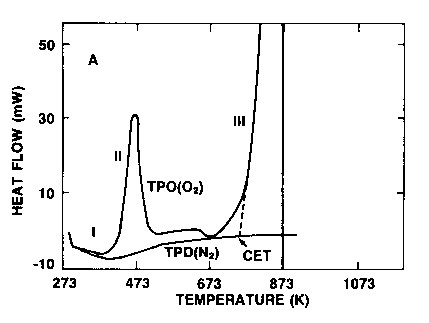
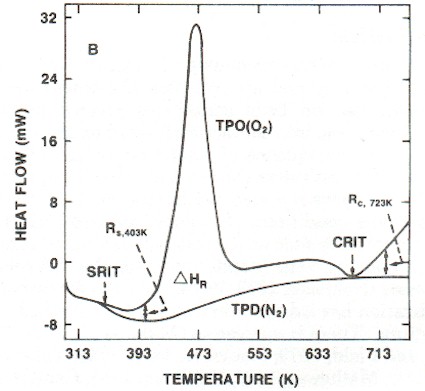
Figure 1. Oxidative behavior of
carbon-solvent (BPL-MEK) system showing (A) regions of activity and (B)
reactivity parameters.
Results and Discussion
Criteria for Determination of Oxidation
Stabilities of Carbon-Solvent Systems. The reactivities of
carbon-solvent systems were determined by temperature programmed oxidation (TPO)
and temperature programmed desorption (TPD) techniques (see Figure 1).
Activated carbons containing oxidizable organic solvents generally showed
three regions of activity as a function of temperature in the presence of
air/oxygen. The sequence of activity consisted of desorption of adsorbate
(region I), oxidation of adsorbate (and desorption of adsorbate and
oxidation products) (region II), and oxidation of carbon skeleton (region
III).
The test conditions chosen were such that the
oxidation reactions were chemically controlled. Minor diffusional
resistances were noted during severe oxidation reactions involving highly
reactive carbon-solvent systems.
The oxidative activity characteristics of a
carbon-solvent system were determined using the following parameters from
DSC data (see Figures 1 and 2):
A. Solvent reaction (oxidation)
initiation temperature (SRIT). This is the temperature of first deviation
from a temperature programmed oxidation (TPO) profile (DSC step 6) and a
temperature programmed desorption (TPD) profile (DSC step 4) when
superimposed. It gives an indication of the temperature at which any
recognizable oxidation of the adsorbate inititates on a particular adsorbent
carbon. This is essential in prevention of hot-spot generation in carbon bed
under stagnant conditions.
B. Apparent (effective) heat of reaction.
This is the area under the TPO and TPD profiles to 723K: total apparent
(effective) heat generated by the system [(∆HR)tot];
total apparent (effective) heat generated expressed per mole of solvent
adsorbed [(∆HR)]. These
parameters give a measure of the extent of oxidation reaction primarily due
to the adsorbate on carbon. The importance of these parameters lies in the
fact that they give an indication of the relative amounts of heat that need
to be dissipated from the carbon-solvent system if solvent oxidation
occurs. Large amounts of heat are less easily dissipated and more easily
propagated into bed combustion. Thus, greater precautionary or preventive
measures should be exercised when such carbon-solvent systems are in use, in
order to prevent bed exotherm.
C. Oxidation (heat production) rate of
adsorbed solvent (Rs,T). This is measured by the difference in
heat flow between TPO and TPD profiles at a given temperature of interest;
s, T denotes solvent and temperature, respectively. (A temperature of 403 K
was chosen.) This parameter indicates how fast the heat rise due to
adsorbate oxidation will occur. This is important since the sustainment of a
hot spot depends on the local thermal balance between the rate of heat
generation by chemical reaction and the rate of heat removal by convective
heat transfer. Awareness of the relative rated of heat production
(especially when compared to well-studied carbons, such as JXC) will help
prevent carbon bed exotherms as corrective or preventive actions can be
implemented.
D. Combustion/oxidation characteristics of
the carbon skeleton (matrix). Carbon reaction (oxidation) initiation
temperature (CRIT) indicates the temperature at which oxidation of the
carbon matrix initiates. This is important in the prevention of carbon bed
combustion. Carbon excursion temperature (CET) indicates the temperature at
which carbon bed combustion will occur. This temperature should be avoided
when air/oxygen is present. Oxidation (heat production rate of carbon matrix
(Rc,T) (where c, T denotes carbon and temperature, respectively)
gives a measure of how rapid the heat rise due to oxidation of carbon matrix
(leading to complete bed combustion) will occur.
Since all carbons are loaded to the same
level, the DSC parameters as defined represent the adsorbent's ability to
catalyze oxidation of the adsorbate. The reported ∆HR
or (∆HR)tot
are effective (or observed) values and not heats of reaction due to
oxidation of the total amount of adsorbate originally loaded on the carbon.
For carbons loaded to saturation some of the adsorbate molecules residing at
lower energy sites will desorb at lower temperatures (in accordance with
Polanyi adsorption potential theory; see Figure 1) prior to reaching the
adsorbate oxidation initiation temperature.
The criteria for determining oxidative
activity of a solvent-carbon system using DSC data are described with a
"reactivity-criteria correlation scheme" shown in Figure 2. This
sketch (which does not imply any linear relationship) shows the general
trend in classification of the relative oxidative stabilities of
carbon-solvent systems. Carbon-solvent systems with lower SRIT, CRIT, and
CET and higher ∆HR, (∆HR)tot,
Rs,T, and Rc,T exhibit high oxidative activity and,
thus, greater potential for carbon bed exotherms. The converse is also true,
as shown in Figure 2.
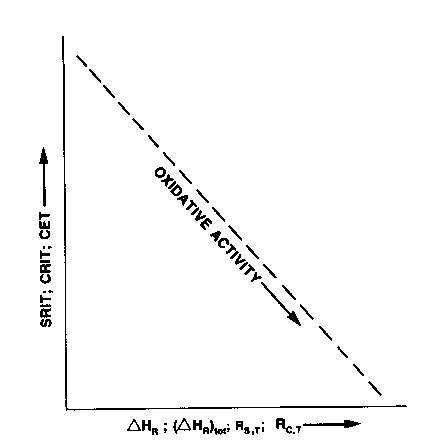
Figure 2.
Reactivity-criteria correlation
scheme.
The TGA-TPD profile in nitrogen gave the
desorption characteristics of a particular solvent from activated carbon.
While in an oxidizing atmoshpere, the TGA-TPO profile yielded some
information on the oxidation characteristics of the carbon-solvent system.
This included the desorption and/or accumulation behavior of the oxidation
products.
The DSC/TGA data obtained may be compared to
a given carbon-solvent system for which process data exist, in order to
establish relative performance. The test method developed is useful in
screening carbon-solvent systems. A range of carbon-solvent systems can be
evaluated in a short period of time.
Optimization of Test Procedure. A
number of variables were studied in order to optimize test conditions.
Conditions which allowed determination of oxidative stability of
carbon-solvent systems in the absence of diffusional limitations and also
amplified oxidative activity were chosen. The variables and/or parameters
investigated include oxygen level, adsorbate composition, bed depth,
particle size, heating rate, and gas flow rate. The test parameters were
standardized to those listed in Table I.
Behavior of Carbon-solvent Systems under
Various Conditions. A number of conditions (discussed below) were
studied in order to monitor behavior of carbon-solvent systems under such
environments. Carbon-solvent systems employed comprised BPL and A-7 carbons
and methyl ethyl ketone (MEK).
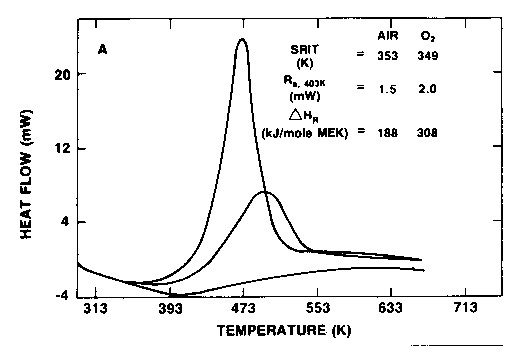
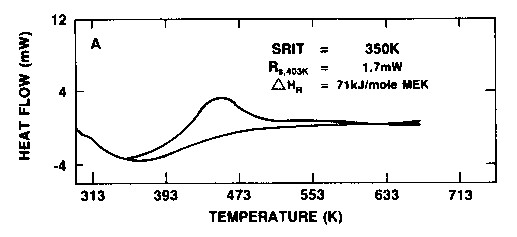
Gas Environment. To determine the
influence of oxygen concentration, the behavior of the carbon-solvent
systems was monitored in atmospheres of nitrogen, air, and pure oxygen using
the DSC, in a temperature-programmed mode. In this case, the concentrations
of MEK and carbon were kept constant while oxygen concentration varied. The
results (Figure 3) show that no oxidative activity occurred in nitrogen
atmosphere. Only desorption of the adsorbed MEK was observed. As the
concentration of oxygen increased, the oxidative activity of the
carbon-solvent system increased These results indicate that, to minimize the
oxidative activity of a carbon-solvent system, and, therefore, decrease the
potential for bed combustion, oxygen levels should be reduced substantially.
Also, in recovery of solvents for reuse, oxygen levels should be minimized
at, or close to, the solvent reaction initiation temperature in order to
avoid excessive solvent decomposition to oxidation products. These results
are consistent with those previously reported by Naujokas (1985).
Solvent Concentration. To determine
the role of solvent level on the oxidative activity of carbon-solvent
system, four concentration levels - 4, 10, 19, and 30% MEK - were
investigated. Oxygen concentration and carbon loading were kept constant
while MEK concentration was varied as shown in Table III. As in the case of
oxygen concentration, the oxidative activity of the system increased as the
total amount of adsorbed MEK increased. Also, the total apparent heat of
reaction, (∆HR)tot,
generated by the system increased with amount of MEK adsorbed. This
indicates that more frequent regeneration cycles may be needed to avoid
large amounts of reactive adsorbates on carbon and, thus, minimize the
potential for bed combustion.
Figure 3. Effect of oxygen
concentration on oxidative behavior of carbon-solvent systems: (A) BPL-MEK
and (B) A-7-MEK
Table III. Effects of MEK Concentration on
Reactivities of Various Activated Carbons
| Carbon |
Concn, % |
SRIT, K |
Rs,403
K, mW |
(∆HR)tot,
aJ |
BPL
A-7
965
|
4
10
19
30
4
10
19
30
4
10
19
30 |
350
351
349
349
379
380
380
379
383
382
382
383 |
1.2
1.7
2.0
2.0
0.3
0.5
0.5
0.5
0.4
0.5
0.6
0.6 |
4.7
7.2
8.8
9.0
2.9
4.6
5.5
5.4
3.2
5.0
6.1
6.4 |
a Total apparent heat of reaction
(total area under TPO and TPD profiles) generated by system.
Carbon-Solvent Size. The effect of
size of solvent-laden carbon on oxidative activity was determined using four
different carbon loadings. In this case, the concentration of oxygen was
kept constant while the amount of solvent-laden carbon was varied. As shown
in Figure 4, the overall oxidative activity of the system increased as the
amount of solvent-laden carbon increased. This indicates that more effective
heat dissipation capability will be necessary in large adsorbers if solvent
oxidation should occur, in order to avoid severe carbon bed exotherms. These
observations are consistent with those reported by Mathewes (1986) on carbon
adsorbers.
Effects of DSC Pan and Cover. A
solid-to-liquid transition is sharp (as in the case of indium fusion) and
independent of pressure. Such a process is generally considered
instantaneous and, thus, can be carried out in an open system. On the other
hand, a liquid-to-vapor transition is controlled by pressure and will only
occur at a constant temperature if the vapor pressure over the liquid is
kept constant. Processes such as boiling or other vaporization or desorption
processes require mass transfer from the liquid surface to the vapor phase.
As a consequence, the peak shape will depend on the rate of vaporization,
which is a function of temperature and of the rate at which vapor is
removed. Accordingly, the surface area of the liquid and the size of the
opening through which the vapor escapes to the surroundings are, therefore,
important factors.
In this study the DSC experiments compared
the behavior of carbon-solvent systems in open and loosely covered pan
configurations. One such result is shown in Figure 5. The open pan system
exhibited a lower oxidative activity, with heat of reaction that is about a
factor of 5 less than that of loosely covered pans. Also, the observed rate
of solvent oxidation, measured by Rs,T at T = 403 K, showed lower
values for the open system. However, the SRIT's were fairly similar. The
loosely covered pans exhibited higher oxidative activity due to decrement in
the rate of solvent vaporization. Thus, more solvent vapor was present in
the system at the temperature of solvent oxidation on that particular
carbon. This gives an indication of the high degree of oxidative activity
which would be generated in an adsorber, if there was a buildup of pressure
or solvent vapor during in situ oxidation at low temperatures.
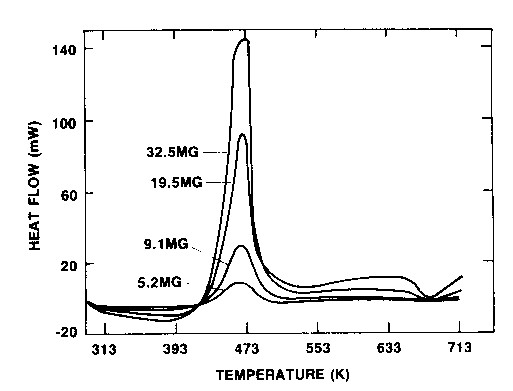
Figure 4. Effect of
carbon-solvent size on oxidative
To determine the variability and
reproducibility of the test procedure, two sets of experiments were
conducted. The first set of experiments investigated the effects of reusing
a particular set of DSC sample pan and cover after use in several runs. The
results are shown in Table IV. It was observed that reuse of the DSC sample
pan had not significant effect on oxidative activity characteristics of
carbon-solvent systems. The second set of experiments investigated the
effects of using different sets of pan and cover (from the same
manufacturing lot) for a particular carbon-solvent system. Results indicated
only negligible effects on carbon-solvent system behavior (Table IV).
Table IV. Variability and Reproducibility
of Test Procedurea
| Conditionsb |
Expt. No. |
SRIT, K |
Rs,403 K, mW |
∆HR, kJ/mol
MEK |
| I. Same set
(pan and cover) |
1
2
3 |
349
350
348 |
2.0
2.0
2.1 |
310
306
314 |
| II. Different
set (pan and cover) |
1
4
5 |
349
347
351 |
2.0
2.1
1.8 |
310
319
302 |
a The BPL-MEK system was employed
in this study. b Same set (pan and cover): The same set of DSC
pan and cover employed in several experiments of oxidative activity
evaluation was used. Variability and reproducibility tests were conducted at
different times during the entire study. Different sets (pan and cover):
Different (but similar) sets of pan and cover were used to evaluated
oxidative activity of a particular batch of carbon-solvent system.
Several carbon-solvent systems were evaluated
using the same DSC sample pan and cover in order to keep the size of the
opening constant and, thus, minimize variability. This allowed
carbon-solvent systems to be evaluated under similar conditions.
Figure 5. Comparison of sample pan
configuration on oxidative behavior of carbon-solvent (BPL-MEK) system: (A)
open and (B) loosely covered sample pan.
Table V. Initial Oxidative Activity
Characteristics of Various Activated Carbons Containing MEK
| Carbon |
SRIT, K |
Rs,403 K, mW |
∆HR, kJ/mol
MEK |
Calgon Carbon A-7
Witco 965
Witco JXC
Takeda Shirasagi S
Calgon Carbon BPL
Calgon Carbon CP-IV A
Norit Sorbonorit B3
Norit Sorbonorit B4
Calgon Carbon PCB |
380
383
378
371
349
343
332
329
331 |
0.5
0.6
0.7
1.0
2.0
2.3
3.5
3.2
6.6 |
175
218
211
305
310
295
>850
>850
>850 |
Behavior of Various Activated Carbons
Containing Adsorbed Organic Solvents. The oxidative activity characteristics
of various activated carbons containing oxidizable organic solvent were
investigated. MEK was chosen as the oxidizable solvent for this comparison
study since it has been studied extensively by other investigators and also
had been implicated in carbon bed combustion (Nauokas, 1985; Wildman, 1988).
As previously noted, the solvent reaction
initiation temperature (SRIT), apparent heat of reaction [∆HR,
(∆HR)tot], solvent oxidation (heat production)
rate
Rs,T), and oxidation characteristics of the carbon matrix (CRIT,
CET, Rc,T) were used to define oxidative activity. Carbon-solvent
systems showing higher SRIT, CRIT, and CET and lower ∆HR, (∆HR)tot,
Rs,T, and Rc,T exhibit low oxidative activity (high
oxidation stability) and, thus, lower potential for carbon bed exotherms.
The converse is also true. The solvent oxidation (heat production) rate was
measured at a temperature of 403 K [designated as Rs,403 K] in
order to compare the results obtained in this study to previously reported
column studies (Naujokas, 1979, 1985).
The initial oxidative activity
characteristics of the carbons evaluated are summarized in Table V. The
carbons are listed in order of decreasing oxidation stability, as shown by
the decreasing SRIT values and increasing Rs,403 K and ∆HR
values. Carbons A-7, 965, and JXC exhibited the least oxidative activity to
adsorbed MEK and, thus, the least potential for carbon bed combustion.
(Carbon A-7, which showed the least oxidative activity, is an experimental
low-reactivity carbon developed by Calgon Carbon Corp.) PCB, Sorbonorit B3,
and Sorbonorit B4 showed the highest oxidative activity toward adsorbed MEK.
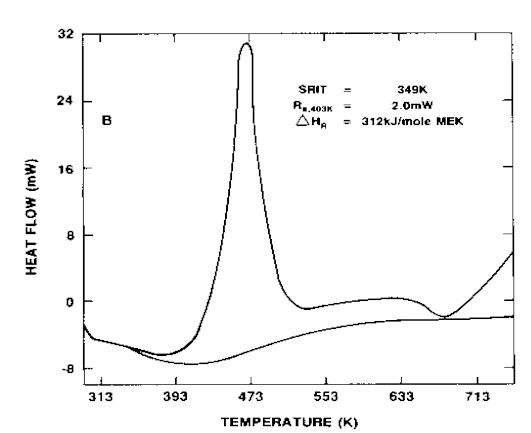
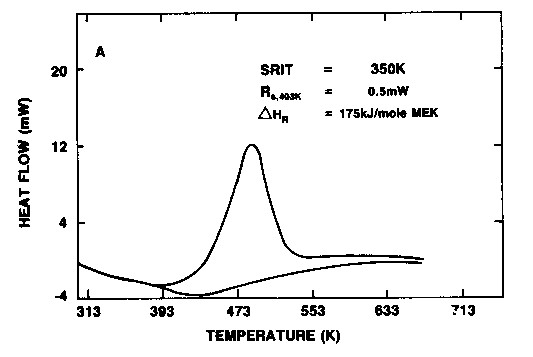
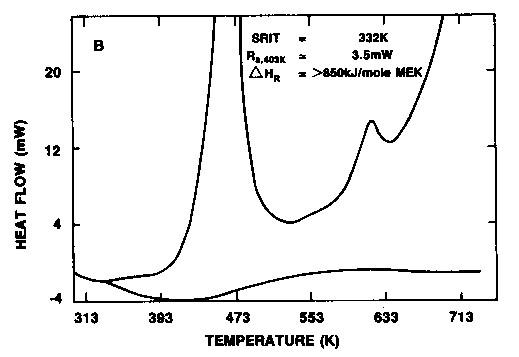
Figure 6 shows the thermograms of two carbon-MEK systems and their relative
oxidative activity characteristics. Figure 6B shows that, in addition to
high adsorbate oxidation initiation temperature, high exothermic heat, and
the large rate of heat generation due to solvent oxidation, oxidation of the
carbon matrix initiates at a lower temperature. Carbon-solvent systems
exhibiting this type of behavior are more easily propagated into carbon bed
combustion, compared to carbon-solvent systems of the type depicted in
Figure 6A, where low exothermic heat, low rate of heat generation, and high
temperature for oxidations of solvent and carbon matrix are observed.
The results obtained on the initial oxidative
activity of various activated carbons were compared to those obtained from
column studies previously reported by Naujokas (1985). The comparison is
shown in Table VI. In Naujokas' column studies measurements of time and
positon of hot generation in the carbon column and associated temperature
and CO concentration changes were used to define oxidative activity of the
carbon-solvent systems. The higher the values of time and position of
hot-spot generation in the carbon column, the lower the oxidative activity.
Carbon-solvent systems exhibiting steady state temperature gradients along
the bed showed the least oxidative behavior toward adsorbed organic
solvents. Given the oxidative activity criteria for this study and Naujokas'
study (Naujokas, 1985), Table VI shows the two test methods to predict
similar trends in oxidative behavior of various activated carbons containing
oxidizable organic solvent, such as MEK.
It is obvious that various activated carbons
exhibit different levels of oxidative behavior toward adsorbed oxidizable
solvents. Thus, proper choice of carbons for systems recovering reactive
solvents can help minimize the potential for carbon bed combustion.
Table VI. Comparison of Initial Oxidative
Activity Trends of Carbons Containing MEK
|
Column
studies (Naujokas, 1985)a
hot spot parameters
|
|
this study |
non-steady
state
|
steady state
|
| Carbon |
SRIT,
K |
Rs,403 K, mW |
∆HR,
kJ/mol MEK |
time,
min |
position,
cm |
∆T,K
K |
Witco JXC
Takeda Shirasagi S
Calgon Carbon BPL
Calgon Carbon CP-IVA
Norit Sorbonorit B3
Norit Sorbonorit B4
Calcon Carbon PCB |
378
371
349
343
332
329
331 |
0.7
1.0
2.0
2.3
3.5
3.2
6.6 |
211
305
310
295
>850
>850
>850 |
23
9
7
4
3
3 |
85
45
70
22
32
25 |
33
|
a Conducted at 398K
Table VII. Oxidation Characteristics of
Selected Organic Solvents on Activated Carbon (Calgon Carbon BPL)
| Solvent |
bp, K |
mol wt, kg/kg-mol |
SRIT, K |
Rs,403 K, mW |
(∆HR)tot,
J |
∆HR,
kJ/mol solvent |
Toluene
Hexane
Acetone
MEK
Cyclohexanone |
383.6
342.0
329.5
352.6
428.6 |
92.1
86.2
58.1
72.1
98.1 |
453
451
398
349
338 |
0
0
0.05
2.0
20.0 |
3.8
3.8
3.8
9.0
48.9 |
169
157
105
310
2286 |
Figure 6. Oxidative behavior of
various activated carbons toward adsorbed MEK: (A) A-7-MEK and (B)
Sorbonorit B3-MEK
Behavior of Selected Organic Solvents on
Activated Carbon. To determine the impact of adsorbed organic solvents
on the oxidative activity characteristics of a carbon-solvent system, a few
solvents selected from the alkane and ketone classes were tested. BPL carbon
was used as the adsorbent. The results are summarized in Table VII. The
temperature programmed oxidation (TPO) profiles are shown in Figure 7.
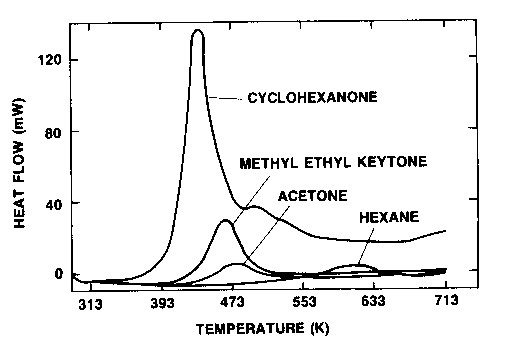
Figure 7. Oxidative behavior of
various organic solvents adsorbed on activated carbon (BPL).
Table VII shows that toluene and hexane
exhibited negligible oxidative behavior with high SRIT and very low ∆HR
values. There were no detectable solvent oxidation (or heat production)
rates as shown by a
Rs,403 K value
of 0. On the other hand, all of the ketones evaluated exhibited oxidative
activity to various extents. The reactivities appeared to have increased
with molecular weight and/or boiling point of the solvents in the order
acetone < methyl ethyl ketone <cyclohexanone. Cyclohexanone displayed
a very high oxidative activity, with a heat of reaction that was more than a
factor of 5 greater than that of MEK and more than 1 order of magnitude
greater than that of acetone. Note from Figure 7 that cyclohexanone shows
multiple exothermic (oxidation) peaks, indicating more than one partial
oxidation step and/or oxidation of intermediate products at higher
temperatures.
It is clear that various organic solvents
behave differently on activated carbon. Thus, the nature of the solvent
plays an important role in the oxidative activity of the carbon-solvent
system.
The results obtained on solvent reactivities
were compared to those reported by Naujokas (1985). The comparison is shown
in Table VIII. Given the reactivity criteria for both studies described
previously, Table VIII shows that while the carbon adsorbents employed in
the two studies were different, similar ranking in solvent reactivities was
observed. This similarity in predictive capability establishes the validity
and reliability of the test method developed in this study.
Table VIII. Comparison of Reactivity
Trends of Organic Solvents Contained on Activated Carbon
| This
studya |
Column
studies (Naujokas, 1985)b |
| Solvent |
SRIT, K |
Rs,403 K,
mW |
(∆HR)tot,
J |
Time, min |
Position, cm |
Temp rise, K |
Max carbon
monoxide, ppm |
Toluene
Actone
MEK
Cyclohexanone |
453
398
349
338 |
0
0.05
2.0
20.0 |
3.8 (169)
3.8 (105)
9.0 (310)
48.9 (2286) |
4 |
20 |
3
33
>200 |
25
2700
>10000 |
a Calgon Carbon BPL was used as
adsorbent. b Witco JXC was used as adsorbent. Test was conducted
at 398K. cValues in
parentheses are ∆HR
expressed in kJ/mol solvent.
Practical Implications. Detailed quantitative
considerations of system dynamics - mass and heat transfer and chemical
kinetics (in an adsorber) - are not fully discussed in this paper.
Nonetheless, these properties are important in the consideration of carbon
bed combustion. As indicated by Naujokas (1979, 1985), fast-changing
temperature and concentration gradients (associated with continuous
desorption and readsorption of adsorbates and reaction products) exist
during hot-spot generation and/or carbon bed combustion. These generally
result in system perturbations under appropriate conditions. The rapidly
changing temperature and concentration gradients, with associated
nonlinearity of chemical reaction kinetics and non-homogeneity of carbon
bed, tend to make the carbon-solvent system somewhat difficult to
characterize.
Since in an adsorber hot spots are generally
localized, monitoring of bed temperatures alone may not always reveal onset
of bed combustion. Measurements of changes in amounts and rates of solvent
and carbon decomposition products (C0, C02, etc.) above the bed
and exhaust stack, in conjunction with bed temperature measurements, provide
for more reliable means of detecting bed combustion. Detection of unusually
high levels of decomposition products generally signifies onset of bed
exotherm. Carbon-solvent systems with lower SRIT,
CRIT, and CET and higher ∆HR,
(∆HR)tot,
Rs,T,and Rc,T
exhibit high oxidative activity and, thus, are more prone to generation of
high levels of decomposition products. Systems of this type exhibit high
potential for bed combustion and, therefore, should be monitored more
regularly. More detailed discussions on precautionary and corrective
measures can be seen elsewhere (Naujokas, 1985).
In the comparison of results of this study to
those of Naujokas' column studies (Naujokas, 1979, 1985), SRIT and Rs,403 K
values generally correlated to time and
position of hot-spot generation in the carbon column, while ∆HR
and (∆HR)tot (which define the extent of
reaction) generally correlated to the degree of ∆T and carbon monoxide
concentration changes in the carbon column.
This paper provides some insights and
awareness of some of the conditions and/or system behavior that might effect
carbon bed exotherms. This allows for implementation of adequate corrective
and/or preventive measures which, in turn, provides for safer operation of
carbon adsorbers. It must be emphasized that while appropriate choice of
carbons can help minimize the potential for carbon bed combustion for systems
recovering oxidizable (reactive) solvents, proper bed design, operation, and
maintenance are also very important. Furthermore, though some of the carbons
evaluated exhibited some degree of oxidative activity toward adsorbed
oxidizable solvents, these carbons are, nontheless, suitable or good
adsorbents for recovery of non-reactive (non-oxidizable) solvents or, in
some cases, less reactive solvents such as acetone (see Tables VII and
VIII).
Conclusions
A comparatively simple and rapid test method
has been developed to evaluate the relative oxidative activity
characteristics of carbon-solvent systems. The test method predicts trends
in carbon and solvent reactivities similar to those determined from column
studies reported in the literature. Carbon-solvent systems generally showed
three regions of activity as a function of temperature in the presence of
oxygen. These regions consist of desorption of adsorbate, oxidation of
adsorbate, and oxidation of carbon matrix. Various carbons exhibit different
levels of oxidative activity. The nature of the solvent plays an important
role in the oxidative behavior of the system. While appropriate choice of
carbons can help alleviate the potential for carbon bed combustion in
systems recovering oxidizable solvents, proper bed design, operation, and
maintenance are also very important. Though some of the carbons evaluated
exhibited some degree of oxidative activity toward adsorbed oxidizable
solvents, these carbons are, nevertheless, suitable or good adsorbents for
recovery of non-reactive (non-oxidizable) solvents or, in some cases, less
reactive solvents such as acetone or similarly ranked solvents.
Registry No. MEK, 78-93-3; C, 7440-44-0; PhMe,
108-88-3; C6H14, 110-54-3; MeC(O)Me, 67-64-l;
cyclohexanone, 108-94-l.
Literature Cited
Boiston, D.A. Acetone Oxidation. J.Br.Chem.Eng.
1968, 85-90.
Bowes, P.C.; Cameron, A. Self-Heating and Ignition of Chemically Activated
Carbon. J.Appl.Chem.Biotechnol.1971, 244-250.
Cameron, A.; MacDowall, J.D. The Selft Heating of Commercial Powdered
Activated Carbon, J.Appl.Chem. Biotechnol. 1972, 22,
1007-1018.
Chapman, M.J.; Field, D.L. Lessons from Carbon Bed Adsorption Losses. Loss
Prev., CEP Man. 1979, 12, 136-141.
Hardman, J.S.; Street, P.J. Spontaneous Ignition Behavior of TEDA*-Carbon.
Fuel 1980, 59, 213-214.
Hardman, J.S.; Street, P.J.; Coling, T.S. Studies of Spontaneous Combustion
in Beds of Activated Carbon. Fuel 1980, 59, 151-156.
Johnson, J.E.; Woods, F.J. Flammability of Activated Charcoal Used in Air
Purification. J.Fire Flammability 1971, 2, 141-156.
Mathewes, W. Conclusions From Fire Tests in Activated Carbon Filled
Adsorbers. Proc.DOE/NRC Nucl. Air Clean Conf. 1986, 19th, 51-67.
Miller, K.J.; Noddings, C.R.; Nattkemper, R.C.Preventing Bed Fires in Carbon
Adsorption Systems. Proc-APCA Annu.Meet. 1987, 80th, Vol. 3,
87/50.7, 1-11.
Naujokas, A.A. Preventing Carbon Bed Combustion Problems. Loss Prev., CEP
Man. 1979, 12, 128-135.
Naujokas, A.A. Spontaneous Combustion of Carbon Beds. Plant/Oper.Prog. 1985,
4 (2), 120-126.
Takeuchi, Y.; Mizutani, M.; Ikeda, H. Prevention of Activated Carbon Bed
Ignition and Degradation During the Recovery of Cyclohexanone.
J.Chem.Eng.Jpn. 1990, 23 (10), 68-74.
Wildman, J.Practical Problems in Solvent Recovery Using Activated Carbon. Proc.Int.Conf.Carbon
1988, 185-187.
Received for review February 4, 1991
Revised manuscript received August 2, 1991
Accepted August 15, 1991
Reprinted from I&EC
RESEARCH, 1992, 31.
Copyright © 1992 by the American Chemical Society and reprint by permission
of the copyright owner.
|