


|
Papers Delivered
at International Conference on Cleaner Production | ||||||||||||||||||||||||||||||||||||||||||||||||||||||||||||||||||||||||
Eco-Industrial Networking in AsiaAnthony SF Chiu, Manila
Introduction Globalization, international competitiveness, and some post-War factors have driven many Asian nations to put up their individual industrialization programs during the second half of the 20th century. Japan being the earliest and now a world-class industrial leader, followed by the four tigers of NICs in the 70s. We also have the Asian giant – China – who joined this bandwagon in the past two decades at fascinating growth rate. The developed countries in North America and Europe; pressured by the amplified local cost of production, shift of conventional mass production management to Just-in-Time place-based manufacturing system, and attraction of the Asian Pacific Rim Megatrend, have increasingly transferred to off-shore operations in Asia as well. This trend called for the formation of several industrial clusters in Asian nations for improved economies of scale and proximity to shared inputs and infrastructure such as energy, water, and road. These clusters took the form of Export Processing Zones, Economic Zones, Industrial Parks, Industrial Estates, Science Parks, and many others. While industrialization brought wealth and development to their economies, it has also carried along many externalities, and one of these is industrial pollution. Pollution problems started attracting attention of the industrialists in the early day under the umbrella of safety and health of workers, sanitary engineering, and related disciplines. Pollution abatement came in later and it used dilution or emission-based measures, we traditionally called this end-of-the-pipe (EOP) approach. Until the late 80s, pollution prevention concept has increasingly gained ground. Policy regulators were gradually moving from Command-and-Control (C&C) measures to Market Based Incentives (MBI) and Suasive measures. Hence, for greater efficiency, eco-industrial networks are rapidly emerging as an approach that can deliver positive results to both competitiveness and environment. An unofficial count revealed that there are about 4,000 industrial estates in Asia nowadays.[1] This volume of clustered industrial activities can create significant impact, depending on the choice of management. We shall now briefly look into various components of developing an eco-industrial network. Eco-Industrial Networking Concept In many Asian economies, the industrialization does not happen overnight. It evolved from the backyard family operations, to small and medium enterprises (SMEs) located in un-zoned areas. Furthermore, they developed into linked businesses due to supply chain force, and eventually many of them succeeded to become medium and big multinational companies (MNCs) located in clustered industrial estates. Similarly, the total quality environmental management (TQEM) approach of the industrial clusters also has their four developmental stages. They can be explicitly described as follows (Chiu, 2000):
Stage IV is achieved when it envelops all the three key features of industrial ecology.
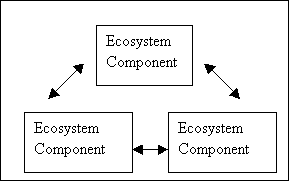
There will be interaction and inter-relationship among the various players in the ecosystem; they are the stakeholder elements in the form of NGOs, policy bodies, industrialists vis-à-vis natural capital such as biodiversity, water body, energy sources, etc. It is meant to achieve a harmonious economical, environmental, and social ecosystem.
There must be a balanced industrial mix in mature ecosystem wherein energy, materials, industrial activities, etc. are close-looped and self-sustainable within ecosystem.
The ideal end objective of a recycling-oriented society is the transformation from a linear to a mature closed loop ecosystem. In the linear system, it follows the Life Cycle from cradle to grave. The mature ecosystem is one in which full cyclicity has been achieved (Figure 1). It forms the cradle-to-cradle cycle, and it is self-sustainable. In such system, all material and energy flow are close-looped, with an exception of an influx of renewable energy to the system.
Eco-Industrial Networking Approaches Two main streams of EIN approaches are essential; namely: primary hardware and supportive software. The primary hardware provides the structural programs and action plans as EIN components, while the supportive software covers the infrastructural needs to hold up the components.
Planning and design of programs need to review the goals of industrial ecology; namely: inter-relationship, metabolism, and mature ecosystem. Asian EIN planners should study the macro environmental conditions[2] in the region before starting the development. Several core drivers were highlighted in the literature, to name a few: (Cohen-Rosenthal; Cote; Lowe)
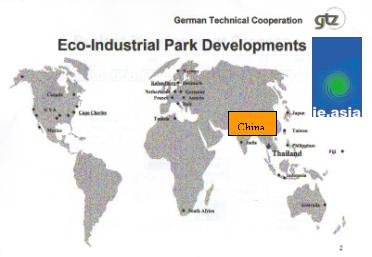
To keep the hardware programs in place, it is inevitable that the appropriate supports should also be present. Among the important infra-structural supports, top of the list in many Asian economies are the national policy and development framework. Next in line is the commitment of the management and leadership. Selected Asian Eco Industrial Development Overview[3] Quoting Cohen-Rosenthal’s (2000) statement “ … industrial ecology to be successful it has to demonstrate superior business as well as environmental results.”; economic bottom line remains in the top list of many Asian industrial estates’ environmental projects. Environmental and social commitment is also strong, but it needs some more driving forces. Philippines and India have both started doing the EIN earlier than the neighboring economies. Thailand, on the other hand, has shown strong enthusiasm and the infrastructure is very strong. While some countries have already been practicing some EIN components unofficially, there are also other nations like Vietnam and Nepal conducting initial feasibility studies (Sathasivan and Hoang Hai, 2001) In Malaysia, earlier publication on website by USAEP (Bateman and Tan, 2000[4]) revealed environmental activities in the industrial estates, but similar to Japan, they were rarely referred to as EIN or Eco-industrial park (EIP). GTZ compiled some EIN developments in the region, and the figure below shows some other progress.
The Asian cases below depict some successful forms of an EIN development while others explore future Asian potential in this line of development. This shortlist is not exhaustive, there are still many other forms of eco-industrial networking, and the succeeding section will touch on those various models. China Launched EIP Project in Dalian August 8-11, 2001 marked the significant “step” put forward by the Chinese eco-industrial development. UNEP delegation led by Fritz Balkau and Wei Zhao co-hosted a four-day workshop on Environmental Management of Industrial Estates at Dalian, China. As the conclusion of the intensive workshop, four sites were named as pilot zones. They are Dalian Development Zone, Tianjin Development Zone, Yantai Development Zone, and the Suzhou New Zone. Dalian Zone is the largest among the four, sitting on a 220-square kilometer land, and possesses a world-class APELL system – as observed by the expert team headed by Ray Cote. This is a joint project of UNEP DTIE and the PRC SEPA. Each zone selected some areas of strength to evolve, e.g. Tianjin on Programmatic Cleaner Production, Suzhou on post-EMS development. Most of the zone management admitted that EIP is a long-term goal, but a small step forward starts the ball rolling. Philippines BPX & Programmatic EMS projects in Calabarzon & Bataan Five CALABARZON industrial estates located geographically close to each other entered into partnership on two programs. The first is to have by product exchange (BPX) among the locators within the estate; and then among the estates and its communities. This was necessary as many estates were composed of mainly two or three major industries, by products of these major industries have limitation for exchange to the other two industries. This intra- & inter-estate BPX setup is first of its kind in the region, and it is very feasible and advantageous due to short distance transportation. The second program is an integrated resource recovery system (IRRS). To date, the first program has gone through the awareness, team building, mutual trust, planning, by product matching, and commitment of some proactive locators. By product exchange practice was also initiated much earlier by the Industrial Waste Exchange Program (IWEP) of the Philippine Business for Environment in much wider scope. The second project has the main player, 550-ha PNOC petrochemical industrial park with access 5 km downstream of its refinery site, practicing programmatic EMS and byproduct exchange. Being a petrochemicals complex, the naphtha cracker will generate various byproduct options at its upstream and downstream industries. The estate management together with the locators is currently in the stage of programmatic EMS planning and greening the supply chain. Many estates in these two projects possess some good environmental management at estate level, such as common effluent treatment plants, hazardous waste treatment plan, emergency response system, secure landfills, shared facility program, etc. Aside from the above-mentioned primary programs of the two projects, the major leapfrog progress of the project is finalization of the National IE Policy and Framework & Development Plan (F&DP). Many BPX activities encounter problems within the policy framework of the government. As seen in most other cases in North America, transportation of toxic and hazardous waste, label change, cost of by product, etc. can be major barriers. The National Policy on IE received inputs from stakeholders and will be the key infra-structural support to the project.
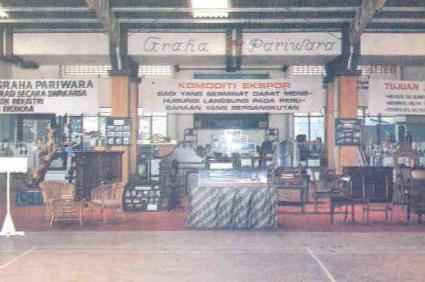
A 100 ha-industrial estate mainly for small firms considers an estate-wide biowaste treatment project and good housekeeping program for its 480 locators. Although it is still in the planning stage for this EIN motive, there are scavengers currently performing the traditional waste recovery by manual segregation. Some useful recyclable materials were sold, some re-processed; but in some extreme cases the technology causes environmental problems (e.g. battery burning to recover plumbum). A good potential of the estate is that the management provides showroom for shared marketing called Graha Pariwara. This can be the future venue for further EIN activities such as information exchange of by products, enhanced government-industry cooperation, or setting up of a Cleaner Production advisory center, etc.
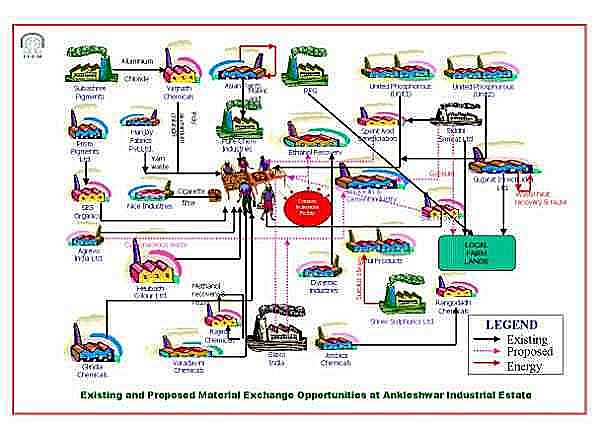
Three cases in Gujarat, India were received; they are Naroda Industrial Estate (NIE1), Ankleshwari Industrial Estate (AIE), and Nadeseri Industrial Estate (NIE2). In one of these industrial estates, an initial attempt to survey byproduct through questionnaires generated the list of five major areas and one significant waste stream. Hence, further investigation depicted that certain eco-industrial partnership activities are already taking place; these areas are chemical gypsum, biologically degradable waste, mild steel scrap, spent sulphuric acid, and iron sludge. These partnerships are presently being developed with the injection of cleaner production strategy. In all three cases, Common Effluent Treatment Plant (CETM) plays a very important role. This node of the EIN structure exhibits the major judiciary support extended by the World Bank, as well as its role in igniting technology transfer and CP practices. Furthermore, in the AIE and NIE2 cases, locators are using clean energy (e.g. natural gas), estates conduct shared human resources training (e.g. post-graduate programs on CP and Industrial Safety). AIE and NIE2 have (at the minimum) 20% additional capacity which is planed to be utilized to house industrial-ecology partners, and beneficiation centers for residues enabling their re-utilization; hence, one step forward to IRRI plan. Among these Indian cases, some authors claimed that strengthened judiciary, total commitments of the corporate management, and information drives are the main supporting software the EIN sustainability needs in the future. (Khanna; Patel et al.)
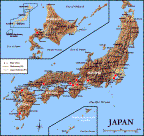
Kitakyushu Ecotown, Japan: An Integrated Resource Recovery System (IRRS) Japan, the dragon economy in Asia, has evolved from the old “mass-production, mass-consumption, mass-disposal” society to the “recycling-oriented” economic system today. (with the influence of Realization of Recycling Society Bill, and series of product take-back bills) Two main EIN components are housed in the Kitakyushu Ecotown:
The Comprehensive Environmental Industrial Complex is the venue where tenants involved in environmental industries work together to reuse and recycle materials, thus minimizing wastes. Here in Hibiki the tenants disassemble the used products, and make use of them for remanufacture. These industries inside the HRA also share the common facilities, tools, etc. The energy generated by combustion of some wastes is used effectively and supplied to the facilities of the Complex. Currently, locators settled in this HRA are:
Discussions are now being held for the commercialization of some recycling products:
This HRA is devoted to a total integrated resource recovery system wherein the normal linear life cycle will be turned into a close loop system. IRRS is not the end of the project, but as a stepping-stone of a learning process. It is through this practice that Kitakyushu demonstrates a sustainable recycling-oriented economic system, and establishes itself as the Asian hub of a reservoir for future reusable resources (see figure below).
The other component of the Kitakyushu Ecotown is the Practical Research Area. With the cooperation of business, government, and academia, it is creating a center for environmental industries in the city by gathering organizations that do research and development on cutting-edge environmental technologies. The major partners are Japanese, British, and German institutions. They provide and back up the technology needed in the environmental businesses, such as
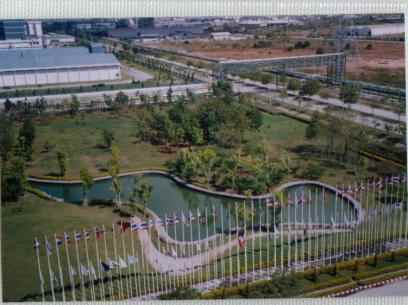
Map Ta Phut Industrial Park, Rayong, Thailand on Center-Satellite BPS Pollution Prevention concept has received much attention in Thailand since its early introduction to Asia.[6] There are currently five industrial estates certified with ISO14001, and Thailand is among the earliest Asian nations to have developed an Eco-Label in product and in ecotourism. The government’s commitment to “ecologize” industrial estate is firm and sound. Commitment by IEAT Board of Directors of management started in 1999 and it was clear to apply the principles of eco-industrial development as the main strategy for future industrial development in Thailand.[7] The unique feature of this EIN plan is not only centered at BPX and IRRS activities inside Map Ta Phut Industrial Estate, but also interacting with the neighborhood estates such as Bang Poo, Eastern Sea Board, and most important, the stand alone plants surrounding the estates. It is a center-satellite system with strong centripetal bonding force. The success of the project, according to a consultant, requires capacity development, improvement of interagency cooperation, and changes in investment strategies, policies, research priorities, and training. The objectives of eco-industrial development provide the framework for design and management of EIEs in Thailand and the basis for an estate earning the right to call itself an eco-industrial estate. The IEAT initiative will be contributive to the guidance of an international setting of standards. Socially, a new batch of educated immigrants was brought to the Rayong area when Map Ta Phut was built, 20% of the estate employees are local residents, while the 80% are selected from outside. Like Philippines, stakeholder total involvement including zonal representatives of the locators plays a proactive role in Map Ta Phut. A community enhancement office is part of the eco-industrial supporting institutions to manage projects with neighboring communities.
More EIN or environmental management projects are in different stages of developments; the ff. table browses through some of the activities in Asian economies:
Conclusion: EIN-Asia Model and EIN-Asia Networking Among the various EIN set up, we observed several commonalities in one hand, and some unique features in another; such as:
Last one in this simple list, but certainly not the last feature: The learning processing of networking and cooperation! Among these findings, there are success factors and barriers. This Conference and Workshop aims to target the key issues of EIN development in the region, locate the options for solution, and identify the support needed for action. Asian cultures may vary from each other, but common interest can bond different cultures together. There is a need to create a network among these EIN practitioners and researchers in Asia, to learn from each other’s success stories, as well as untold stories. The working environment and structures among many Asian countries are quite similar, so that learning models from each other can be applicable. GTZ published an “Eco-Industrial Parks – A Strategy towards industrial ecology in developing and newly industrialized countries” (2000), and it proposed some common models suggested by Marian Chertow and Ernest Lowe, that may be useful for initiating EIN plans.
References Allenby, Braden R. 1999. Industrial Ecology: Policy Framework and Implementation. Prentice Hall, New Jersey: USA. Chiu, Anthony SF. 2000. Discovering Asian EIP Case Book from its Cover. Presentation at Taiwan Eco-Industrial Park Training Workshop, December 11-13, 2000. Taipei, Taiwan. Chiu, Anthony SF and Sison, Georginia. 2001. Ecological Industrial Networking Strategy in Asian Industrial Development. Proceeding of the 3rd Asia Pacific Roundtable on Cleaner Production, February 28 – March 2, 2001, Manila, Philippines. A. Sathasivan and Hoang Hai, 2001. Feasibility of Converting Sai Dong Industrial Zone in Hanoi, Vietnam to Eco-Industrial Park. Article to be read in International Symposium on Development and Environment, Ho Chi Minh City, April 20-22, 2001. Morikawa, Mari. 2000. Eco-Industrial Developments in Japan. Indigo Development Working Paper #11. RPP International, Indigo Development Center, Emeryville, CA. Naisbit, John and Aburdene, Patricia. 1990. Megatrends 2000. Avons Books : USA. Cohen-Rosenthal, Edward. 2000. A Walk on the Human Side of Industrial Ecology. American Behavioral Scientist, forthcoming. Presented at the APO Workshop, September 2000, Penang, Malaysia. Cote, Raymond and Reid, Holly. The Environmental Management of Industrial Estates. 1997. Compiled by. UNEP, France. Lowe, Ernest A., Moran, Stephen R., and Holmes, Douglas B. 1997. Eco-Industrial Parks: A Guidebook for Local Development Teams. Indigo Development, USA. Proceedings of Eco-Industrial Networks: Devising Practical Tools for Success. Edited by Peck & Associates, March 26, 1998, Canada. Uemura, Eiji, Manager of Kitakyushu City Environment Bureau, Environmental Industries Promotion Office. Interview through environment translation officer Fujioka Toshiko, December 12, 2000, Taipei. Additional Resources Some individual case writings forwarded to the Eco-Industrial Networking–Asia (EIN-Asia) Conference or Conference Coordinator, April 3-6, 2001. These are:
Interview, email, personal site visits, or other communications with the Resource Persons (e.g. Chertow, Lowe, Cote, Erkman, Francis, Wilderer, Geng, Allenby, Koenig, Chavanich) and applicants of the EIN-Asia Conference 2001. [1] 1992 documents revealed 7 Asian countries totaled 639. Philippines alone increased from 63 to 136. IEAT Thailand alone manages 29 estates, excluding BOI registered estates, 1992 listed only 23. (UNEP 1997) [2] here we refer macro environmental condition in the Porter school of thought, and not literarily “environment” per se. [3] The selection is not based on success or failure but rather to complement the case presentations during the conference and workshop. Another basis is on geographical distribution and model / component diversity. [4] Visit USAEP website at http://www.usaep.org/ [5] Page 9, Naroda Industrial Estate Case Writing. Partnership is repeatedly emphasized and termed. In Asian scenario, partnership sends a stronger message than merely networking. [6] Thailand hosted the 1st Asia Pacific Roundtable on Cleaner Production, and is the hub and headquarters of the Greening the Industry Network – Asia. [7] Presentation materials from IEAT, GTZ, and interviews with officials and consultants. |
©SETC 2000-2002