Preventing Livestock Pollution in North Dakota
Livestock Waste Management Regulations
North Dakota Department of Health
Water
Quality Division
1200 Missouri Ave
PO Box 5520
Bismarck, ND
58506-5520
(701) 328-5210
THE FEEDLOT PROGRAM
Statutory Responsibility
The North Dakota Department of Health has the statutory responsibility to control the pollution of surface waters, groundwaters, and the air of the state.
Water Quality Standards have been developed and adopted for the surface waters of North Dakota, as provided by the Water Quality Act of 1965. An extensive Water Pollution Control Act, addressing among other things the control of livestock waste, was adopted by the 1967 state legislature.
The Rules and Regulations for the Control of Pollution from Certain Livestock Enterprises were first issued in 1972 by the State Health Department and updated in 1989.
Definitions
To describe the feedlot program, a few key terms must be defined. Definitions given below are based on the livestock regulations (North Dakota Administrative Code 33-16-03-04).
| Animal | AU Equivalent |  |
| 1.5 feeder cattle | 1 | |
| 1 mature dairy or beef | 1 | |
| 1 horse | 1 | |
| 4 swine | 1 | |
| 8 sheep | 1 | |
| 30 turkeys | 1 | |
| 80 chickens | 1 |
For animals not listed, one AU equivalent is approximately equal to the average weight of the animal divided by 1,000 pounds.
Prohibited Practices
State law prohibits the following practices.
1. Feeding of livestock on ice.
2. Feeding of livestock or handling livestock waste in any way that would allow the waste to enter waters of the state, or to be washed into these waters by runoff from rain or snow melt.
Operations Requiring Approval
Approval from the State Department of health is needed for the following operations.
For example, if you have 100 animal units and if they are fed within 200 feet of any surface water not completely contained on your property, you must have approval from the department.
How to Get Approval
Waste management systems of the livestock operations described above must be approved by the State Department of Health.
For a livestock operation to be approved, an application must be sent to the departments Water Quality Division. The application should be as complete as possible. A sketch should be included, showing distances from barns, open lots, and manure stockpiles to surface waters, drainage ways, and existing and abandoned wells (see example). A map of the entire area within a 2-mile radius of the facility should also be attached. A topographic map showing land contours and drainage ways is preferred.
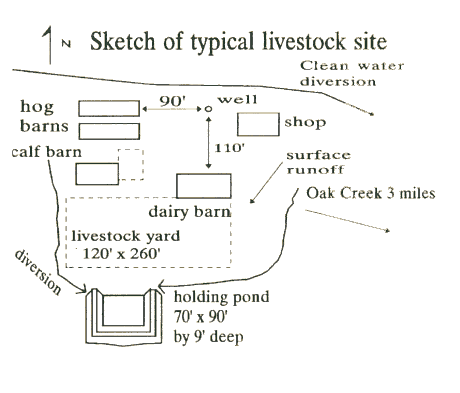
The department will review the application. If the facility is designed and operated to prevent livestock waste from entering waters of the state and to prevent pollution, a letter of approval will be sent to the operator. This approval is valid as long as the facility is not changed.
If the facility has the potential to cause pollution, the department will require steps be taken to prevent waste from entering waters of the state. These steps can range from fencing livestock out of a certain area to constructing diversions or a storage pond to contain and hold all waste.
WASTE MANAGEMENT PRACTICES
Land Application
The best way to keep livestock waste out of waters of the state is to put it on cropland where the nutrients can be utilized. It is beneficial to test the nutrient content of the waste so it can be applied at a rate that will supply the needs of the crop to be grown. More of the nutrients remain in the soil if waste is incorporated into the soil. Incorporating waste also helps minimize odors from land-applied waste. When applying waste, it should be kept out of drainage ways or areas where it could be washed away.
Open Livestock Lots
The amount of waste can be minimized by diverting clean water away from the livestock lot. All waste and runoff from the livestock lot should be contained on the property and prevented from reaching any natural drainage. A containment pond is often constructed to contain the waste and runoff from the site. This pond must be emptied regularly and must not be allowed to overflow under normal conditions. If there is no natural drainage nearby, the runoff may be diverted to cropland or pasture where it can be spread out so vegetation can use the moisture and nutrients.
Indoor Livestock Facilities
Indoor facilities should be able to store livestock waste for at least 180 days to avoid land application on frozen ground. Waste stored outside must be in an area where any runoff can be contained. Many enclosed livestock facilities have liquid waste handling systems which include a holding pond. These systems work very well when they are maintained and emptied regularly (usually one or two times per year). These ponds must not be allowed to overflow.
WANT MORE INFORMATION?
There are several places you can obtain information on managing livestock waste.
For information on regulations and developing waste management systems, Contact:
North Dakota Department of Health
Water Quality
Division
1200 Missouri Avenue
P.O. Box 5520
Bismarck, ND
58506-5520
(701)328-5210
Your local Natural Resources Conservation Service office may also be able to provide information on developing livestock waste systems and utilizing waste for crops.
The Extension Service at North Dakota State University or your local county Extension agent have reference materials on livestock waste systems and may be able to assist you. One helpful publication is the Livestock Waste Facilities Handbook published by the Midwest Plan Service which can be purchased through NDSU Extension.
Your local district health unit may also be able to assist you with questions on livestock waste issues.
Many North Dakotans want to know more about State regulations designed to prevent pollution from livestock waste.
Questions frequently asked include:
* Does livestock waste really cause pollution?
* What regulations apply to North Dakota livestock operations?
* As a livestock producer, do these regulations affect me?
* If so, what must I do?
* How should waste be handled?
* Where can I get more information?
A RESOURCE OR POLLUTION?
Livestock waste is a valuable resource when used properly. It provides essential nutrients, organic matter, and moisture to cropland. However, these nutrients, which are so beneficial to crops and soils, can have detrimental effects when carried into surface waters or groundwater. In surface waters, they may cause large growths of algae (algal blooms), resulting in fish kills and decreased recreational opportunities. Nutrients in ground water may contaminate drinking water wells.
Our challenge then is to use livestock waste as a resource for food production, but prevent it from polluting surface or ground water resources.
For more information call 701.328.5210 or email Brady Espe or Gary Haberstroh.