
Praegitzer Industries, Inc.
The Fine Line in Printed Circuits
Praegitzer Industries' Redmond, Washington plant manufactures printed circuit boards for computer manufacturers located in the U.S. The company designs and manufactures multiple-layer circuit boards. The process requires considerable coordination with customers to ensure the prompt delivery of high quality circuit boards that meet their requirements and exceed their expectations.New Name, Same Philosophy
Originally a small company named Circuit Technology, the company was purchased by Praegitzer in November 1995. The buy-out provided the plant with additional resources, capital and new customers. Of course, with the change of ownership came challenges in management and the introduction of new policies and guidelines. Amidst all the change, the Redmond facility has retained its focus on pollution prevention.Even when the Redmond facility was a small company known as Circuit Technology, its management policy emphasized a commitment to reduce wastes when and wherever possible and find and use alternatives to hazardous substances whenever possible. They also aimed to involve production employees in the process and encourage their input. Obvious benefits of their environmental improvement efforts have included better communication, improved product quality, increased productivity, safer working environment, reduced exposure to hazardous chemicals and a shared sense of pride. In 1995, Praegitzer received an honorable mention as part of the Governor's Pollution Prevention Awards.
From a cost standpoint, Praegitzer has accomplished dramatic reductions in raw chemical costs, treatment expenses, labor hours and the capital equipment expenses to handle hazardous wastes.
A New Beginning
The improvement process began at the Redmond facility almost a decade ago. As a small company, they had to build their own treatment systems in house. In 1988, as the company began plans for construction of the current facility, management invested a great deal of time and capital to incorporate equipment and technologies to prevent or reduce wastes. This provided the company with a unique opportunity. Praegitzer estimates that it reduced wastes by 60-75 percent through such design innovations as installing double and triple cascading rinses and automatic feed and bleed systems. Installing electronic panel sensors and high pressure/low volume spray nozzles also produced significant reductions in waste generation. The company's goal was to ensure that the best available technologies would be in place to minimize hazards and wastes.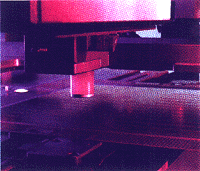
Developing a Plan
A few years ago, when Praegitzer developed its Pollution Prevention Plan, Todd Kirkendall, the environmental manager for the plant, worked closely with officials at Washington State Department of Ecology. Praegitzer had already made dramatic progress in reducing pollution with the design of its new plant, and Kirkendall had a year's head start in drafting the plan. But according to Kirkendall, help from Ecology was the key to completing the Pollution Prevention Plan efficiently and without wasting time and resources.As part of the pollution prevention process, Praegitzer used ion-exchange technology to remove metals and recycle rinse water. Process changes were also made, and best management practices were instituted to reduce the generation of wastes and recycle as much as possible.
Praegitzer sees the value of reducing the waste at the source as opposed to investing in expensive treatment systems at the end of the line. Chlorine solvents and toluene were completely eliminated from the plant. Praegitzer has also installed a heat exchanger for energy conservation, installed flow restriction devices to conserve water and added a computerized rinse control system.
Progress Continues
Recently, Praegitzer invested in new treatment technologies and systems, transforming a chemical waste treatment process into a copper and tin ore manufacturing operation. The investments in capital equipment and technology allowed them to create feed stock for the manufacturing process from what was once considered hazardous wastes. This has reduced the amount of reportable hazardous wastes by 90 percent from 1992 levels. Praegitzer plans to achieve over 99 percent reductions by December 31, 1996. The Redmond plant's goal is to move from a large quantity generator status (previously producing 14-20 million pounds of hazardous wastes annually) to a small quantity generator (producing less than 2,400 pounds annually) in 1997. This project will provide a savings of $28,000 annually.Praegitzer made further refinements in environmental operating procedures through its quality management program. Work done in revising procedures during ISO 9000 initiatives has helped in reducing the amount of waste generated. Praegitzer received its ISO 9000 certification in 1994.
Despite its recent incorporation into a larger company, the Praegitzer plant in Redmond continues to pursue improvements in its environmental performance in the traditions of the best Washington companies. The printed circuit manufacturer has built pollution prevention into its state-of-the-art facility and has continued to improve processes and reduce wastes.