by: D. John Hunt
Pages: S-4; March,
2001
Part cleanliness becomes critically important as
mechanical, optical, and electronic parts shrink in size and
formerly inconsequential particles grow in comparison.
High-technology cleaning techniques, such as ultrasonic bath
cleaning, are widely used. Today’s precision industrial applications
now employ ultrasonic cleaning baths as well.
In-situ particle monitoring (ISPM) provides a tool to observe
particle removal behavior in the ultrasonic cleaning bath process at
work and in real time, thus providing the ability to quickly select,
adjust, and optimize the cleaning process. ISPM measures particle
counts directly during the cleaning process in both ultrasonic rinse
and wash baths.
An Example of How ISPM Works
A known amount/type of
particle contamination was deposited on glass slide test coupons.
Several cleaning agents were tested for their effectiveness in
removing the contamination by monitoring the rate of particle
removal in the bath.
Figure 1 shows the addition/mixing of the agent C at three
different concentrations. Each concentration change appears as a
rise in particle counts, until the mixing is complete. The test
coupon is then inserted into the bath and the resultant peak
particle count is noted.
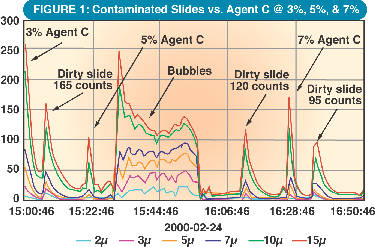
The sudden and dramatic jump in particle counts after the 5
percent concentration was added to the bath — but before the test
coupon was inserted — was caused by bubbles in the bath and was
characterized by high counts for all particle sizes, unlike that of
typical contamination. Particle counts larger than 5 microns are
typically close to zero after mixing and before insertion of the
test coupon, whereas during bubble interference they approach 100
counts per ml.
With appropriate precautions, bubble interference can be
minimized and even eliminated. Bubbles are often a sign of over
concentration of the cleaning agent and frequently do not appear at
optimal cleaning agent concentration.
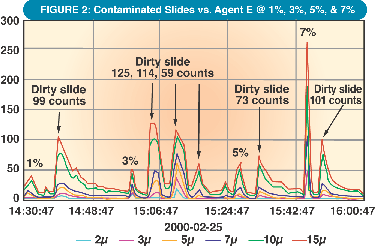
Figure 2 shows particle count response using cleaning
agent E at various concentrations.
To determine the actual total particles removed, the area under
the particle count curve over time should be integrated. However,
for the sake of convenience, only the particle peak was initially
used as a measure of comparing cleaning agent effectiveness. The
flaw in choosing this method was revealed when agent E was
tested.
Agent E’s composition was decidedly different from the other
cleaning agents tested. Its cleaning behavior was a surprise as
well. While the other agents appeared to achieve their best cleaning
results immediately, agent E seemed to keep on attacking successive
layers of contamination. This was confirmed by close visual
examination after rinsing and drying of the glass slide coupons.
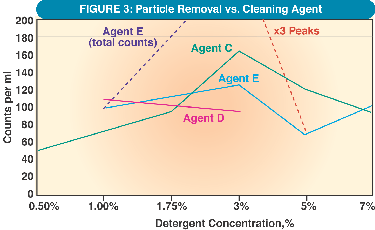
Figure 3 shows the cleaning bath peak particle counts for
several cleaning agents versus concentration. While it at first
appears that agent C yields the best results, closer examination
confirms that agent E did indeed remove the most particles.
D. John Hunt is an Applications Research Engineer at Pacific
Scientific Instruments (Grants Pass, OR).