|

Introduction The Universal Waste Rule (UWR) codified in Title 40 Code of Federal Regulations (CFR) Part 273, "Standards for Universal Waste Management," was promulgated by the Environmental Protection Agency (EPA) on 11 May 1995. The EPA developed the UWR to improve waste management practices of widely generated, low risk Resource Conservation and Recovery Act (RCRA) hazardous wastes. Through streamlined RCRA waste management practices, the EPA hopes to develop a system to separate these "universal" hazardous wastes from the municipal waste stream and ensure proper waste management. The streamlined management established by the UWR provides relief from the full regulatory aspects of RCRA by simplifying collection and management requirements for universal wastes. In 1995, the EPA designated three types of hazardous wastes as universal: batteries, pesticides, and thermostats. In 1999, the EPA added lamps to the list of universal wastes. Although the UWR is less stringent than RCRA, EPA believes the rule encourages resource conservation and improves the implementation of RCRA. EPA developed the rule to facilitate and expand collection of universal wastes, and hopes the rule will encourage unregulated entities to participate, further diverting these wastes from the municipal solid waste stream. The purpose of this fact sheet is to introduce readers to provisions of the UWR and how it is implemented. What is a Universal Waste? EPA chose "universal" to describe the nature of certain widely dispersed hazardous wastes. The term does not have any specific regulatory meaning; however, if a hazardous waste exhibits any of the following common characteristics it could be classified as a universal waste:
Listed Universal Wastes In the final rule published in 1995, EPA listed only three hazardous waste items - batteries, pesticides, and thermostats as universal wastes. In July of 1999, the EPA amended the UWR by adding a fourth item - lamps. These four items, discussed in detail below, are characterized by the EPA as universal and may be managed under the universal waste regulations instead of the full RCRA requirements. Wastes that do not meet the specific requirements listed in Title 40 CFR 273, Subpart A, must be managed to the full requirements of RCRA contained in Title 40 CFR Parts 260 through 272. Note: Household hazardous materials (HHM) and conditionally exempt small quantity generator wastes are exempt from RCRA regulations. These unregulated entities are also not required to participate or manage wastes under universal waste regulations, however, they may choose to do so. More Information on managing HHM can be found in PRO-ACT's "Managing Household Hazardous Materials" Fact Sheet. Batteries
A battery is defined in Title 40 CFR 273.9,
"Definitions," as a device designed to receive, store, and deliver
electric energy that consists of one or more electrically connected
electrochemical cells. The term also includes an intact, unbroken battery
from which the electrolyte has been removed. In short, many kinds/types of
batteries are covered under the universal waste regulations as long as
they are hazardous wastes. Spent lead-acid batteries, which are managed
under Title 40 CFR Part 266, Subpart G, "Spent Lead-Acid Batteries Being
Reclaimed," are exempt from universal waste regulations. However, if spent
lead-acid batteries are not managed under Title 40 CFR Part 266, Subpart
G, then they are subject to management under universal waste regulations.
Lamps
A lamp is defined as "the bulb or tube portion of an
electric lighting device." Examples of common universal waste lamps
include spent fluorescent, high intensity discharge, neon, mercury vapor,
high pressure sodium, and metal halide lamps. As of 6 January 2000, any
spent or waste lamp that is hazardous or exhibits one of the hazardous
waste characteristics identified in Title 40 CFR Part 261, "Identification
and Listing of Hazardous Wastes," is subject to regulation as a universal
waste.
Pesticides
A pesticide means "any substance or mixture of substances
intended for preventing, destroying, repelling, or mitigating any pest, or
intended for use as a plant regulator, defoliant, or desiccant, other than
animal drugs and feeds. Therefore, any unused pesticide products that are
collected and managed as part of a waste pesticide collection/recall
program mandated by the Federal Insecticide, Fungicide, and Rodenticide
Act (FIFRA), or a voluntary recall program, are subject to management
under universal waste regulations. [Note: Recalled pesticides managed by
farmers in compliance with Title 40 CFR Part 262, "Standards Applicable to
Generators of Hazardous Wastes," Subpart G, "Farmers," are not subject to
regulation as a universal waste.]
Thermostats
A thermostat means "a temperature control device that
contains metallic mercury in an ampule attached to a bimetal sensing
element, and mercury-containing ampules that have been removed from these
temperature control devices." A thermostat becomes a solid waste on the
date it is discarded, at which time the generator must determine if the
thermostat exhibits any hazardous waste characteristic: ignitability,
corrosivity, reactivity, or toxicity. If thermostats are not wastes, or
are not determined to be hazardous wastes, they are not subject to
universal waste regulations.
Subpart A, "General"
Discusses and defines the wastes to which the rule applies.
Subpart B, "Standards for Small Quantity Handlers of
Universal Waste"
Small quantity handlers of universal wastes are handlers who accumulate
less than 5,000 kilograms (11,000 pounds) of universal waste (batteries,
lamps, pesticides, or thermostats calculated collectively) at any one
time.
Subpart B prohibits a small quantity handler of universal wastes from
disposing of and diluting or treating universal wastes; and contains
specific procedures for managing, storing, and marking/labeling each of
the four types of universal wastes. It provides for employees of small
quantity handlers to be informed of the proper handling and emergency
procedures appropriate for the universal wastes handled at the facility.
Subpart B stipulates that universal wastes may be accumulated for up to
one year without a permit, and imposes standards for responding to
releases, exporting, and shipping of universal wastes. This subpart also
exempts small quantity handlers of universal wastes from notifying the EPA
of universal waste handling activities and from keeping records of
universal waste shipments. Although hazardous waste manifests are not
required for shipping universal wastes, other Department of Transportation
(DOT) rules, Title 49 CFR Parts 171 through 180, regarding labeling and
placarding still apply.
Note: Although Small Quantity Handlers are exempt from certain record
keeping requirements, it is recommended that record keeping practices are
formulated similar to those required for Large Quantity Handlers of
universal wastes.
Subpart C, "Standards for Large Quantity Handlers of
Universal Waste"
Large quantity handlers of universal wastes are handlers who accumulate
over 5,000 kilograms of universal waste (batteries, lamps, pesticides, or
thermostats calculated collectively) at any time. The designation as a
large quantity handler is retained through the end of the calendar year in
which 5,000 kilograms or more of universal wastes is accumulated.
The standards covered in Subpart C for large quantity handlers are
identical to the standards discussed above for small quantity handlers,
except for the requirement to notify (in writing) the regional EPA office
of universal waste handling activities prior to meeting or exceeding the
5,000 kilogram limit. Large quantity handlers of universal wastes are also
required to track universal waste shipments, and Subpart C mandates that
large quantity handlers keep a record of each shipment of universal waste
received and sent from the facility for a minimum of three years. In
addition, Subpart C requires management practices for marking/labeling,
accumulation time dating, and employee training. It also prohibits the
disposing, diluting, or treating of universal wastes.
Note: Status as a Small/Large Quantity Handler of universal wastes is
not the same as being classified as a Hazardous Waste Small/Large Quantity
Generator in accordance with Title 40 CFR 262.34, "Accumulation Time."
Universal waste handler status is derived solely from the accumulation of
universal wastes, whereas hazardous waste generator status is derived
solely from the accumulation of hazardous wastes excluding universal
wastes.
Subpart D, "Standards for Universal Waste
Transporters"
A universal waste transporter is any person engaged in the off-site
transportation of universal waste by air, rail, highway, or water. Subpart
D limits the amount of time a transporter can keep a universal waste
on-site to 10 days, specifies requirements for off-site shipments and
exports of a universal waste, and requires transporters to comply with all
applicable DOT regulations at Title 49 CFR Parts 171 through 180. This
subpart also requires transporters to contain all releases of universal
wastes, and to determine if the release is a hazardous waste subject to
RCRA.
Subpart E, "Standards for Destination Facilities"
Subpart E requires destination facilities, defined as any facility that
treats, disposes of, or recycles a particular category of universal waste,
to meet all applicable requirements for hazardous waste facilities
including permitting and notification requirements under RCRA, Title 40
CFR Parts 264 through 270. This subpart also provides regulations for
off-site shipments and tracking of universal waste shipments.
Subpart F, "Import Requirements"
Subpart F specifies that any persons managing an imported universal
waste from a foreign country are subject to the portions of the regulation
which apply (Subparts B through E) when the waste enters the United
States.
Subpart G, "Petitions to Include Other Wastes Under 40
CFR Part 273"
EPA, under Subpart G, provides a mechanism for persons to petition for
a regulatory amendment and seek to add a hazardous waste to the listing of
universal wastes. The subpart specifies factors that petitioners should
address to demonstrate a hazardous waste is appropriate for the universal
waste category.
On 13 May 1996, the Mercury-Containing and Rechargeable Battery
Management Act (Battery Act) was signed into law. The Battery Act phases
out the use of mercury in batteries and facilitates the recycling of
rechargeable batteries. The Act made the UWR for batteries covered by the
Act effective in all fifty States, creating a consistent program for
collection, accumulation, and transportation of batteries nationwide.
States' Role
As noted earlier, the UWR is only automatically effective in States
that do not have an EPA authorized RCRA program. In RCRA authorized
States, the EPA encourages the State to adopt the entire UWR or portions
of the rule. For States with authorized RCRA programs, the UWR will not be
applicable until the State revises its current program to adopt equivalent
requirements under State law and is authorized by the EPA. The EPA also
gave States the flexibility to add additional wastes to their universal
waste programs without the EPA having to add the waste at the federal
level. Many RCRA authorized States have adopted the rule and have
classified additional items such as antifreeze, aerosol cans, cathode ray
tubes, and fluorescent lamps (prior to the federal listing) as universal
wastes.
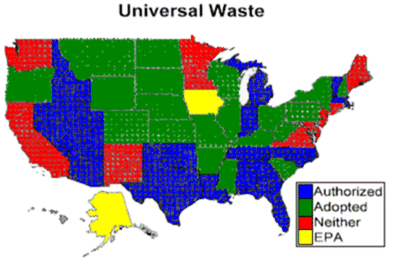
The State Authorization Tracking System (StATS) utilized by the EPA's
Office of Solid Waste, tracks the status of RCRA authorization and
adoption, including the UWR. The StATS Universal Waste graph, (seen on the
next page), illustrates State authorization and adoption information for
the UWR:
Federal Additions to the UWR
The EPA realizes that many States have adopted and
implemented State universal waste programs, which include standards for
additional State universal wastes. However, if the EPA classifies a
hazardous waste, such as spent lamps, at the federal level as a universal
waste, then the States must have equivalent standards. Thus if a State's
standard is less stringent than those promulgated by the EPA, the State
must amend its regulations to make them equivalent to the federal
standards.
An example of this is the crushing of spent lamps, which is viewed as
treatment at the federal level under RCRA, and is prohibited if the spent
lamps are managed as a universal waste. Although the UWR prohibits
crushing (i.e. treatment), the EPA believes that some State programs may
have standards that allow crushing that are equivalent to the new federal
standards. The EPA has stated that it will make the determination if
crushing under controlled conditions is equivalent to the federal
prohibition at the time of authorization of the State's program.
|