AIR QUALITY MANAGEMENT
USING
POLLUTION PREVENTION:
A JOINT SERVICE APPROACH
Distribution authorized to Federal Agencies only; Administrative/Operational Use; March 1998.
POLLUTION PREVENTION AND AIR QUALITY MANAGEMENT
PROCESSES
Appendix B: APPROVAL AUTHORITY
Appendix D: REGULATORY INFORMATION
Appendix E: EPA PROGRAMS & RESOURCES
Appendix G: HOW TO INCORPORATE P2
This information resource is not a DoD Policy document. This document primarily contains ideas and information about what others in the DoD are doing. All decisions to implement any of the opportunities described herein should be authorized through normal channels.
The mention of product names in this document does not constitute endorsement by the Services, DoD, or other Federal agency, but is for clarification purposes only.
The development of this document was sponsored by the U.S. Army
Environmental Center. The Center supports implementation of the Army compliance
program and encourages the use of pollution prevention techniques to minimize
the impacts of regulatory requirements. More information about the Army Air
Quality Compliance Program can be found by visiting the USAEC website at
http://aec-www.apgea.army.mil or calling the Air
Quality Media Manager at
(410) 671-1214/DSN 584.
The authors gratefully acknowledge the substantial contributions of the installations, as well as the National Aeronautics and Space Administration and the U.S. Coast Guard.
This Joint document was created through the efforts of the U.S. Army Center for Health Promotion and Preventive Medicine (USACHPPM), the U.S. Air Human Systems Center (HSC/OEBQ) and the Naval Facilities Engineering Service Center (NFESC). These three organizations have gathered information from installations within the Services, NASA, Coast Guard and from other resources to assemble within this document. This document highlights pollution prevention (P2) techniques that have either been successfully implemented at facilities or have potential to be implemented successfully. The current status of some relevant research efforts are included where appropriate. This document is not comprehensive. There was no data call, and many valuable ideas may have been missed. It is our intent to update this document as our readers bring new information to our attention. This document is a clearinghouse of potential solutions to Air Compliance Programs using P2, and will be posted on the Defense Environmental Network Information eXchange (DENIX) website.
Contact Information:
POLLUTION PREVENTION AND AIR QUALITY MANAGEMENT
This document is for Air Quality Managers who would like to learn more about their options for using pollution prevention (P2) to manage air quality and achieve compliance. This is a forum for you to learn from each other about what works and what doesn't work. Success stories from throughout the Services are the core of this document. In addition, background information and summaries of current research are included for some processes. All of this information in the body of the document is organized according to the affected process, with references to associated regulations. The appendices also contain a variety of useful information.
This document differs from and compliments the Joint Service P2 Technical Library and the Hazardous Air Pollutant (HAP) Status Binder. The Joint Service P2 Technical Library was created to outline "off the shelf" technologies for use by DoD installations. The HAP Status Binder was developed to keep DoD Air Quality Managers apprised of the status of National Emission Standards for Hazardous Air Pollutants (NESHAPs). So while the former is oriented toward what technologies are available, and the latter is oriented toward what the regulations require, this document presents what is actually being done now in the Military and provides contact information to enhance networking. Web addresses are listed in Appendix C.
P2 means changing products used or manufacturing processes to reduce impact to the environment. This involves incorporating environmental considerations into product design and into the design, operation, and maintenance of production processes resulting in improved efficiency and performance. By operating more efficiently we protect human health, strengthen our economic well-being, and preserve the environment. P2 is a cost-effective and sound approach to environmental protection and is key to obtaining environmentally sustainable economic development.
Executive Order 12856, signed by President Clinton in August 1993, required Federal facilities to comply with the Emergency Planning and Community Right to Know Act (EPCRA), which was authorized in October 1986, and the Pollution Prevention Act (PPA) which was authorized in December 1990. The DoD required every facility that was not scheduled for operational closure by 31 December 1997 to develop and implement a P2 plan. This plan is supposed to address the actions required by the facility for reducing pollution from all sources and to all media, including the installation’s strategy for meeting the goal of a 50% reduction by 1999 in Toxic Release Inventory reportable releases and off-site transfers.
DoD Directive 4715.1 defined P2 as source reduction (as defined in the PPA of 1990, 42 U.S.C. Sections 13101-13109) and other practices that reduce or eliminate the creation of pollutants through: (a) increased efficiency in the use of raw materials, energy, water, or other resources; or (b) protection of natural resources by conservation.
The PPA defined source reduction as "any practice that (a) reduces the amount of any hazardous substance, pollutant, or contaminant entering any waste stream or otherwise released into the environment (including fugitive emissions) prior to recycling, treatment, and disposal; and (b) reduces the hazards to public health and the environment associated with the release of such substances, pollutants, or contaminants. The term includes equipment or technology modification, process or procedure modification, reformulation or redesign of products, substitution of raw materials, and improvements in housekeeping, maintenance, training, or inventory control." Source reduction does not entail any form of waste management (e.g., recycling and treatment).
Under Section 6602(b) of the PPA, Congress established a national policy that:
The primary focus of Air Quality Managers is to comply with regulations. Pollution prevention is a tool to meet or proactively surpass the regulatory requirements.
The Emergency Planning and Community Right-to-Know Act (EPCRA) was promulgated as Title III of the Superfund Amendments and Reauthorization Act in 1986. The EPCRA requires covered facilities to:
Federal facilities were not covered by EPCRA, but Executive Order 12856 directed Federal agencies to comply with EPCRA and to reduce their reportable releases and off-site transfers of toxic chemicals by 50% by 31 December 1999 using the 1994 TRI reports as the baseline.
In the DoD’s 1994 TRI report, air emissions represented about two-thirds of all TRI reportable releases and off-site transfers (see Figure 1), and over 97% of all TRI reportable on-site releases (see Figure 2). The DoD did not realize the high percentage of toxic releases to the air until the release of the 1994 TRI report. These air emissions are primarily from maintenance activities associated with the painting and depainting of aircraft and cleaning and degreasing activities. The list of hazardous air pollutants (HAPs) included in the 1990 amendments of the Clean Air Act (CAA90) was based to a large extent on the TRI list. Title III of the CAA90 was one of the Environmental
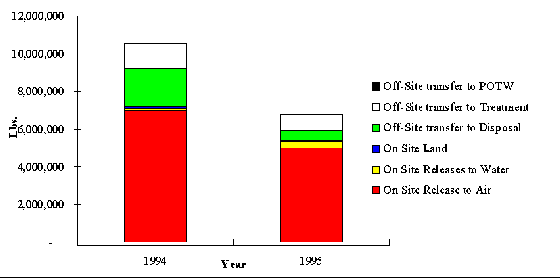
Figure 1: TRI Reportable Releases And Off-Site Transfers for 1994 and 1995
Protection Agency's (EPA’s) tools to achieve a reduction of TRI pollutants. Table 1 compares the TRI top ten chemicals reported for the DoD for 1994 and 1995. Notice that all but one are HAPs.
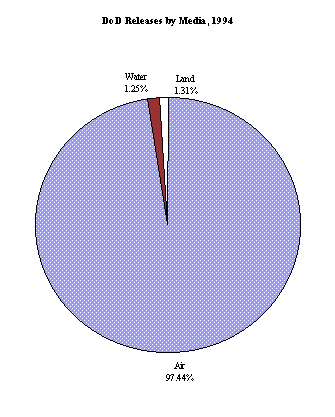
Figure 2: 1994 DoD TRI On-Site Releases By Media
Table 1: Change in Top 10 Chemical Releases and Transfers Information
| Top 10 1994 Chemical |
1994 (1,000 lbs) |
1995 (1,000 lbs) |
Change |
| *Dichloromethane (methylene chloride) |
2,236 |
1,617 |
-28% |
| *Methyl ethyl ketone |
1,505 |
1,097 |
-27% |
| *1,1,1-Trichloroethane (methyl chloroform) |
1,232 |
751 |
-39% |
| *Ethylene glycol |
537 |
329 |
-39% |
| *Toluene |
445 |
235 |
-47% |
| *Phenol |
412 |
267 |
-35% |
| Zinc compounds |
409 |
45 |
-89% |
| *Tetrachloroethylene (perchloroethylene) |
359 |
217 |
-39% |
| *Hexachloroethane |
351 |
56 |
-84% |
| *Hydrochloric acid |
298 |
Delisted |
Not Applicable |
|
Note: * indicates this TRI substance is also a HAP | |||
The primary goal of the Clean Air Act (CAA) is to "protect the public" from air pollution with an "adequate margin of safety". End-of-pipe control technologies have been the primary method of reducing pollution emissions.
Under CAA Title I Section (§)112 and §129, Congress mandates that stationary sources be required to use Maximum Achievable Control Technology (MACT) or Generally Achievable Control Technology (GACT). Title I requires the EPA to set National Ambient Air Quality Standards (NAAQS) and State and Local agencies have the option to use either tools developed by the EPA or within their own agencies to control air emissions from stationary sources. New Source Performance Standards, Control Techniques Guidelines, Alternative Control Techniques, Best Available Control Technology, Best Available Control Measures, and Reasonably Available Control Technology are examples of some of the methods State and Local agencies typically use to control emissions. The strong emphasis on controlling emissions using control technologies under the CAA is easy to see. Facilities generally find it much easier to install a standard control technology called out under a specific regulation than to identify and implement a P2 option.
In recent years, EPA has been writing P2 opportunities along with control technologies into their standards. The EPA has tried to change their focus to performance based and cost effective standards.
Developing P2 strategies may require longer term investing than the three years usually allotted for compliance with a standard. Some processes may require large equipment changes thus making P2 cost prohibitive under the current funding system, which does not accommodate longer payback periods. This encourages the use of control technologies in those cases where the upfront cost is lower. The EPA has been trying to write into rules incentives for industry to develop P2 by giving longer time periods to comply if P2 initiatives are implemented (a one year extension is the typical length of the time period). The EPA also seeks to provide regulatory relief for the development of P2 through such cross media efforts as the Common Sense Initiative, Project XL, and ENVVEST. All of these programs have been very difficult to implement within both Industry and the DoD because consensus on solutions among industry, the EPA, and environmental groups has proved difficult to achieve.
The P2 initiatives that have been the most successful are those with a low up-front cost, such as coating and degreasing processes. Coating reformulations and application techniques have significantly contributed to HAP and volatile organic compound (VOC) reductions. Switching to aqueous degreasers has reduced both VOCs and operating costs.
The Solid Waste Disposal Act (SWDA) of 1965 was the first Federal legislation that addressed the nation's waste management practices. This act, as amended by the Resource Conservation and Recovery Act (RCRA) of 1976 and the Hazardous and Solid Waste Amendments (HSWA) of 1984, is commonly referred to as RCRA.
Within the DoD, P2 seems to focus on the minimization of hazardous and solid wastes. There are four possible reasons for this. (1) The Resource Conservation and Recovery Act (RCRA) is the environmental law for which the DoD has paid the most fines. In addition, a number of DoD employees have been prosecuted for violation of RCRA regulations. Reducing the use of hazardous materials reduces liability. (2) There are hazardous waste minimization requirements within RCRA. Hazardous waste generators must submit a Biennial Report, to include a description of the efforts undertaken and progress made to reduce the volume and toxicity of waste generated [40 CFR 262.41(a)(6,7)]. In addition, RCRA requires the permit holder of a treatment, storage, and disposal facility to have, at a minimum, annual certification that there is a program in place to reduce the volume and toxicity of the hazardous waste generated, and to minimize the present and future threat to human health and the environment [40 CFR 264.73 (b)(9)]. (3) Hazardous waste disposal costs are high, so that P2 in this area yields a direct and immediate cost savings. (4) Solid and hazardous waste quantities and costs are more easily determined than air emission quantities and costs.
Many Military documents focus on solid and hazardous waste P2. The Joint Service P2 Technical Library’s introduction states that the purpose of the Library is "to identify available P2 technologies, management practices, and process changes that will reduce the amount of hazardous and solid waste being generated at joint service industrial facilities."
Some P2 initiated because of RCRA has benefited air quality, despite the apparent trend to pigeonhole P2 with hazardous/solid waste minimization efforts. Examples of common P2 applications which were initiated because of hazardous waste but have benefited air quality are: vapor degreasers replaced with aqueous parts washers, low VOC coatings formulated, and parts depainted using blasting techniques such as plastic, glass, wheat starch, or sodium bicarbonate where once solvents were used.
WHY INCORPORATE P2 INTO AIR PROGRAMS?
P2 is typically managed by the Hazardous Waste Manager or the P2 Program Manager. Consequently the installation’s Air Program is not usually involved with P2 and opportunities may be missed. Yet there are often substantial benefits from incorporating P2 into Air Programs:
1. Immediate Cost Savings
2. Regulatory Relief
3. Regulatory Policy Compliance
The following tables cross-reference statutes, regulations, and executive orders to processes and sources. Success stories and potential alternatives gathered from Department of Defense installations are found under the Processes section. Points of contact and sources of the information are listed for further questions.
Table 2
|
The Clean Air Act & Amendments Referenced to Regulations | |||
| Title | Name | CAA Section | Regulation |
| I | New Source Performance Standard (NSPS) Program | 111 | 40 CFR 60 |
| I | National Ambient Air Quality Standards (NAAQS) Program | 105-110, 160-193 | 40 CFR 50-53, 55, 58, 81, 93 |
| II | Mobile Sources Program | 202-250 | 40 CFR 80, 85-88 |
| III | National Emission Standards for Hazardous Air Pollutants (NESHAP) Program | 112 | 40 CFR 61, 63, 68 |
| IV | Acid Rain Program | 401-416 | 40 CFR 72-78 |
| V | Operating Permit Program | 501-507 | 40 CFR 70-71 |
| VI | Stratospheric Ozone Protection Program | 601-618 | 40 CFR 82 |
Table 3
| Laws Referenced to Processes | |
| Laws and Regulations | Affected Processes and their Section Numbers in This Document |
| Accidental Release Prevention Program | 5.1 Listed Substance Storage |
| Aerospace NESHAP | 1.1 Methylene Chloride
Cleaning 2.1 Paint Stripping: Methylene Chloride 3.1 Paint Gun Washers 3.2 Primers 3.3 CARC Painting 3.4 Touch Up Painting 3.5 General Painting |
| Architectural Coating NSPS | 3.6 Architectural Coatings |
| Cadmium Compounds HAP | 3.7 Cadmium Plating |
| Carbon Monoxide NAAQS | 4.5 Boilers 4.7 Aerospace Ground Equipment |
| Chromium Compounds HAP | 3.2 Primers 3.8 Chromic Acid Anodizing 3.9 Chromate Chemical Conversion Coating 3.10 Hard Chrome Plating |
| Engine Test Facilities NESHAP | 4.9 Jet engine testing |
| Executive Order 12902, Section 305 | 4.5 Boilers |
| Existing Source Emission Guideline | 4.1 Medical Waste Incinerators 4.3 Municipal Waste Combustors |
| Halogenated Solvent Cleaners NESHAP | 1.1 Methylene Chloride
Cleaning 1.2 1,1,1-Trichloroethane |
| Hazardous Waste Combustor NESHAP | 4.4 Treatment, Storage, Disposal Facility |
| Industrial Combustion Coordinated Rulemaking | 4.2 Classified Waste Incinerators |
| Lead NAAQS | 6.3 Weapons Training at Firing Ranges |
| New Source Performance Standard (NSPS) | 4.1 Medical Waste Incinerators 4.3 Municipal Waste Combustors |
| Nitrogen Dioxide (NO2) NAAQS | 4.5 Boilers 4.7 Aerospace Ground Equipment 4.9 Jet Engine Testing |
| Ozone Depleting Substances | 1.2 1,1,1-Trichloroethane 1.3 CFC-113 1.5 General Cleaning 1.6 Weapons Cleaning: Wipe Cleaning 1.7 Weapons Cleaning: Dip Tanks 1.8 Electronics Cleaning |
| Ozone NAAQS (measured in VOCs and NOx) | 4.5 Boilers 4.7 Aerospace Ground Equipment 4.9 Jet Engine Testing |
| Particulate Matter NAAQS | 4.5 Boilers 4.7 Aerospace Ground Equipment 4.8 Generators 6.1 Fire Fighting Training 6.2 Field Training Exercises |
| Sulfur Dioxide (SO2) NAAQS | 4.5 Boilers |
| Ozone NAAQS (measured in VOCs and NOx) |
1.1 Methylene Chloride 1.2 1,1,1-Trichloroethane 1.4 Parts Washing: Stoddard Solvent 1.5 General Cleaning 1.6 Weapons Cleaning: Wipe Cleaning 1.7 Weapons Cleaning: Dip Tanks 2.1 Paint Stripping: Methylene Chloride 3.1 Paint Gun Washers 3.2 Primers 3.3 CARC Painting 3.4 Touch Up Painting 3.5 General Painting 3.6 Architectural Coatings 7.2 Fuel Dispensing 7.3 Pesticides 7.4 Lubricants 7.5 Adhesives and Sealants |
Table 4
| Processes Referenced to Laws, Order of Appearance | |
| Processes Covered in this Document In Numerical Order By Section Number |
Laws and Regulations
Affected by Change |
| 1.1 Methylene Chloride | Ozone NAAQS (measured in VOCs and
NOx) Halogenated Solvent Cleaners NESHAP Aerospace NESHAP |
| 1.2 1,1,1-Trichloroethane | Ozone Depleting Substance Ozone NAAQS (measured in VOCs and NOx) Halogenated Solvent Cleaners NESHAP |
| 1.3 CFC-113 | Ozone Depleting Substances |
| 1.4 Parts Washing: Stoddard Solvent | Ozone NAAQS (measured in VOCs and NOx) |
| 1.5 General Cleaning | Ozone NAAQS (measured in VOCs and
NOx) Ozone Depleting Substances |
| 1.6 Weapons Cleaning: Wipe Cleaning | Ozone NAAQS (measured in VOCs and
NOx) Ozone Depleting Substances |
| 1.7 Weapons Cleaning: Dip Tanks | Ozone NAAQS (measured in VOCs and
NOx) Ozone Depleting Substances |
| 1.8 Electronics Cleaning | Ozone Depleting Substances |
| 2.1 Paint Stripping: Methylene Chloride | Ozone NAAQS (measured in VOCs and
NOx) Aerospace NESHAP |
| 3.1 Paint Gun Washers | Ozone NAAQS (measured in VOCs and
NOx) Aerospace NESHAP |
| 3.2 Primers | Ozone NAAQS (measured in VOCs and
NOx) Chromium compounds (HAP) Aerospace NESHAP |
| 3.3 CARC Painting | Ozone NAAQS (measured in VOCs and
NOx) Aerospace NESHAP |
| 3.4 Touch Up Painting | Ozone NAAQS (measured in VOCs and
NOx) Aerospace NESHAP |
| 3.5 General Painting | Ozone NAAQS (measured in VOCs and
NOx) Aerospace NESHAP |
| 3.6 Architectural Coatings | Architectural Coating NSPS Ozone NAAQS (measured in VOCs and NOx) |
| 3.7 Cadmium Plating | Cadmium Compounds HAP |
| 3.8 Chromic Acid Anodizing | Chromium Compounds HAP |
| 3.9 Chromate Chemical Conversion Coating | Chromium Compounds HAP |
| 3.10 Hard Chrome Plating | Chromium Compounds HAP |
| 4.1 Medical Waste Incinerators | Hospital/Medical/Infectious Waste
Incinerator (HMIWI) New Source Performance Standard (NSPS) Existing Source Emission Guideline (EG) |
| 4.2 Classified Waste Incinerators | Industrial Combustion Coordinated Rulemaking |
| 4.3 Municipal Waste Combustors | Municipal Waste Combustor NSPS/EG |
| 4.4 Treatment, Storage, Disposal Facility | Hazardous Waste Combustor NESHAP |
| 4.5 Boilers | Carbon Monoxide (CO)
NAAQS Executive Order 12902 Section 305 Nitrogen Dioxide (NO2) NAAQS Ozone (measured in VOCs and NOx) NAAQS Particulate Matter (PM) NAAQS Sulfur Dioxide (SO2) NAAQS |
| 4.6 Vehicles | PM and Ozone NAAQS Executive Order 13031 |
| 4.7 Aerospace Ground Equipment | Carbon Monoxide (CO)
NAAQS Nitrogen Dioxide (NO2) NAAQS Ozone (measured in VOCs and NOx) NAAQS Particulate Matter (PM) NAAQS |
| 4.8 Generators | Carbon Monoxide (CO)
NAAQS Nitrogen Dioxide (NO2) NAAQS |
| 4.9 Jet engine testing | Engine Test Facilities
NESHAP CO, NO2, Ozone, PM NAAQS |
| 5.1 Listed Substance Storage | Accidental Release Prevention
Program (Risk Management Programs and Plans) |
| 6.1 Fire Fighting Training | Particulate Matter (PM) NAAQS - Fugitive Emissions |
| 6.2 Field Training Exercises | Particulate Matter (PM) NAAQS – Fugitive Emissions |
| 6.3 Weapons Training at Firing Ranges | Lead NAAQS |
| 7.1 Ethylene Oxide Sterilizing | State-Specific Regulations |
| 7.2 Fuel Dispensing | VOC and HAP Emissions |
| 7.3 Pesticides | VOC and HAP Emissions |
| 7.4 Lubricants | VOC and HAP Emissions |
| 7.5 Adhesives and Sealants | VOC and HAP Emissions |
| 7.6 Potential to Emit | Criteria and HAP Emissions |
Table 5
| Processes Referenced to Laws, Alphabetical Order | |
| Processes Covered in this Document in
Alphabetical Order (Section Number in Parentheses) |
Laws and Regulations
Affected by Change |
| 1,1,1-Trichloroethane (1.2) | Ozone Depleting Substance Ozone NAAQS (measured in VOCs and NOx) Halogenated Solvent Cleaners NESHAP |
| Adhesives and Sealants (7.5) | VOC and HAP Emissions |
| Aerospace Ground Equipment (4.7) | Nitrogen Dioxide (NO2)
NAAQS Particulate Matter (PM) NAAQS |
| Architectural Coatings (3.6) | Architectural Coating NSPS Ozone NAAQS (measured in VOCs and NOx) |
| Boilers (4.5) | Executive Order 12902 Section
305 Sulfur Dioxide (SO2) NAAQS Nitrogen Dioxide (NO2) NAAQS Ozone NAAQS (measured in VOCs and NOx) Particulate Matter (PM) NAAQS |
| Cadmium Plating (3.7) | Fugitive Emissions - Cadmium |
| CARC Painting (3.3) | Ozone NAAQS (measured in VOCs and
NOx) Aerospace NESHAP |
| CFC-113 (1.3) | Ozone Depleting Substances |
| Chromate Chemical Conversion Coating (3.9) | Chromium Compounds HAP |
| Chromic Acid Anodizing (3.8) | Chromium Compounds HAP |
| Classified Waste Incinerators (4.2) | Industrial Combustion Coordinated Rulemaking |
| Electronics Cleaning (1.8) | Ozone Depleting Substances |
| Ethylene Oxide Sterilizing (7.1) | State-Specific Regulations |
| Field Training Exercises (6.2) | Particulate Matter (PM) NAAQS – Fugitive Emissions |
| Fire Fighting Training (6.1) | Particulate Matter (PM) NAAQS - Fugitive Emissions |
| Fuel Dispensing (7.2) | VOC and HAP Emissions |
| General Cleaning (1.5) | Ozone NAAQS (measured in VOCs and
NOx) Ozone Depleting Substances |
| General Painting (3.5) | Ozone NAAQS (measured in VOCs and
NOx) Aerospace NESHAP |
| Generators (4.8) | Carbon Monoxide (CO)
NAAQS Nitrogen Dioxide (NO2) NAAQS Ozone NAAQS (measured in VOCs and NOx) |
| Hard Chrome Plating (3.10) | Chromium Compounds HAP |
| Jet engine testing (4.9) | Engine Test Facilities
NESHAP CO, NO2, Ozone, PM NAAQS |
| Listed Substance Storage (5.1) | Accidental Release Prevention
Program (Risk Management Programs and Plans) |
| Lubricants (7.4) | VOC and HAP Emissions |
| Medical Waste Incinerators (4.1) | Hospital/Medical/Infectious Waste
Incinerator (HMIWI) New Source Performance Standard (NSPS) Existing Source Emission Guideline (EG) |
| Methylene Chloride (1.1) | Ozone NAAQS (measured in VOCs and
NOx) Halogenated Solvent Cleaners NESHAP Aerospace NESHAP |
| Municipal Waste Combustors (4.3) | Municipal Waste Combustor NSPS/EG |
| Paint Gun Washers (3.1) | Ozone NAAQS (measured in VOCs and
NOx) Aerospace NESHAP |
| Paint Stripping: Methylene Chloride (2.1) | Ozone NAAQS (measured in VOCs and
NOx) Aerospace NESHAP |
| Parts Washing - Stoddard Solvent (1.4) | Ozone NAAQS (measured in VOCs and NOx) |
| Pesticides (7.3) | VOC and HAP Emissions |
| Potential to Emit (7.6) | Criteria and HAP Emissions |
| Primers (3.2) | Ozone NAAQS (measured in VOCs and
NOx) Chromium compounds (HAP) Aerospace NESHAP |
| Touch Up Painting (3.4) | Ozone NAAQS (measured in VOCs and
NOx) Aerospace NESHAP |
| Treatment, Storage, Disposal Facility (4.4) | Hazardous Waste Combustor NESHAP |
| Vehicles (4.6) | PM and Ozone NAAQS Executive Order 13031 |
| Weapons Cleaning: Dip Tanks (1.7) | Ozone NAAQS (measured in VOCs and
NOx) Ozone Depleting Substances |
| Weapons Cleaning: Wipe Cleaning (1.6) | Ozone NAAQS (measured in VOCs and
NOx) Ozone Depleting Substances |
| Weapons Training at Firing Ranges (6.3) | Lead NAAQS |