
Previous section Concentrate feed production
Domestic animal diversity
Environmental challenges
Thoroughly modified and adjusted to meet society's needs, livestock genetic resources are a basic environmental input to animal production systems. The utilization of the genetic reservoir largely determines the type and level of animal production system employed. These resources also determine how animals, through man's manipulation, utilize the environment, because livestock utilization of natural plant communities is influenced by breed differences. Knowledge of animal genetic resources is essential for efficiently allocating land, labour and capital. It is therefore essential to monitor this vital resource. For example, it is projected that by 2015 the U.S. Holstein population will have an effective population size of 66 animals (Hanson, 1995). In other words, the genetic relationship between animals will be so high it will be as if there are only 66 animals which are not related. Such a reduction in genetic diversity places this breed and others at risk, if disease or environmental changes (e.g., global warming) develop with which the remaining genotypes cannot cope.
Globally there are approximately 4,000 breeds or landraces of domesticated animals used by man. This number is about equal to the total number of mammalian species currently in existence. Given the number of breeds it is logical to ask how much of the world's animal genetic resources can we afford to lose or how much should we concern ourselves with saving? Currently there is no obvious answer to this question. Some might contend that we need to conserve all genetic resources in existence. Besides cost, this neglects the fact that some portion of the domestic animal population is not genetically different. To make a decision concerning the number of species to conserve requires a more complete assessment of genetic resources than is currently available. Therefore one of the greatest challenges will be to develop an institutional framework to maintain the minimum number of genotypes for optimal future genetic improvement.
State
FAO's Global Databank for Animal Genetic Resources records the status of 3,882 livestock breeds (Table 5.3). Of those breeds with adequate data for assessment, 19 percent were classified as endangered. In developed countries, where there are 1,892 breeds of the main eleven categories, 21 percent of the breeds are at risk (Table 5.4). Market forces are causing much of the diversity problems in the OECD countries. For example, dairy production is dominated by the Holstein breed. Holstein cattle in Europe and in North America account for 60 percent and 90 percent of the dairy cattle population, respectively. Such extreme specialization narrows the genetic base and in a recent study, U.S. Holsteins have a predicted inbreeding increase of 0.725 percent per year from 1990 to 2015, corresponding to the effective population size of 66 animals mentioned before.
In developing countries, where two-thirds of the world's livestock population is located, documentation of breed types is far from complete. Approximately 1,300 breeds have been described with population data and 2,000 have been partially categorized (Table 5.4). The data from both developed and developing countries show that erosion of biodiversity at the breed level is not simply a concern for the distant future, but of immediate concern.
Animal uses, genetic variance and abundance of genetic diversity change across production systems. As different production systems evolve varying pressures are being placed upon the existing breeds.
| Table 5.3 Breeds of domestic animal at risk by species. | ||||
|---|---|---|---|---|
| Species | On file | With population data | At risk * | Projected at risk |
| Ass | 77 | 24 | 9 | 9 |
| Buffalo | 72 | 55 | 2 | 2 |
| Cattle | 787 | 582 | 135 | 80 |
| Goat | 351 | 267 | 44 | 37 |
| Horse | 384 | 277 | 120 | 96 |
| Pig | 353 | 265 | 69 | 52 |
| Sheep | 920 | 656 | 119 | 85 |
| Yak | 6 | 6 | 0 | 0 |
| Dromedary | 50 | 40 | 2 | 2 |
| Camelid | 19 | 19 | 1 | 1 |
| Avian | 863 | 733 | 372 | 195 |
| Total | 3,882 | 2,924 | 873 | 559 |
| * At risk based on breeds with population data having <1,000 breeding females or <20 males and for which there is no conservation programme in place. | ||||
| Source: Hammond and Leitch, in press. | ||||
Grazing systems. Among the world's regions, these systems are relatively of greatest importance in Latin America. Of particular importance from the point of view of biodiversity are the populations of Andean Camelidae (alpaca, llama, vicuña and guanaco). In the humid and subhumid tropical grassland systems of Latin America, cattle predominate. The genetic resources have three origins: the original Criollo types, which are Bos taurus cattle with 500 years of adaptation to tropical conditions; Bos indicus breeds derived from Indian importations during the last century; and European and North American breeds, imported in recent times.
For arid and semi-arid grassland systems, the most important areas are sub-Sahara Africa for cattle and small ruminants, and the West Asia/North Africa region for sheep. Because the African systems are the latest to start intensification and development, these populations are likely to come under more rapid genetic pressure than those elsewhere. Because of the diversity of systems, and the shortage of objective information on the livestock resource, the documentation of African ruminant livestock populations must be considered a major challenge.
| Table 5.4 Breeds of domestic animals at risk by region. | ||||
|---|---|---|---|---|
| Region | Breeds on file | Breeds with population data | At risk * | Projected at risk |
| Africa | 396 | 239 | 27 | 27 |
| Asia & Pacific | 996 | 710 | 105 | 97 |
| Europe & NIS | 1,688 | 1,501 | 638 | 358 |
| Latin America | 220 | 143 | 29 | 27 |
| Near East | 378 | 214 | 15 | 9 |
| North America | 204 | 117 | 59 | 41 |
| World | 3,882 | 2,924 | 873 | 559 |
| * At risk based on breeds with population data having <1,000 breeding females or <20 males and for which there is no conservation programme in place. | ||||
| Source: Hammond and Leitch, in press. | ||||
Mixed farming systems. These are the dominant forms of livestock use in tropical countries. The largest challenge is likely to be in Asia. Among the major concerns are:
The genetic future of livestock populations in mixed farming systems is closely linked to crop integration. As human pressures increase, livestock's role for draft, feed utilization (most of which is crop waste) and the relatively high value of dung for fuel and manure, will be affected. If, for example, subsidized mechanization is encouraged by governments this will lessen the number of draught animals kept and therefore reduce the genetic base.
| Box 5.5 Key indicators of the state of animal genetic resources |
|---|
|
A number of indicators have been identified for determining the status of genetic diversity in animal populations. These include population size and inter-population gene flow. Risk assessment and monitoring for a breed should take into account the following factors and recommended threshold levels:
Additional information concerning breeding structure, which refers to the composition of the breed's population, include the following factors:
For well documented populations, annual statistical reports normally include most of these factors. |
| Source: Simon and Buchenauer, 1993. |
Industrial systems. The external inputs used in industrial systems allow them to relieve environmental constraints, so that an animal's full genetic potential can be expressed. Therefore, especially with monogastrics, there is a significant reduction in the genotypes used. In essence, resistance to environmental challenges become less of a concern. However, prudent management of genetic resources for use in such systems still requires attention to be focused upon existing and potential genetic stocks.
Driving forces
Animal genetic resources are under the same types of human population pressures as other natural resources. Pressures take the form of changing farming systems, market value attached to animal performance, and alteration in the physical environment. In general, these types of pressures affect animal genetic resources by decreasing the number of breeds and thereby losing between and within breed genetic diversity. Table 5.5 lists ways in which animal genetic resources are lost.
The pressure on domestic animal resources in developed and developing country alike goes in parallel with farming system intensification. Breed choice and selection within breeds occurs as part of this intensification process, spurred by economic pressure for ever increasing animal and feed productivity. Genetic change is both a result and a prerequisite for intensification. Genetic change has made possible livestock system intensification while the improvement of feeding systems (supply), management and health care has made possible the support of high producing genotypes. This type of feedback or interaction has been the driving force of the intensive highly productive livestock systems, which are found in OECD countries today. Almost inevitably, genetic resources are being lost as agriculture undergoes transition. For example, switching from draught to mechanical power causes a massive decrease in genetic variation as those types of animals used for draught are displaced.
The successes achieved through selecting animals for high production in the developed world has largely been a disincentive for producers and scientists in the developing countries to attempt similar efforts with their own indigenous genetic resources.
In many development activities the importation of breeds developed for use in high-input farming systems was favoured over long term development of indigenous genetic resources. Although imported breeds may have been productive in their relatively benign environment of origin, their productivity dramatically decreases when they are placed in more rigorous environments found in developing countries. As a result of this genetic-environmental interaction the development strategy has been to alter the environment to accommodate these imported breeds.
Disaster and social insecurity can be very detrimental to the diversity of animal genetic resources. As a result of drought and political instability in Somalia, cattle and small ruminant populations decreased by 70 and 60 percent, respectively. Such reductions in herd size can significantly reduce genetic diversity. Not only does the decrease in animal numbers affect the food security and economic well being of the livestock owners and national economy but such decreases can create evolutionary bottlenecks.
| Table 5.5 Causes for breed extinction or risk of loss. | |
|---|---|
| Reason | Description |
| Development policy | Lack of incentives to develop and use breeds, giving preference to those few developed for use in high-input, high-output relatively benign environments. Commercial interests in donor communities promoted the use of a few temperate climate breeds and over expectations concerning "modern" breeds in developing countries. |
| Specialization | Undue emphasis placed on a specific product or trait leading to the rapid dissemination of one breed of animal to exclusion and loss of others. |
| Modern technologies |
|
| Violence/disaster | Wars and other forms of socio-political instability. Natural disasters such as floods, drought or famine. |
| Source: Hammond and Leitch, in Press. | |
Response: Technology and policy options
Society's response to utilization of domestic animal genetic resources ebbed and flowed over the past three decades. In most situations during the 1960s and 1970s, breed substitution through crossbreeding was the most common mechanism used to increase the genetic potential of livestock in developing countries for a specific character (e.g., milk production). During the mid to late 1980s, there was an increasing awareness that indigenous breeds were highly adapted to the rigorous environments in which they were expected to produce. With this realization came a series of initiatives to conserve animal genetic resources. In some countries, for example India, government and non-government agencies have well-developed programmes of support and conservation for local genetic resources. In many others, such infrastructure is absent. This underscores the need for research, documentation and education activities in this area.
The actors. To effectively conserve and utilize animal genetic resources requires a concerted effort by a number of actors (Table 5.6). These actors include individuals (breeders), breed associations, national governmental organizations, and international organizations.
| Box 5.6 Breed population size - a critical balancing point. |
|---|
|
There are two ways in which population reduction affects genetic diversity: First, certain genes or gene combinations are lost from the population. Second, with limited animal numbers in a breed there is an increased probability that parents of any new individual are related to each other, which increases the inbreeding of the offspring and decreases genetic variability. The impact of small population size on genetic diversity within a population is also affected by the following:
|
| Source: Cunningham, 1995. |
As the various actors initiate conservation assessments and efforts, there is a need for a clearly charted course. The first step is a complete inventory of existing breeds and their status in terms of numbers and genetic diversity. To a large extent FAO's programme in domestic animal genetic resources is accomplishing this goal. An evaluation based upon genetic distancing is important for understanding how unique a breed is and for determining how different various breeds are from one another. Using techniques such as genetic distancing also reduces long term conservation costs, because only the most diverse and endangered breeds will be conserved. This type of assessment is only taking from at this point in time and should be encouraged.
Costs of conservation. The preferred path to conserving a breed is to use it in an economically viable fashion. In some countries it may be possible to provide modest subsidies in order to make conservation of key genetic resources possible. In other environments it may be possible to alter technological components of the farming system, which will enhance the performance of the conserved breed and thereby make it economically competitive. In addition to these approaches it must be remembered that zoos have played a critical role in preserving diverse animal genetic resources. They may continue to provide a suitable means for maintaining live animals and also frozen semen and embryos.
The amount of animal genetic resources which can be preserved via in situ or ex situ methods is determined by the costs of preservation and the expected current value of the preserved resources. The biggest problems are long time horizons and uncertainties about current and future values and uses. The financial resources are lacking to assess and preserve all breeds. However, by using DNA techniques, it is possible to assess the genetic differences between breeds and thereby determine which breeds are truly unique and scarce. Although taking such an approach may have a high initial cost, in the long run it requires fewer financial resources as well as allows greatest attention and efforts to be placed upon those breeds which are in critical need of preservation.
| Table 5.6 Relative importance of different actions for different participants in animal genetic resource conservation. | ||||
|---|---|---|---|---|
| ACTIONS | Breeder/Farmer | Breeders' organization | National authority | International agencies |
| In situ conservation | *** | *** | ** | * |
| Ex situ conservation | * | ** | *** | * |
| DNA characterization |  |
* | *** | * |
| Databases | * | ** | ** | *** |
Costs associated with the development of databases, DNA analysis, and international protocols and accords fall into the category of protecting or enhancing public goods. However, the maintenance costs of databases could be shared with livestock owners, breed associations, national authorities and international agencies. On a per head basis the costs involved are modest. For example, long term costs for semen and embryos preservation are in the order of one US dollar per unit per year, depending on scale. One-time genotyping the DNA of a breed within a country for across breed comparison costs approximately US$ 1,000 to US$ 3,000 (US$ 5 to US$ 10/head) and does not have to be repeated. To recover these costs fairly modest incremental benefits are required. For example, (Cunningham, 1995) at a discount rate of 7.5 percent, an incremental benefit of 80 times the annual cost could repay a 25 year investment in the conservation of a breed. Thus, a return of US$ 800,000 would be required to recover the costs of a breed conservation programme covering 10,000 animals over 25 years. If we assume that such benefits would impact on ten million animals the incremental yields per animal required to repay the investment would be less than US$ 0.10. This is an estimate of the initial returns to conservation. As the genotype continues to be productive there would be additional returns, which would continue to lower the cost of conservation.
| Box 5.7 Tools for conservation. |
|---|
|
Bread improvement goals. Past attempts at improving livestock productivity in developing countries have focused largely on importation of exotic breeds. This approach was taken, instead of within breed selection, because crossbreeding appeared to be a faster means of achieving increased production. The imported breeds were then crossed with existing genetic stocks and, as a result, in many instances replaced indigenous breeds.
Selection of imported breeds was based upon a partial analysis, which indicated that they could produce higher quantities of milk, meat or wool. However, the analysis lacked a full appreciation for genetic-environmental interactions and lifetime productivity. This practice of selecting for individual production characteristics (growth rates, meat production and/or milk production) versus lifetime productivity and/or biological efficiency, has carried over to selective breeding of indigenous populations. The result is a partial analysis of how indigenous breed types perform. Because the entire process of animal production has not been evaluated these actions have also contributed to the displacement and loss of biodiversity. Furthermore, over the long term most exotic breeds have not been able to maintain high levels of productivity. The result is not only a loss in biodiversity but also a loss in economic returns.
Compounding the problems of partial analysis has been a disregard for genetic traits for fitness associated with the adaptation complex. Animals in a specific environment have developed resistance or adaptation to a full range of environmental challenges; e.g., ticks, internal parasites and temperature (Hammond and Leitch, in press). These characteristics have not been fully accounted for in planning and executing breeding and selection schemes in developed or developing countries.
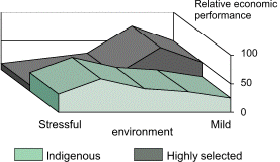
Figure 5.3 demonstrates how different genotypes respond to different types of environments. By removing environmental stresses the genotype of highly selected breeds can more fully express itself. By viewing breeds in the context of composite productivity, it becomes much more apparent how indigenous breeds (or those breeds which have been selected for a different set of characteristics) can have the potential for higher levels of productivity.
An alternative approach to breeding animals for perceived economic returns and conserving genetic resources is to match genotypes to environments (Box 5.8). Instead of importing a genotype and attempting to modify the environment through increased input levels, indigenous breeds should be used and, where appropriate, pre-evaluated with exotic breeds. The basis for comparing performance should be lifetime productivity (number of offspring per female), economic returns for the herd or flock (vs. individual performance) and biological efficiency (output/input). In essence, such a strategy implies that there can be no general recommendations about breeds without accounting for the specific environment in which they are expected to perform. Furthermore, such an approach would weigh the costs of altering environmental conditions to maintain modern breed productivity levels with minimal costs of environmental change and improving the productivity levels of indigenous breeds. Studies to characterize this re-ranking of genetic types in differing environments are not easy to design or conduct. However, simulation models have been developed which allow a screening of breed types in different environments (Blackburn, 1995).
Policy. To stem the dangerous erosion of domestic animal genetic resources, the following policy options are recommended:
| Figure 5.3 Relative breed performance of selected and indigenous genotypes across environments. |
|---|
 |
Research needs. Using the above example as a basis for determining conservation and better animal breeding practices the following research initiatives are required:
| Box 5.8 Improving competitiveness of indigenous breeds. |
|---|
| An important tactic for conserving indigenous genetic resources is to make those breeds more beneficial. Combining existing breed attributes with traits that increase the economic value of the breed is such a mechanism. The N'Dama cattle of southern Senegal have traditionally been the most important element in the farming system in the Casamance. In this area, the trypanosomiasis challenge is high, and other breeds cannot survive in that environment. Although the N'Dama is able to withstand the trypanosome challenge their productivity is low: two year calving intervals, low growth rates and milk production averaging about 700 kg per cow. A research programme has been initiated to improve the performance of the N'Dama using feed products which are readily available (groundnut hay, cotton-seed meal). By improving the N'Dama's nutrition, performance has been doubled. |
Next section Livestock and greenhouse gases