| "Precision Cleaning - The Magazine of Critical
Cleaning Technology" Parts Cleaning The
Key to Ultrasonics — Cavitation and Implosion
We are in the midst of an evolution in the cleaning industry. The evolution involves not only the way we clean, but the way we perceive cleaning and the importance of cleanliness. Cleanliness is increasingly being measured using sensitive analytical techniques. A part formerly judged "clean" if it was visually free of contamination may now be subject to particle testing, gravametric analysis or any one or more of a battery of tests now becoming commonplace. At the same time as cleaning is assuming a higher profile, vapor degreasing, long popular due to its effectiveness and simplicity, is losing that popularity because it uses volatile solvents that are being removed from the market. Classical wash, rinse and dry technology using aqueous chemistries is becoming the more prevalent cleaning process. Ultrasonic cleaning, once used in only the most sophisticated cleaning applications, is now being used more extensively as the switch is made to the often less-aggressive aqueous cleaning chemistries. The following description of the mechanism of ultrasonic cleaning is intended to be helpful to both those newly-introduced to the technology as well as those charged with the responsibility of effectively using it in a variety of cleaning operations. Time, Temperature, Chemistry and Agitation The classic parameters important in achieving maximum cleaning effectiveness are time, temperature, chemistry and agitation. As these parameters are interrelated, a change in one can be counteracted by a change in the others. For example, a reduction in the temperature of a cleaning bath may be overcome by using an extended immersion time for cleaning. Ultrasonic energy is a source of enhanced agitation and can be used to reduce the time, temperature and the chemical concentration required for effective cleaning. Agitation can be provided in a cleaning bath in a number of ways. Air agitation, physical agitation through tumbling or part movement and brushing are all means of providing agitation. Any of these may be adequate in some cleaning applications. Ultrasonic energy is also a source of agitation which has the potential to be as effective as any of the above when properly used. Cleaning most often involves the dissolution of a contaminant by a solvent and begins when the solvent comes into contact with the material to be removed. Continued dissolution requires that solvent at the interface be refreshed as the old solvent becomes saturated with the removed contaminant. The purpose of agitation is to refresh the solvent at the interface. "Macro" agitation — provided by spraying and other common means — is often adequate if the surface being cleaned is relatively smooth and accessible. Parts with complex contours, however, make providing sufficient agitation difficult. Blind holes and internal cavities complicate matters even more. Ultrasonic energy provides agitation on a "micro" scale to facilitate cleaning of complex and interior surfaces. Even on the simplest parts, ultrasonics will increase the speed and effectiveness of cleaning. Why Ultrasonics?
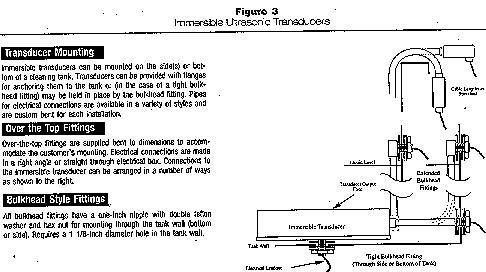
Getting the Most from Ultrasonics Specifying the appropriate cleaning process is important to assure maximum cleaning results using ultrasonics. Proper selections of cleaning solution temperature and chemistry, ultrasonic energy density and distribution and the elimination of dissolved gas in the system are important parameters in the ultrasonic cleaning process. Time remains an important cleaning parameter, but does not relate to the effectiveness of the ultrasonic cleaning process. Temperature The intensity of cavitation in a liquid varies with temperature. Cavitation intensity increases as temperature is increased up to a temperature of approximately 160�F. Above 160�F cavitation intensity decreases. Cavitation is theoretically nonexistent at the boiling point. As chemical effectiveness and stability is also temperature-dependent, it is important to explore both cavitation and chemical considerations in the temperature selection process. Many of today’s chemistries perform optimally at lower temperatures and should not be operated above the recommended temperatures even with ultrasonics. Chemical Selection Chemical selection may be the most complex part of specifying an ultrasonic cleaning process. Consideration must be given not only to the cleaning effect of the chemicstry, but its ability to cavitate and its environmental compatibility as well. Hydrocarbon/water emulsions and chemistries containing water miscible solvents are generally avoided in ultrasonic systems as they are often difficult to cavitate. Ultrasonic Energy and Distribution Successful ultrasonic cleaning requires that all surfaces to be cleaned are exposed to sufficient levels of both ultrasonic energy and cleaning solution. In order to assure this, it is necessary to carefully consider the positioning of both ultrasonic transducers and parts to provide maximum exposure. Parts with pockets which will trap air and water must be rotated to assure proper exposure and draining. Parts holding racks must be designed to allow easy penetration of ultrasonic energy and must not be made of materials (such as plastic) which will absorb sound energy. Elimination of Dissolved Gas Gas dissolved in the cleaning liquid will prevent effective ultrasonic cavitation. Cleaning solutions must be degassed prior to use. Degassing is accomplished by operating the ultrasonic energy (see Sidebar.) Solutions should be degassed after adding the cleaning chemistry and bringing the solution to the proper temperature. Ultrasonic Cleaning Systems Ultrasonic systems can be supplied as stand-alone tanks or as integrated consoles which may include rinsing and drying stations as well as automated parts handling capability. For large or custom installations, immersible ultrasonic transducers are available in a variety of sizes and configurations. Standard stand-alone ultrasonic cleaning tanks as well as console systems are available from most suppliers in sizes up to approximately 60 gallons. Most are supplied complete with temperature controlled heaters in all tanks. Typical options include sparging systems to remove particles multi-tank rinses, oil coalescing filters and chambers as well as level controls, automatic chemical makeup systems, etc. Numerous options beyond what has already been listed is as extensive as the range of applications the machines serve.
Conclusion Ultrasonic cleaning, once thought appropriate only for the laboratory, has come of age and is an important tool in achieving effective cleaning with today’s aqueous chemistries. When properly applied, the technology will provide cleaning which exceeds the standards formerly met using solvent vapor for cleaning. About the Author F. John Fuchs is currently the director of sales and applications engineering for Blackstone Ultrasonics and has more than 25 years experience in the industry. Fuchs graduated with a B.S. in industrial engineering from the University of Michigan. |
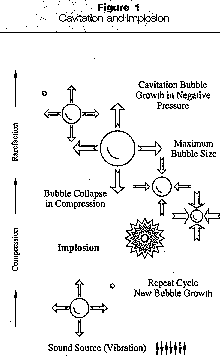 To understand how the power of ultrasonics is derived,
it is helpful to have an understanding of the nature of the energy and its
source. Ultrasonic energy is sound at frequencies above the limits of human
audibility — above 20kHz. This sound energy is created by a specialized
high frequency vibrator called a transducer which is either attached to the
outside of the cleaning vessel or immersed in the cleaning liquid. The
transducer is powered by an ultrasonic generator which converts line current to
alternating electrical energy at the required ultrasonic frequency. As the
sound waves produced by the transducer propagate through the cleaning liquid,
each point in the liquid is subjected to alternating negative and positive
pressure as the compressions and rarefactions of the sound waves pass. During
the rarefaction or negative pressure portion of the sound wave, cavities called
"cavitation bubbles" are formed as the liquid is literally torn apart
by negative pressure (Figure 1). The negative pressure of rarefaction is
quickly replaced with positive pressure as the compression portion of the sound
wave moves in. As a result, the cavitation bubbles implode; releasing a shock
wave of energy not unlike that released as thunder as a result of a lightning
strike. The resulting shock wave provides the energy used to assist cleaning.
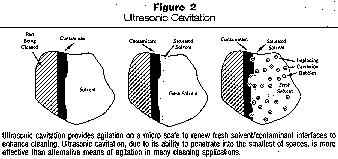
The shock waves resulting from implosion provide agitation on a micro scale to
reach where sprays or even the bristles of a brush cannot (Figure 2).
To understand how the power of ultrasonics is derived,
it is helpful to have an understanding of the nature of the energy and its
source. Ultrasonic energy is sound at frequencies above the limits of human
audibility — above 20kHz. This sound energy is created by a specialized
high frequency vibrator called a transducer which is either attached to the
outside of the cleaning vessel or immersed in the cleaning liquid. The
transducer is powered by an ultrasonic generator which converts line current to
alternating electrical energy at the required ultrasonic frequency. As the
sound waves produced by the transducer propagate through the cleaning liquid,
each point in the liquid is subjected to alternating negative and positive
pressure as the compressions and rarefactions of the sound waves pass. During
the rarefaction or negative pressure portion of the sound wave, cavities called
"cavitation bubbles" are formed as the liquid is literally torn apart
by negative pressure (Figure 1). The negative pressure of rarefaction is
quickly replaced with positive pressure as the compression portion of the sound
wave moves in. As a result, the cavitation bubbles implode; releasing a shock
wave of energy not unlike that released as thunder as a result of a lightning
strike. The resulting shock wave provides the energy used to assist cleaning.
The shock waves resulting from implosion provide agitation on a micro scale to
reach where sprays or even the bristles of a brush cannot (Figure 2).
| Copyright 1999, Witter Publishing Corporation � 84 Park Avenue, Flemington, NJ 08822 � Phone: 908-788-0343 � Fax: 908-788-3782 Email: [email protected] � Please e-mail comments and questions to: mailto:[email protected]?subject=[www.PrecisionCleaningWeb.com] Reposted with permission of Precision Cleaning. |